![PortStrategy[GreenPort]](https://www.portstrategy.com/wp-content/uploads/2026/09/PortStrategyGreenPort.svg)



TERMINAL CHOICES
Shipping line/shipping line affiliate or independent common user terminal operator, which way to jump in selecting a best-fit terminal operator? Mike Mundy highlights recent market developments and summarises key differences in the offerings of the two groupings
There is no doubt that over the last couple of years as the prosperity of shipping lines has risen, off the back of supply lines disrupted by COVID-19, their interest in investing in the terminal sector has risen. There is no bigger signal of this intent than MSC’s knockout bid of €5.7 billion for 100 per cent of Bollore Africa Logistics which includes 16 container terminals in its network. The deal for the sale was signed on 1 April this year and is pending regulatory and competition approvals with it expected to be completed by the end of the first quarter of 2023.
In general, however, it is true to say that when a concession opportunity comes to the market there is today a greater incidence of shipping line (encompassing the line itself or its terminal operating affiliate) interest in bidding for the opportunity. Cash rich the lines are now actively looking for investment opportunities and the terminal sector is a natural target – one that has always been there and has been participated in previously as witnessed by the formation of APM Terminals by Maersk’s parent A P Moller, Terminal Investments limited by MSC and Terminal Link by CMA CGM.
The increased activity on the part of lines is broad-based. It doesn’t just encompass the development and operation of 100 per cent dedicated terminals – facilities such as those in Singapore or Abu Dhabi which have been put in place mainly to serve the interests of the line or consortia’s core shipping business. There is also a stronger focus today on facilities that have a more common user role – that serve multiple lines including lines that are competitors.
A current example of this is the forthcoming privatisation of the STS10 terminal in Santos, Brazil where both Maersk and MSC are known to be candidate bidders. Indeed, they jointly operate BTP, the biggest active container facility in Santos on a 50: 50 basis and had hoped to bid for STS10 jointly but have been prevented from doing so by the state watchdog Cade, based on concerns over them achieving a monopoly. Hence, they will now bid separately, albeit that they both promote the point of view that one enlarged terminal facility in Santos – the STS10 site is adjacent to their BTP terminal – will enable Santos to become the hub port for East Coast South America. The counter argument, promoted by competing terminals Santos Brasil, DP World Santos and other parties, is that one large terminal would effectively create a monopoly and stultify competition.
Suffice it to say that STS10 demonstrates both the interest of lines in bidding for common user terminal facilities and their expertise at putting a good argument together to achieve this goal.
WHICH WAY TO JUMP?
Shipping lines and their affiliates do tend to carry one trump card when bidding on both existing container terminal businesses and new facilities aimed at serving multiple users – they can invariably achieve a quicker ramp up of volume over the early years of taking up a concession as a result of being able to direct group-generated volumes that way. The strong counter argument, however, is that the presence of a line operating a terminal or its terminal operating affiliate may ultimately act as a deterrent to use by multiple lines and thus volume development can be negatively impacted over the longer term.
It is a debate that has raged back and forth for a while but nevertheless one that is still very worthwhile considering – the anti-line lobby summarise it as: “short-term gain or long-term pain.”
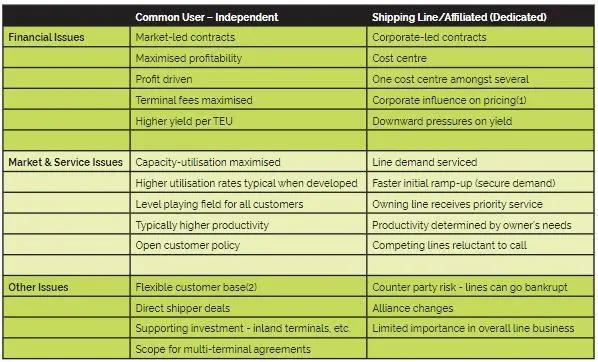
Of course, while there are a lot of common denominators about concession opportunities no two cases are exactly the same and as such each case has to be judged on its own merits as to the right profile of investor. But what are the important factors to consider in deciding ‘which way to jump’ between selecting a shipping line/shipping line affiliate or a common user terminal operator in conjunction with a concession award?
Table 1 highlights key market and service issues that are worthy of consideration in the selection process. It is hoped the summary is both informative and a useful guide for those involved with the challenging task of terminal operator selection.
Related Articles
 EQUIPMENT
 OPERATIONS
 OPERATIONS