



Terminal valuation moves
Johan-Paul Verschuure of Rebel examines valuation activity in the container terminal sector: current and forward trends; investor profiles and strategic thinking
The global port industry rollercoaster has not stopped with fresh surprises popping up. Sharp rises in interest rates, increased revenues for terminal operators and strong variations in demand growth across continents are key themes in 2022. These factors are “shifting the box business” with different types of investors taking charge, a new port finance landscape and a new balance of power. Although the future is highly uncertain some early conclusions can be drawn.
INTEREST RATE HIKES
The increase in interest rates is expected to result in lower M&A activity from the financial sector. Infrastructure funds have been benefitting from the low interest rates for some time increasing their stake in the port and terminal industry. Their leveraged deals and low return requirements from the partners of these funds has driven high valuations and delivered winning bids.
Looking, however, at the deals in 2022 so far, it seems that the activity of the financials is at the same level as last year. The scenario has not yet emerged of rising interest rates lowering deal activity and valuations. One explanation for this could be that the deals undertaken so far this year were already partially prepared last year
Supported by current massive liner profits, industry players have begun to take back control in the M&A market. An increasing number of deals in recent months involve shipping line linked terminal operators. It is also notable that overall the number of deals processed this year has actually increased relative to 2021. Privatisation and greenfield developments have seemingly taken the upper hand after years of infrastructure funds dominating M&A headlines.
INCREASED REVENUES?
Despite a jump in revenues in 2021, financial results do not point to a much more profitable business model for the sector. Global Terminal Operators (GTOs) were faced with increased costs which has partially offset the jump in revenues. When reviewing the financial accounts for nine of the ten largest port operators, combined revenues jumped by 24 per cent in 2021 vis-à-vis 2020. This is much higher than the 2.6 per cent in 2020 and average of 10.4 per cent between 2017-2019.
The analysed major port operators saw their combined volumes increase by 8.7 per cent in 2021 – significantly exceeding the earlier average. On a terminal ownership adjusted basis, volumes grew by just over seven per cent in 2021 for these operators, according to Drewry. Higher storage revenues, therefore, seem to be the main reason for the revenue jump, followed by increased volumes.
However, the corresponding EBITDA grew at a marginally slower pace. Although terminal operators may have had some flexibility with front loading expenditure now that revenues have increased.
APMT and ICTSI are showing an improvement in margin, while DPW is facing a high growth in its cost base offsetting very healthy revenue growth. The rising costs are most likely an effect of the congestion witnessed at the terminals in combination with COVID-19 measures reducing the efficiency of operations and resulting in additional costs for the operators. However, if the tariff levels can be maintained and efficiency improves in the coming years, the upside may still come.
REGIONAL DEMAND DIFFERENCES
In 2022 strong regional differences in container demand are underway. While inflation has been soaring for several months, consumer spending (in particular in the US) has held up surprisingly well. This was undoubtedly partly due to large savings built up during the COVID-19 years, but even with a return to more typical conditions, demand has kept up in recent months with fresh throughput records noted in some ports. Similarly, in the Far East the picture is also positive.
In contrast, Europe has witnessed a steep drop in demand, mainly due to a drop in Russian trade. Africa and South America also recorded declines in comparison to last year.
Overall demand has not yet taken the hit many were expecting given the global macro-economic conditions. As a consequence, strategic port investments and even greenfield ports are popular topics again. If inflation remains high, container demand will soften further. And with the first newbuilds ordered during the first COVID-19 wave coming into operation, the ‘bullwhip’ effect could lead to fast adjusting conditions in the opposite direction. This is something Maersk’s CEO indicated in June as a possible scenario. In addition to downward pressure on freight rates, it may also impact confidence in the container terminal business.
IMPACT ON VALUATIONS
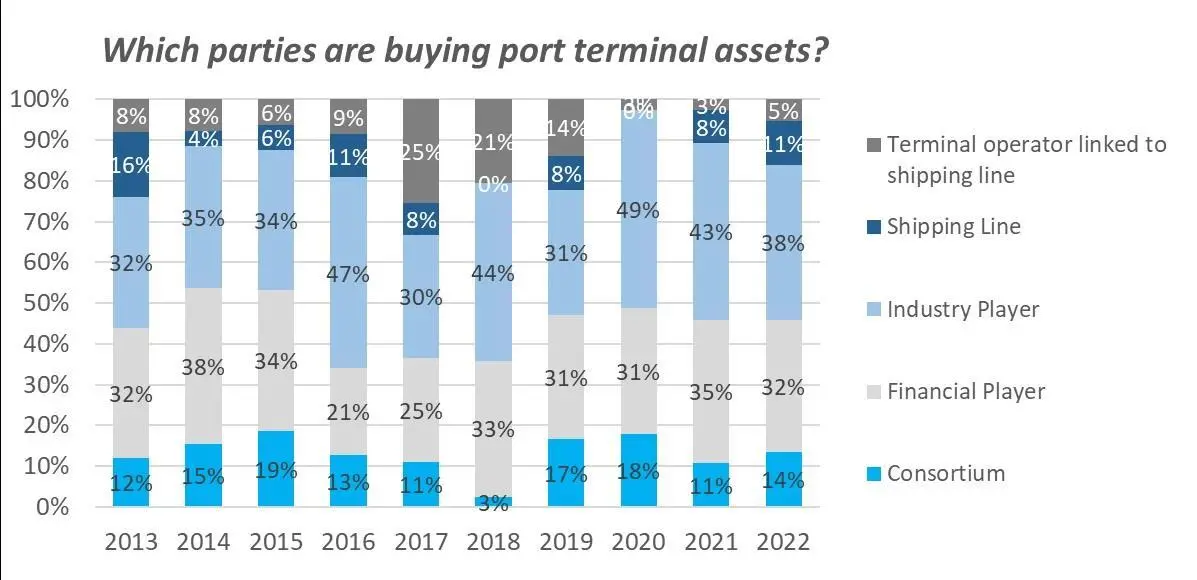
Rapidly rising interest rates will theoretically impact valuations for port assets. Increased cost of capital, by definition, will drive down the high multiples seen in the last few years. Where historically EBITDA multiples are typically between 12 and 15, several recent transactions reached over 20 times EBITDA. Currently the base interest rate on US 10-year government bonds is still hovering at the peaks of 2013 and 2018 and in that sense remain historically relatively low. Using standard valuation metrics with average two per cent growth per year and an increase in cost of capital from 5 to 6.5 per cent (following the 1.5 per cent increase in base interest rates since the beginning of the year) will result in a reduction in valuation of up to around 30 per cent. Part of that will be compensated by the inflation affecting cash flows, but a relatively small increase in interest rates can result in large variations in valuation.
Typically, infrastructure funds and financial investors by using larger amounts of debt with low rates at the acquisition stage could ultimately achieve higher valuations on exit.
Many industry players are more focused on equity based financing or corporate financing for their investments. The rising interest rates will impact their investment appetite to a lesser extent than it will the financials. However, rising interest rates also have implications for operators with business models reliant on high levels of debt when they need to refinance. The credit rating agencies recently lowered Adani’s rating due to its exposure to increasing interest rates. Other terminal operators relying on leveraged deals will also face different financing conditions when their debt matures.
Another group which may be affected in the medium term if rates stay up are the funds which need to find an exit for their assets. Although valuations will likely exceed the acquisition price in many cases, the achieved returns may disappoint if interest rates do not come down again.
STRATEGIC VALUE
So far in 2022 no real drop in appetite and valuations has been witnessed. Valuations like those for Haifa and more recently for Mumbai are indications of this. Naturally, the cash flooded shipping lines are partly helping to keep up prices for particular strategic assets supporting the shipping network of the lines. In addition, the typical time which it takes to prepare a bid for a port asset will influence the lag in price reaction to the liquid bond markets. A typical transaction will take more than half a year to complete and, in most cases, even longer. The new financial conditions will take a while before they work through in the valuations for port assets. Thirdly, port assets and infrastructure in general are typically good hedges against inflation. With, as a rule, sufficient space to increase tariffs when costs are rising, there is little exposure to inflationary woes.
Another key reason for port valuations staying up is reappraisal of the strategic nature of port assets. The last few years underlined that having secure access to berthing windows is valuable to shipping lines and alliances. In combination with the liners’ and GTOs’ shift in focus to integrating the entire supply chain, the container terminal is a must have asset rather than a profit centre by itself. The value of controlling the entire supply chain will be incorporated in future bids, more than was the case pre-COVID-19. Financials and smaller operators will struggle to incorporate this value component. The shipping lines focusing on this strategy and who have cash to burn are in pole position to benefit with nobody close behind them.
LINER RESHUFFLE?
The container lines are under intense scrutiny over high freight rates and policy makers are openly targeting the alliance structure and block exemptions. In an attempt to bring down rates and thereby inflation, it is possible the shipping markets will be reformed to reintroduce competitive market forces. An end to the alliances may reshuffle the container terminal industry after years of increased focus for terminals serving mainly their own alliance. For liners anticipating these moves the strategic value of port assets coming on to the market will be even greater. Just in case policy makers are successful, it may prove wise to have secured alternatives.
If it can be proven that the shipping market has indeed become too concentrated for healthy market dynamics, one can wonder whether the same would hold for the terminal business in some places? In several locations alliance partners control the majority of the terminal market. After MSC acquires Bollore, the 2M alliance will have an extremely strong foothold in the terminal business in Africa, for example. Also, greenfield projects are increasingly difficult to finance without the involvement of one of the major shipping lines. In this case, the strategic value may be for port authorities and local governments to select multi-user-operators and not become too dependent on a single major player. This way smaller liners are also able to secure the right conditions for running a profitable shipping line and optimising the connectivity of a port.
IN CONCLUSION
Even though current macro-economic conditions seem to suggest that port asset prices will drop, this is not noted – so far. The strategic value of port assets has been proven in the last few years and it is likely that this will be increasingly recognised rather than a narrow focus on financial expectations. It is, however, likely that other industry players will be more in a position to capture this than has been the case in the past few years. The stock prices of listed terminal operators have mostly moved sideways. Perhaps in an uncertain overall market this should be viewed as a healthy performance with a positive outlook?
Related Articles
 OPERATIONS
 OPERATIONS
 OPERATIONS