



Turkey: Moscow’s transit hub
Oleksandr Gavrylyuk details Russia’s reaction to economic sanctions – the changes of direction in trade volume and value terms, and the opportunistic role Turkey is playing
Despite international economic sanctions being in place against it, in 2022 Russia, managed to increase the volumes of its trade with a range of foreign countries Surprisingly these included the European Union (EU) member-states of The Netherlands, Spain and Belgium which registered growth of 32, 57 and 81 per cent respectively over 2021 performance.
However, it was the Kremlin’s economic ties with Middle Eastern and Asian nations that generated the most impressive figures, as recently confirmed by a report from Moscow- based Associated Cargo Experts (ACEX). The report identifies Russia as positioning itself as a key player in a ‘Eurasian International Logistics Alliance’.
The 64 per cent annual growth achieved in Russo-Chinese trade is not a big surprise, given the two countries longstanding ‘special relations.’ What is particularly notable, however, is the rocketing trade growth achieved with Turkey and India, comprising increases of 198 per cent and 310 per cent respectively over 2021 trade volumes.
The underlying financial realties of such increases do not always, however, tell such a positive story – in the case of India, for instance, the value of trade rose from US$13.5 billion in 2021 to slightly more than US$30 billion in 2022, just over double whereas the actual trade volume registered a much larger increase. To a large extent, this reflects New Dehli’s opportunistic buying of Russian energy resources at a steep discount, within a short period, facilitated by restrictions in traditional western markets.
THE CASE OF TURKEY
Turkey, on the other hand, has fared much better. According to Russian market experts, the overall turnover between Moscow and Ankara leapt to US$30 billion at the half year point in 2022, compared with the US$33.5 billion achieved for the whole of 2021. Furthermore, data provided by the state- run Turkish Statistical Institute (TurkStat), shows Russian imports (chiefly commodities) totalling US$54.3 billion during the first 11 months of 2022. Practically speaking, this identifies Russia as the leading exporter to Turkey followed by China with a value figure of US$37.7 billion, Germany with US$21.5 billion, the USA with US$14.4 billion and Switzerland with US$12.8 billion and so on.
In the January-November 2022 period, Germany with US$19.3 billion, USA with US$15.5 billion, Iraq with US$12.6 billion, UK with US$11.9 billion and Italy with US$11.3 billion were the leading importers from Turkey.
As the Kremlin did not “qualify” for a top five position, TurkStat does not elaborate on its share.
TURKEY CAPITALISES
While the West has in general scaled down trade with Moscow, Turkey seems to be determined to get the most out of the current political situation and its geographical location. With Russia having virtually lost its direct maritime links with the EU, Turkey now fulfils the role of Moscow’s only trade partner in the Black Sea basin and, even more important, its transit bridge to the entire Mediterranean region and the rest of the world.
Under the circumstances, Turkey’s mega-port of Istanbul with its well-developed infrastructure, has been evolving into the key hub for transhipping containerised cargoes moving to and from Russia through the Turkish Straits.
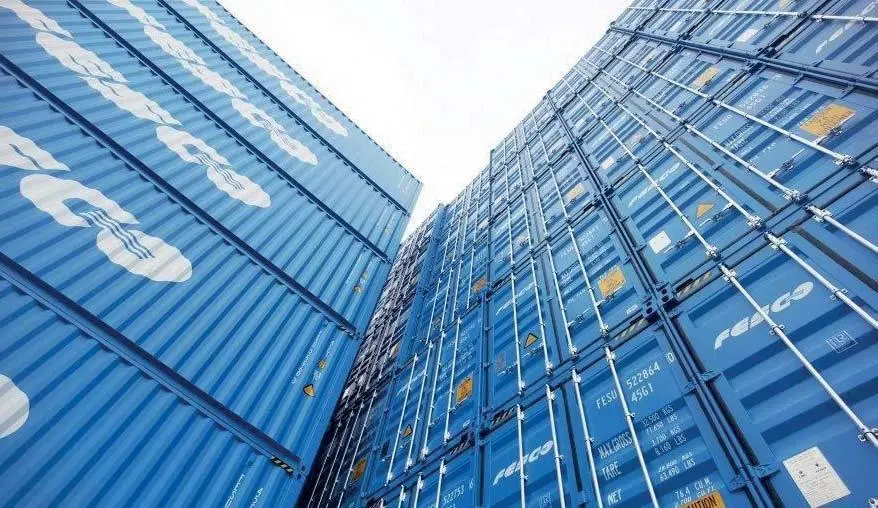
For example, in late October-early November 2022, FESCO, the Russian transport and logistics group, launched FESCO Black Sea Service (FBSS), its first regular (fortnightly) deep- sea line connecting Russia’s Black Sea harbour of Novorossiysk with China’s Pacific ports of Shekou, Ningbo, Shanghai and Qingdao via the Suez Canal.
According to FESCO, it takes FBSS 40-45 days to deliver China’s consumer goods to Novorossiysk, including 30-35 days for reaching Istanbul, where containers are transhipped from an ocean carrier onto feeder ships.
Earlier in 2022, Ruscon, a Novorossiysk-based Third Party Logistics (3PL) operator, started consolidated shipments from Turkey to Russia. Under the project, goods from all over the country are brought to Istanbul, then shipped in containers to Novorossiysk and finally railed or trucked throughout Russia.
In addition, ship operators launched, last year, several ro-ro/ferry services linking Istanbul, as well as Turkey’s Black Sea ports of Karasu and Samsun, with those of Novorossiysk, Kavkaz and Temryuk on the Russian littoral. The services are maritime legs of the intermodal routes between the two nations’ various hinterland destinations.
With Moscow’s growing international isolation, Turkey’s ports have been playing an increasingly significant role in supplying Russia’s manufacturers and consumers with numerous sanctions-hit raw materials and industrial products (such as automotive parts and components, other machinery and equipment).
Furthermore, the Kremlin has been inventing increasingly crafty transit channels and schemes for delivering so-called parallel imports (violating intellectual property rights, but being of vital importance for the country) to Russia via the Turkish ports.
At the same time, recognising that Turkey’s terminals have their limits, Moscow has begun eyeing Egypt’s , Mediterranean harbour of Alexandria which could also fulfil the role of a relay point for Russian cargo.
Related Articles
 OPERATIONS
 OPERATIONS
 OPERATIONS