COMMENT: It was once said of carbon off setting that it is a tool used by rich societies to carry on polluting without the guilt, writes Charles Haine.
Certainly, if businesses and individuals choose to compensate for their pollution as a strategy, rather than actually reduce the GHG emissions for which they are responsible, they run the risk of being nominated for the Greenwashing Oscars.
A famous brand of petrol station claims it off sets – without any cost to you – to make the fuel you buy ‘carbon neutral’. And in one foul swoop, that explains perfectly this type of ‘avoidance’ off set.
What has changed recently is that investors, stakeholders and Governments are looking to pursue binding ‘net zero emissions’ in a race to 2050, or in some cases as early as 2030.
Net zero status is a big step beyond carbon neutrality because it requires you to also look at your supply chain (e.g. customers using your services). In the coming decades and at current levels of know-how, almost every organisation is still going to be engaging in activities (e.g. heating/cooling, travelling to places, purchasing materials, receiving deliveries) that emit the gases causing global warming.
So in order to truly achieve the ‘zero’ bit, you’ll need to either: a) invest in technology, for instance carbon capture and storage (CCS), that physically takes GHGs out of the atmosphere (cue Financial Director breaking into a sweat upon seeing the CAPEX estimate); or b) seek and own (so that you have control over it) biological solutions, such as planting trees.
Items a) and/or b) are termed ‘authentic’ offsets. You may have caught the news that BrewDog – the independent beer maker in Ellon, north of Aberdeen, UK – has just gone ‘carbon negative’.
It’s doing this by investing in renewable energy to strip carbon out of the brewing process, using electric vehicles while also committing to planting one million trees in its own 2000-acre woodland in Loch Lomond. That’s real action!
What’s all this got to do with the maritime industry? Quite a lot, for a sector that is in lag. Shell’s 2020 ‘All hands-on deck’ report corroborated the elevation of decarbonisation – in the last 18 months – as a top priority for shipping companies.
The 28 companies that launched the ‘Getting to Zero Coalition’ (to seek a working zero emissions’ vessel and fuel) a year ago, now boast a membership of 110!
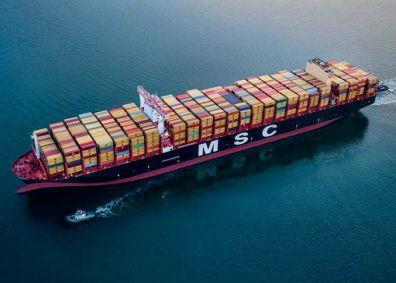
Until researching this column, I was not aware the Mediterranean Shipping Company (MSC) already has a Carbon Neutral Programme. What’s more, its website allows customers to select a project steeped in climate action (hydropower in China or forest conservation in Zimbabwe) to help offset unavoidable emissions.
As a bonus, such projects improve local lives and economies, and can therefore be aligned with the aims of the UN Sustainable Development Goals. MSC correctly acknowledges that this is a ‘bridge solution’ to a net zero future. As the world’s second largest box shipping company by volume, MSC will clearly also have to be at the forefront of researching, ordering and operating a net zero vessel in order to remain credible on offsetting.
It will come as no surprise to you that in true Orwellian style, not all offset programmes are created equal. Remember the horror stories – of carbon cowboys and their flantations (fake plantations) in far flung corners of the world, print-your-own-certificates and your reduced current account.
You cannot even think about entering the world of carbon offsetting until you have a comprehensive knowledge of your GHG emissions’ footprint (including multiple years of robust measurement), and a full due diligence exercise into the organisations promising to deliver certificates that verify the carbon actually saved. To be frank, I would want to see the offsetting project myself (thus, adding more transport carbon to the total needing to be offset).
I am studying the blue economy at the moment, and the latest shiny toy in the store is ‘blue carbon’ projects. Coastal habitats such as mangroves, marshes, tidal creeks, reefs and seagrass beds are getting attention.
This is because as highly productive parts of the ecosystem, they have carbon production rates equivalent to tropical humid forests. Mangroves allocate more carbon below ground in soil and dead roots. This could be news for port authorities and terminals.
Ecology, biodiversity and ecosystem services need to be as high on the agenda as air quality, waste and noise. There could be a carbon goldmine within your jurisdiction or right there on the doorstep!