

Smart vision
Ports are on track to smart port innovation but challenges lie ahead.
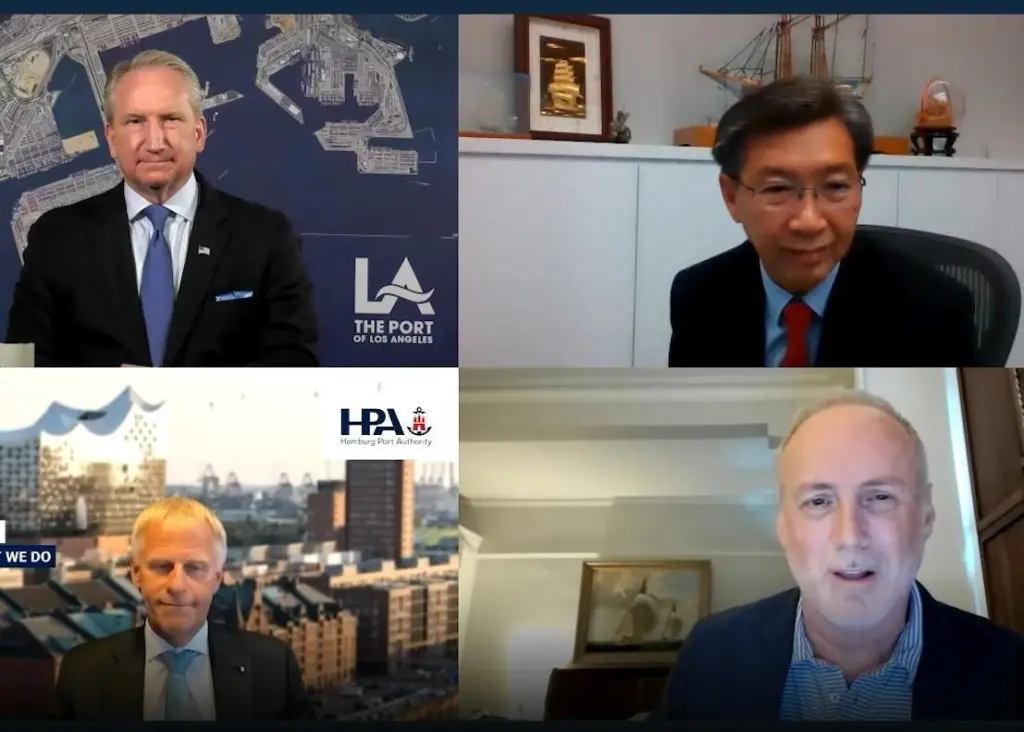
The heads of the Port of Hamburg, Port of Los Angeles and PSA International shared their insights into what the smart port of the future could look like and how ports will make use of smart technologies at the ‘Ports of the Future’ session of the IAPH World Ports Conference 2021.
Hamburg : 2035
Jens Meier, CEO of Hamburg Port Authority, said rather than asking how far are we from a port of the future being achieved? “It is better to look at are we on the right track, are we taking the right steps?”
He discussed the PORTrait vision of the future, developed with partners in the chainPORT network of smart ports. This envisions how a port could look in 2035.
The ports and logistics chain of the future would be able to anticipate incidents like the Evergiven blocking the Suez Canal and therefore mitigate these incidents. Partnerships, increased data transparency and use of smart technology like AI and algorithms would play a part.
“This would be possible if in the port and the supply chain, the physical and digital world are fused with operations running automatically or close to that.”
To use new technologies ports will require digital security infrastructure. He added: “Ports will be pioneers in developing and applying standards for digital ethics centred on the actions and security of people.”
In addition to automation, the pa believes in the implementation of the digital twin, with benefits including reduced lay days, waiting times reduced to almost zero, maintenance of vessels carried out on a just in time basis and clearance of containers taking place much faster.
There would also be guaranteed sustainability, with ports leading the way towards scalable climate friendly infrastructure, green technologies and clean fuel and incentives for use of these.
A future Los Angeles
On the topic of how the port of LA will look in 5-10 years, Gene Seroka, executive director of the Port of Los Angeles, highlighted digitalisation and its growth, the increase of e-commerce and the scalability of the supply chain.
He said both data standardisation and protecting data will be important. He talked about the importance of cyber security. The Port of Los Angeles has created a cyber resilience centre as a reaction to increased cyber-attack attempts.
E-commerce has doubled at a retail level in the US in the last 15 months, noted Seroka. “Its convenience means it will grow, so cargo involved needs to be handled and distributed more efficiency, this will be underpinned by technology.”
The pandemic-induced cargo boom has highlighted more than ever the need for the supply chain to better manage swings in cargo volume, said Seroka. “Our ability to flex and scale to the appropriate levels to all nodes of the supply chain will be looked at very closely.”
PSA view
Looking at how efficiency will evolve and who will be involved, Chong Meng Tan, Group CEO PSA International, said efforts to make the supply chain better and more efficient have already been made by digital companies in the maritime supply chain space. However, sharing data and the choice of common platforms is made difficult by the diverse and competing interests/stakeholder involved.
A second issue is issue is complexity, he explained. Global sourcing, manufacturing and distribution requires you to work across national boundaries. That’s where building a global supply chain that suits every country can hit a snag. There is no one size fits all.”
He added that a whole supply chain approach mentality is starting to emerge, partly because COVID-19 has accelerated the digital economy. “Progress has been made towards convergence, in data standardisation and industry digitalisation, which until now has been somewhat elusive.”
He highlighted the impact of PSA’s digital platform Calista, which is designed to simplify and speed up logistics, finance and compliance management, but also aims to resolve “commonly experienced paint points” including multimodal, document centricity, and non-synchronous trade financing for VCOs and clear supply chain options.
“We try to tackle complex data standards so that data can have high integrity and reusability.”
We should not wait for a digital giant to step into the industry and make changes, Chen said. The industry needs to embrace digitalisation itself.
“I’m optimistic that solutions will become clearer and progressively over the next decade we’ll get to some tipping point where most of the industry will be digitalised.”
PSA believes that ports and the wider logistics chain will both be part of the solution, enabled by a digital twin.
Peter Tirschwell, vice president, Maritime and Trade, IHS Markit, moderated the session.
Related Articles
 TERMINAL OPERATIONS
 DIGITAL
 DIGITAL