Southeast Asia, once considered a pool of low-cost labour, is attempting to ditch its old labels and loosen the grip of some established institutions, writes Stevie Knight
A significant proportion of Southeast Asia, including Thailand and Vietnam, is engaged in “reinventing itself as a high-end manufacturing partner” says Jason Chiang of OSC. It's backed by an overall 5%-plus growth that may, in some cases, have been enhanced rather than damaged by the US-China trade spat.
Certainly, Mark Yong of BMT Asia notes the ports are demonstrating a new appetite for technology. “A number are now seriously evaluating automation – it's becoming a trend,” says Dr Yong. In fact, Malaysia has one very large candidate: recent media reports suggest that Westport, after being hit by stinging losses to Singapore, could be looking in this direction.
But it is a tricky path and the destination doesn't always result in a clear advantage. Take Indonesia's Lamong Bay at Surabaya. Mr Chiang says that “while the automation itself was implemented successfully, there are operational issues because the berth is located further away from the yard, adding to the cost structure”. Combine that with configuration issues at the pier head and the result is “less than efficient”, adds Mr Wignall.
Moreover, according to Dr Yong, a recent survey shows that automation can be a mixed blessing. While around two thirds of the region's ports recognise its safety, control and potential for reducing operating costs, only a third see it as actually improving customer relationships.
Automation alternative
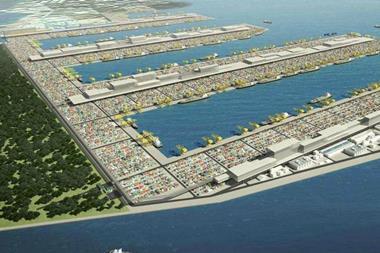
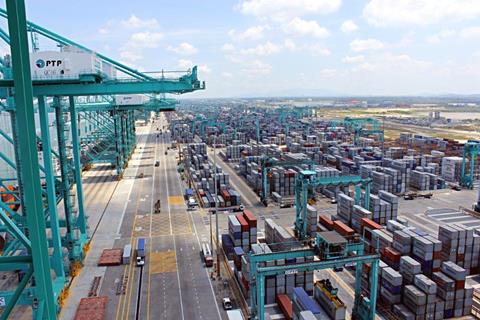
There are others making a go of a high-tech approach, but not necessarily through automation. Tanjung Pelepas (PTP) handled 8.4m teu in 2017 and it's aiming to retain its competitiveness despite Singapore's huge Tuas construction just a couple of kilometres across the water. PTP plans to add another 3m teu capacity by deepening its draught to 18 metres, installing larger quay cranes, upgrading kit and combining all this with a digital strategy that embraces ERP systems alongside other smart technologies.
Likewise, Hutchison's recently opened $600m terminal D at Laem Chabang, Thailand, raises the port's capacity by 40% to 3.5m teu, supported by mobile apps, e-tracking and remote-controlled cranes. In the last year or so it has boosted its top container vessel size from 10,000 to 14,000 teu. Mr Chiang says the terminal “is capable of handling the big 22,000 teu ships, if they choose to call”.
But despite Leam Chabang's relevance to the $54.2bn Eastern Economic Corridor (EEC) and Thailand's 4.0 effort which is intent on raising the value of its production base, there are simple shipping realities to account for: “You have to deviate from the current Europe-Far East sailing route, so it still might not make sense for the largest vessels,” he points out.
Also, the EEC is heavily reliant on Chinese backing and right now the government's critics are weighing the likely costs of debt.
Certainly, a number are looking to Malaysia which has now cancelled its own East Coast Railway Link contract with China Communications Construction Company (CCCC). “The link aimed to bring cargo from the east coast to Port Klang, and yes, it would have cut sailing time, but at a significant cost,” says Dr Yong, adding that at time of writing, the authorities are renegotiating – possibly for half the price.
Further, the tender for Laem Chabang's $3.65bn third phase has been subject to an embarrassing hitch. Dr Yong explains that while as many as 32 parties picked up the Terms of Reference for the third phase, at the January close “it ended up with just a single – disqualified – bid”. He adds that the problem may well not be financial, but rather “additional compliance conditions” forcing the authorities to go back to the drawing board.
Pelindo problems
Indonesia needs to put its weight behind lowering its logistics costs, but behind the headlines that Pelindo 3 is looking at port facility investment worth IDR6.44tr ($455.37m) lies another reality.
Mr Chiang explains that three out of the four state-owned Pelindo port companies “have borrowed whatever they can”. David Wignall of Seaport puts it more bluntly: “While Pelindo II has money, it's sitting tight on it and the other state-owned Pelindo companies, I, III and IV, have maxed out their credit and will need to sell assets to fund more investment.”
There have been a number of projects that reflect a certain lack of planning in the country. Take the multipurpose Kuala Tanjung in North Sumatra. Pelindo I claimed to have invested $350m to have the capacity to handle the big ships, but Mr Wignall highlights that based on its own forecasts “the revenue will be about $25m in 2025 – barely enough to cover the annual interest”.
Even Patimban stands to have mixed results. It's being built with Japanese money, says BMT Asia’s Mr Yong, and is very convenient for the concentration of Japanese auto and manufacturing plants nearby, “but it will definitely impact this cargo stream at Tanjung Priok”, he says. Mr Wignall adds: “Assuming New Priok Container Terminals 2 and 3 are delivered on time, there will be no lack of capacity in the Jakarta-West Java region. Overall, it's hard to see much benefit to the economy.”
Moreover, DP World's exit from the 1.4m teu-capacity PT Terminal Petikemas Surabaya (TPS) joint venture is significant. “They still couldn't come to an agreement with Pelindo 3, despite running the operation efficiently for a number of years,” says Mr Chiang. In fact, DP World publicly stated that “significant positive contributions made by global terminal operators in Indonesia have not been fully recognised, despite our successful track record”.
Although this leaves a hole in Indonesia's cargo strategy, there's possibly a chink of daylight in the form of a promising 2m teu facility not 6 kilometres from TPS. Direct discussions about a competing terminal are underway with the operator, entirely bypassing the state-owned company. “It's pretty clear the Indonesian Ministry of Transport is saying to the Pelindos, if you can't do better, then we'll let in the competition,” observes Mr Wignall.
Indonesia moves
Further developments in Java could also challenge the Pelindo monopoly. Tanjung Emas is pushing its limits with a throughput of around 700,000 teu, but rather than call on Pelindo III it may be that the Ministry of Transport is engaged in discussions about the development of another private, 1m teu terminal. Stories about discussions between major operators and substantial local partners have put PSA, DP World and even Hutchison in the frame with detailed assessments. “We seem to be seeing private operators being allowed by the Ministry to step in to make investments on a purely commercial basis,” Mr Wignall concludes.
In the less developed areas, however, there's a rather more co-operative picture emerging as the Transport Ministry is working with local governors to develop small hubs “with some container capacity, even able to attract a few international calls”, explains Mr Wignall. These would be supported by a network of smaller jetties dealing largely with container barges and ro-ro traffic.
The money is partially being sourced from provincial authorities, some from private investors, plus some from the World Bank or ADB money, he explains. The first two regions off the mark are likely to be the Maluku Islands of Indonesia, with Ambon as its centre, and East Nusa Tenggara (ENT) with the capital port of Kupang as its centre.
“Lessons,” says Mr Wignall, “are being learned.”
VIETNAM DIALS UP THE VOLUME
After a long, dry spell, Vietnam is seeing another round of intense activity on its port front.
In the north, state-owned Vinalines is looking to develop Lach Huyen port with Japanese backing. The first of nine, Haiphong International Container Terminal started work last May, catering for Hannoi and the city's hinterland.
The story around the South's Cai Mep cluster, once painfully overburdened by too much competition, is now looking up “and three of the terminals are now full”, says Jason Chiang.
However, things look like heating up again: “The Gemalink port project in Cai Mep - Thi Vai has been brought off the back burner,” he says, and the 1.5m teu phase one is underway. He points out that as CMA-CGM has a quarter share of the total, 20,600-box ship, 2.4m teu capacity project, “it's likely that it will move over its cargo”.
“I'd say that the patterns are changing... the terminals moving closer to serving the individual lines,” concludes Mr Chiang.