
It could result in more earth being moved than both the Panama and the Suez canals combined - and it won’t pay for itself. Stevie Knight asks if the Thai Canal is still worth consideration?
The Thailand Canal is a potentially attractive idea. It would reduce the shipping distance, emissions and journey times by avoiding Singapore and the busy Malacca Strait, but it has never truly gained any traction. Indeed, it has “moved on and off the table, since the 17th Century,” says JohanPaul Verschuure of the Rebel Group.
The concept is currently gaining new traction. While the former Shinawatra government’s attempt at a feasibility study ended with the 2006 military coup, in more recent years the Thai Canal Association, a group of the country’s ‘movers and shakers,’ has been pushing hard to make it a reality.
UP AND DOWN THE MAP
The project appears to have gained a new breath of life, with Thailand’s Premier recently ordering the National Economic and Social Development Council to push ahead with public hearings and feasibility studies, and making room for them in the national 2021 budget.
However, this idea has not just been on and off the table, it has also moved up and down the map. A proposal in the 1990s for a short-cut across the narrowest part of the isthmus costing around US$20 billion triggered an avalanche of alternatives, such as Phang Nga to Bandon Bay and Pak Bara to Songkhla Port.
While the north has mountains to cross, there is another issue too - cutting a canal would create a ready-made border for the Islamic Malaysia insurgency in the south. That is a real problem, adds Darron Wadey of Dynamar: “If you build a road through a community, there is an immediate sense of severance, but after that fades, you do get two communities, not one. So, domestically and politically, it is a difficult move.”
While social cohesion and environmental concerns are highly relevant, “inflated land sales” have also not helped, says Free Zone lead Tony Restall. Wadey adds: “In Thailand, you can have 500 different owners for a 10km stretch. So, speculation puts up the cost considerably.”
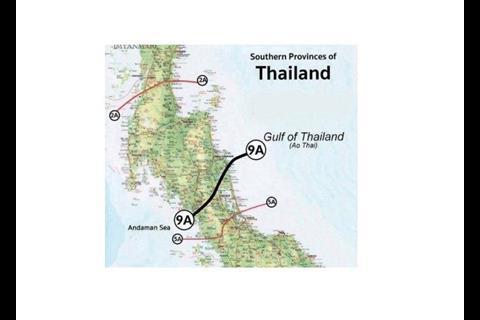
The currently preferred (though still not finalised) option — Route 9A — starts near Ko Lanta in the west and crosses to Ranot, Songkhla on the eastern side. It could be 125km long, and to accommodate two lanes of containerships, be 350m wide and 30m deep.
There is a substantial price tag attached. “The 9A route was pegged at US$28 billion five years ago, but it might be more like US$35 billion for just the construction by now,” explains Restall.
WHY IS IT WORTH CONSIDERING?
“The canal alone will never pay for itself,” says Restall: “Unlike the Panama and Suez canals, it will not provide significant, direct financial returns.” Verschuure adds that “questions remain” about how to get such a massive development moving for a range of reasons, from financing and environmental concerns to politics.
So, why is it worth considering? The answer may be in the free zones at each end. Restall’s experience in helping create the first of Jebel Ali’s Free Trade Zones (and others) has convinced him that access to global trade can set the stage for manufacturing and investment. In his estimation, free zones could create between four and five million new jobs and “establish a significant economic boost”. He further explains that, “Employment and a better life tends to have a neutralising effect on insurgence.”
NOT INTO THE ARMS OF THE CHINESE
There are also concerns about not “running into the arms of the Chinese,” says Restall, explaining, “If it is viable, a project will stand on its own.” Thailand’s neighbour, China, certainly has an interest in the project. “When it comes to supply chain security, the Malacca Strait is a chokepoint,” says Wadey.
While physical constraints mean the largest oil tankers already go through Lombok, if China continues to pursue increasingly assertive policies it will be aware that transiting either the strait or the colossal Indonesian and Philippine archipelagos could become that much harder.
While the Thai Canal might answer China’s so-called ‘Malacca dilemma’, not everyone is happy about it: “China was waving money under the Thai government’s nose, but there is a legitimate wariness,” says Restall.
“There is stiff, very public criticism around China’s handling of investment issues in other host nations, so people are scared of a debt trap,” says Wadey. Chinese-backed rail and Chinese-built submarine programmes have been delayed or worse, with Thai authorities citing excessive costs and lack of transparency. He adds: “There is now a question about how willing Thailand will be to accept another Chinese-led project.”
Wadey also explains that it may be “pure mischief” but a Thai politician has recently said there is interest from Australia, India, and the US, so that could be a way to deny China a route.
DISTANCE SAVINGS – BUT CHARGES ARE KEY
Answering project viability concerns means looking at what the route will save and who it will be serving. Wadey explains further. “A Japanese study, looking from the Gulf of Thailand and southern Vietnam to the Indian Subcontinent and all points west, showed a 1300km saving. Coming from South Korea, Japan, mainland China or Hong Kong, then the saving is only 900km and from Manila it is not even 700km."
So, some distance advantage, but transit charges are still key and the precise charging mechanism is not known. “A toll should be less expensive than sailing around Singapore,” explains Verschuure, but adds that further tolls will reduce the canal’s advantages and make “generating enough direct revenue from the canal challenging.”
“It requires a large amount of money to build,” Verschuure adds, although he does feel that indirect benefits through predicted free zone revenues and other economic developments could “generate confidence to underpin the investment.”
Restall is of a similar opinion. “The free zone is the carrot for the investor and gets the watermill turning with other elements adding traction. The indirect revenue, the housing, the influx of domestic goods... that can yield more than 10 or 15 times the initial spend. It magnifies the economic effect.”
WIDER IMPLICATIONS
This new canal could certainly influence the shipping balance in that part of the world. “If it went ahead, India might be drawn into putting more investment into ports on the Andaman and Nicobar Islands,” says Wadey. “Not only would this put a foot against the door of unrestricted Chinese access to these waters, but a transshipment port would not look like a bad idea.”
In fact, he points out that last year India asked for expressions of interest in developing a US$1bn transshipment port on Grand Nicobar Island, potentially putting itself ahead of the game - a subject Port Strategy considered in the November 2020 edition.
“Malaysian ports like Penang and Klang do have a bit more to lose,” says Restall. “But Malaysia is very successful as an exporting country, so it can still generate its own cargo.” The canal has vocal opponents but also a number of supporters. It is an idea that has been coming back to the table since the 1600s – but the current traction may be the strongest yet.
The Landbridge option
There is another option. In a rare show of unity, a cross-party decision was taken earlier this year to study both the canal and an alternative - in the form of a 120km landbridge connecting ports at Chumphon and Ranong with highways and dual-track rail links.
There are strengths and weaknesses to the landbridge concept. “You don’t need to dig a very expensive canal – with heavy environmental and population consequences, although the downside is double-handling on each side,” explains Verschuure.
The nature of the traffic on Thailand’s east and west coasts is relevant here. “Double handling does not impact long-haul economics that much because each end has a different character. The eastern side of the landbridge will be supplied by smaller vessels on Vietnam or Thai cargo feeds, plus one big loop from Shanghai. On the west side a deep-sea pool can take the longerrange vessels,” he suggests.
The landbridge idea is gaining some traction. Local media are estimating costs at around US$5.5 billion, including US$500 million for port upgrades. This is a fraction of the canal’s price, with potential for multiple joint, private-public sector investment - an attractive proposition for a government struggling to reshape the economy.