

Souring international relations between China and Australia are now seriously threatening coal exports from Australia. AJ Keyes assesses what the impact could be on both sides.
“China is a big destination for Australia’s coal and it’s a growing market,” said Ed Dawson, Associate, WSP. He explained further: “The share of activity has been rising in recent years and around 35 per cent of the country’s coking coal exports in 2020 are going to China, which is an increase on the 2019 share which was just under 30 per cent.”
Clearly, this is a major trade route for Australia, although it is also an important source of raw materials for China as well, so any issues on this established trade lane will bring serious repercussions.
SOURING RELATIONSHIP
The trade dispute between China and Australia has gained momentum during 2020, with the relationship between the two countries worsening since Australian Prime Minister, Scott Morrison suggested that independent investigators should be allowed into the Chinese city of Wuhan to better understand the origins of the COVID-19 pandemic.
The Chinese government objected to diplomatic manoeuvres from its Australian counterpart, stating that Australian support was being offered to the USA in its own trade and security dispute with China.
Irrespective of the rationale from either side, the situation has been escalating. In May, an 80 per cent tariff was applied to purchases of Australian barley, the second-largest agricultural export to China and worth AUS$1.5 billion.
Since then, disputes over Australian wine, beef and lobsters were also dragged into the mire. However, the impact on the coal industry is where the greatest possible concern is focused, especially since it was reported in October 2020 that Chinese mills and utilities were placed under order to stop using Australian coal.
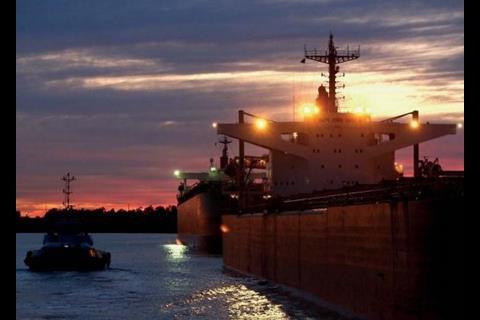
Consequently, delays are occurring, as David Bull, Senior Analyst of London-based Gibson Shipbrokers confirmed. “We are following these developments. We know that recently around 20 large bulk carriers were anchored off the Chinese port of Jingtang and unable to offload millions of tons of Australian coal – 15 units had been waiting for some considerable time and were then joined by a further five ships.”
This shipping specialist then outlined the latest development. “Many ships originally scheduled to deliver Australian coal to China are now being diverted, with calls to ports in India or Vietnam benefitting. This is regarded as a preferable strategy over waiting for access to Chinese ports because it is not known how long the wait might be.”
IMPORTANCE OF COAL TO AUSTRALIAN PORTS IS UNDENIABLE
China accounted for around 30 per cent (A$170 billion or US$120 billion) of Australia’s total exports in 2019, with iron ore, coal and gas collectively comprising 60 per cent of the sales. The country is the largest consumer of Australia’s metallurgical coal and the number two destination for thermal coal exports behind Japan.
However, while thermal coal is one of the limited natural resources in which China is self-sufficient, higher-quality coking coal is very different. This is because the country’s steel plants are highly dependent on supply from overseas and Australia is a key provider of more than half of recent demand.
“Australia’s coking coal is of a much higher quality than from other locations, such as Russia. It is a lower-cost supplier of the commodity, so it’s not just Australia and its ports that are potentially losing out here, so are the companies in China that rely on it,” explained Dawson.
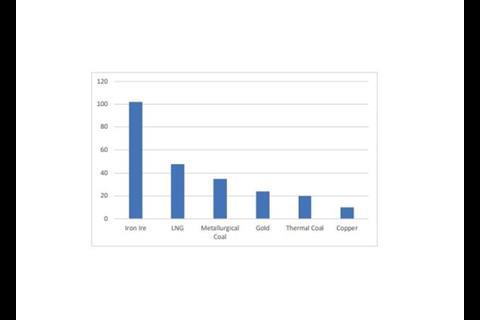
To put the importance of China to the Australian coal industry – and with it Australia’s ports – into perspective, Figure 1 confirms the value of the activity in 2020. Metallurgical and thermal coal combined totalled A$55 billion in fiscal year 2020, so the importance of this commodity to Australian ports – and the trade dispute with China – is undeniable.
THE PORT PERSPECTIVE
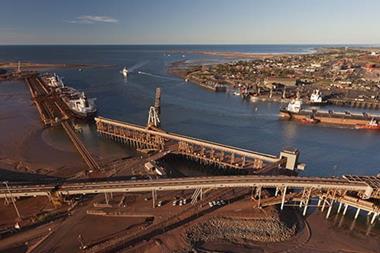
What does this actually mean on a day-to-day basis for the ports and, of great concern, are those facilities investing in infrastructure on the basis that the trade remains in good shape going forward? Well, on the East Coast of Australia, coal is a leading activity at Abbott Point, Hay Point, Gladstone, Brisbane, Newcastle and Port Kembla. In each instance, the volumes and infrastructure supporting them are substantial. In the fiscal year of 2018-2019, the Port of Hay Point recorded 118.3 million tonnes for the North Queensland Bulk Ports Corporation (NQBP).
The Port of Hay Point has two separate coal export terminals: Dalrymple Bay Coal Terminal (DBCT) and Hay Point Coal Terminal (HPCT). There are seven berths for both terminals, four at DBCT and three at HPCT. These facilities service coal mines in Central Queensland’s Bowen Basin. The mines link to the terminals via an integrated rail-port network, so the infrastructure is very well-established and the logistics network from source to port is in place for Australian coal to be exported. The primary destination is China.
Coal export volumes handled through the Port of Gladstone are currently 58 per cent of Gladstone Port Corporation activity overall, of both import and export traffic. In 2019, the port handled 72.5 million tonnes of coal, but with the current capacity at 75 million tonnes, it needs to expand.
“The RG Tanna Coal Terminal (RGTCT) has provision for a fifth berth and that will take its annual capacity up to 90-100 million tonnes, annually,” confirmed Dawson. Coal volumes at the Port of Newcastle currently represent 98.5 per cent of total port activity, so this facility is another good barometer to measure the impact of the trade spat.
The port has released year-to-date figures for coal exports at the end of October 2020. For the first 10 months of 2020, a total of 132.4 million tonnes was recorded. This compares to 137.2 million tonnes for the comparable period of 2019. So, although there was a small decline, to date the trade dispute between Australia and China has not hit too hard.
There is, of course, concern from across the Australian port scene. One executive at another port who would comment but without being named was clear about the issue. “Of course, we are concerned about the trade dispute. The longer it goes on, the more it will impact our export volumes. So far, there has not been too much of a negative impact because we loaded ships and they left for Asia. However, the longer vessels sit waiting for access to China, the longer we may have to wait to load the next ship – then, our export volumes will be impacted. We remain hopeful that politicians on both sides see that the current situation is not ideal.”
ONE WINNER FROM THE TRADE DISPUTE?
One winner from the Australian coal ban has been Russia. In the first ten months of the year seaborne imports of Russian coal to China have leapt 40 per cent year-on-year.
However, Russia does not have the production capabilities to fill in for all of the potential missing Australian coal nor, as Dawson concludes, is the quality of material from this location as high as much of that shipped from Australia. “Much of Australia’s coal is high quality and that is why it is needed in Japan and China. It is still clear that despite the trade dispute, there is still a need for this cargo.”
This view is endorsed by Andrew Penfold, of Mundy Penfold Ltd: “If Beijing refuses Australian coal, then who will step into the gap? Russian coal is not an option for coking coal, so this only leaves Canada and the US - neither are currently on better terms with China than Australia. For thermal (steam) coal there are possible options, South Africa or Indonesia, but once again there are political issues. If this is a long term switch of supply then there will be a need to step up export port capacity. Financing this with current uncertainties will be problematic, however.”
Yet even if the long-haul trade option from Canada and the US serving China is not beset by political issues, the subject of costs (of moving the coal much longer distances than from Australia) is relevant, as Penfold clarifies. “The Canada or US option will add to the CIF price of coal in Chinese ports (longer haul, smaller vessel sizes, higher FOB prices).”
Consequently, China could find itself having to pay more for the coal it needs. Beijing’s potential willingness to destroy a mutually profitable trade relationship is concerning, not only for Australian ports and the coal (and other trades) but also for China’s own requirements too. A potentially dangerous strategy to follow.