


NUDGING OUT THE ROAD TRUCK
Terminal tractors are consolidating their position as the logical choice for moving boxes and trailers around, edging the clumsier road truck out – particularly nowadays in Asia – and showing no great concern over the potential threat from alternative machines. In its march towards supremacy however, significant advances are also being made on the environmental front, as Nick Elliott discovers.
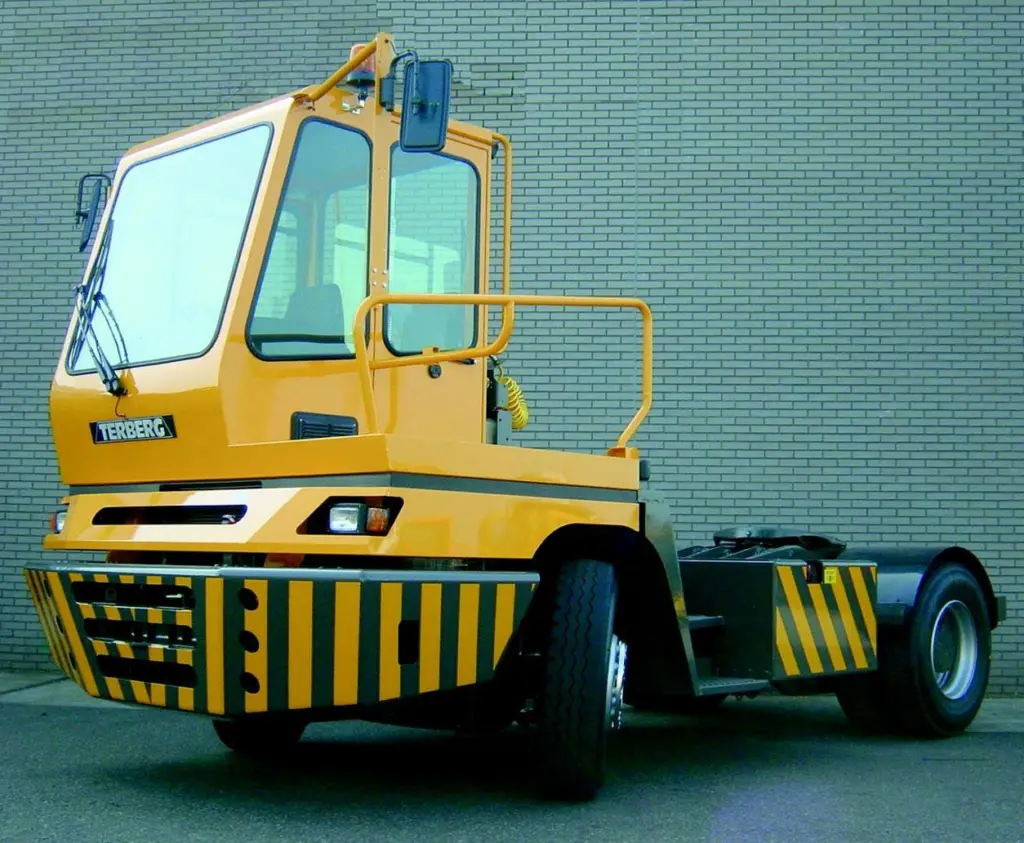
Few would argue that the terminal tractor owes its origins to ‘spotting’ activities in depots and yards across North America’s intermodal infrastructure where they rejoice in a colourful variety of colloquial names such as jockey, shag truck, shunt tractor, hustler, switcher, yard bird, yard dog and yard mule.
Elsewhere in the world, the road truck has often performed a similar function. Whilst Europe and North America have long been familiar with the terminal tractor, many container and general cargo terminals in the developing world have made do with road trucks which are cumbersome and unsuited to terminal use.
Says George Terberg, director at Terberg Benschop: “Clearly for doing a job on the terminal the terminal tractor has many advantages over the road truck: the layout of the driveline, the visibility, the manoeuvrability, the chassis construction with an elevating fifth wheel.
So you see more and more that the trucks are disappearing from the port. Especially we see it in Asia now where in the past the road truck had a dominant position in the port.” He also highlights the cheaper lifetime costs of a specially built machine for a specific application.
As to alternatives such as the shuttle carrier, Terberg says: ” We do not see it as a threat. Containerisation is a growing activity and we think there is room enough for shuttle carriers and terminal tractors.”
Mikko Vuojolainen of Kalmar in Ottawa, Kansas adds: “The shuttle carrier is an interesting concept but nobody has yet seen it through to fruition and I guess the economics are still questionable.” And of trailer trains: “I can’t think of a typical profile where the trailer train makes economic sense over regular trailer movements using terminal tractors.”
Vuojolainen also sees good prospects ahead: “There are still many ports using over-the-road trucks and here there is a potential to grow. Whilst the terminal tractor is designed for the kind of stop-andgo traffic over short distances on the terminal, moving the load from point to point, the road truck as a product is obviously designed to achieve certain speeds and then maintain that for hours so the entire power-train and other parts of the product are designed for something else.
“Also the horsepower must be much higher for a road truck which is not necessary in terminal operations where they are required to accelerate up to 30 or 35 kilometres per hour only and then brake.
So torque becomes far more important than horsepower. So you need a special transmission and a smaller engine which offers better fuel economy. Manoeuvrability is also a key factor. The terminal tractor has a much greater steering angle than the road truck which is not designed to operate in a tight, restricted area.
“Terminal tractors work in tandem with the yard stacking system, ” states Vuojolainen, “and are specifically needed when RTGs, or in some cases reachstackers, are used. When there is an RTG system in a container terminal then there is the potential to sell a terminal tractor. So there should be a correlation between the RTG market and the terminal tractor market.”
Another angle on the debate is from MAFI which manufactures both tractors and trailers. “This ensures a uniform load distribution between trailer and 5th wheel so that the lifetime of the trac-trailer combination can be optimised, ” they maintain.
TO MARKET, TO MARKET? So given the opportunities, how are the top manufacturers approaching their international markets? Terberg’s production is based in Holland but for the Southeast Asian market the tractors are now produced in close cooperation with its Malaysian partner, Tractors Malaysia. “We have just managed to renew several competitive deals in Malaysia and Indonesia and we have now also managed to break into the PSA in Singapore, ” says George Terberg.
“Commercially this year we are doing reasonably well, ” he adds.
“There is a significant improvement compared with last year in both sales and production. Sales are about 20% higher than last year and so is production.” He estimates the total annual production of terminal tractors at around 4,500 “but that includes ro-ro tractors (which is mainly a European activity with a little in Africa) plus yard and warehouse tractors.
Terberg has recently managed to obtain a repeat order for 30 tractors from the PSO in Iran and for 11 tractors for Casablanca, another repeat order from Felixstowe for 20 tractors and seven new units through its UK dealer, Transtec Equipment, for Thamesport. “Overall, throughout Europe we are doing good business, ” he concludes.
CVS Ferrari also reports a buoyant market. “Our sales forecast for TT/TR tractors was achieved within the first part of the year, this also due to a flourishing demand in our domestic market. And our order intake has risen 15%, ” reports sales director Paolo Groppi. .
“We have a distribution set-up in Kalmar that allows us to respond to local needs in a local way, ” says Kalmar’s Vuojolainen. “We don’t have one single approach that we apply all over. We offer whatever the market needs. So we have different programmes in different markets always in response to customer needs.” He cites Port Elizabeth, New Jersey where they have a fleet of terminal tractors operating under a special lease and service agreement for APM Terminals. The agreement allows APM Terminals and Kalmar to focus on their key competencies. Kalmar will see that terminal tractors are ready when needed and operating at top efficiency. Jorma Tirkkonen, president of Kalmar Trailer Logistics, indicates the company has a strategic imperative to develop other such arrangements tailored to the needs of specific customers. He explains: “Kalmar’s leadership in the ports business worldwide puts it in a unique position to predict operating costs at ports and their needs for technology and automation.”
Kalmar also produces terminal tractors from its Shanghai factory now giving it production facilities across three time zones.
But there are other ways. Capacity of Texas recently delivered an order of its trailer jockeys in containers having modified the machine with a new narrow platform that allows the units to be containerised.
Normally shipped as complete units on flatracks aboard ship, containerised shipments allow for more economical movement of product to the far corners of the world, the firm says. Although fully operational, units must have sub-components reassembled by local agents upon delivery.
Says Heath Parsons, national sales manager: “This past year Capacity placed units into key port operations in Southeast Asia, China, Latin America and Korea. Capacity offers several different programmes where this assembly can be performed by the end-user, local Capacity dealer representation, or factory representatives that travel to the specific site.
“Flatrack shipment is feasible, but considerably more expensive.
Containerisation was one avenue to save this additional cost for the Capacity customer, while not sacrificing any operational advantages of the units, or structural integrity. This option has been widely accepted and continues to gain favor with customers around the world.”
MAFI also ships from its German manufacturing base and says it can supply its tractors within a very short period of time as there are always a certain number available from stock both with right or lefthand steering. “As our tractors are operating worldwide, MAFI service technicians are shortly available wherever they are needed on the globe.”
LPG AND LNG SETS THE PACE IN CALIFORNIA It is hardly surprising that California is grabbing the headlines when it comes to environmental advances. Yusen Terminals Inc. (YTI), a subsidiary of NYK Lines, recently placed an order for terminal tractors powered by clean-burning LNG. According to Don Lawrence, western regional manager for Kalmar: “This is the first time in the world that LNG has been used to power a marine terminal tractor.”
“As part of NYK’s Green Policy, YTI is continually working to find ways to reduce emissions from our waterfront transportation services, ” says Masayuki Okutsu, executive vice president for YTI.
“Instead of purchasing traditional diesel powered units, YTI’s investment in these clean air LNG tractors will reduce emissions of NOx by 65% and particulate matter by over 80%.”
The purchase is the result of a twelve-month effort by Sound Energy Solutions (SES), a subsidiary of Mitsubishi Corporation, and Applied LNG Technologies (ALT) to expand the use of clean-burning natural gas in the Ports of Los Angeles and Long Beach.
Funding for YTI’s project has been provided by the South Coast Air Quality Management District (SCAQMD) through its Carl Moyer Air Quality Standards Attainment programme.
Beyond these first two LNG terminal tractors, YTI hopes to continue to replace its diesel fleet with low-emission technologies. YTI has recently submitted an application to the Port of Los Angeles Air Quality Mitigation Fund for the funding of an additional 34 LNG tractors and for an LNG fuel station that will allow the company to continue to replace its fleet of 120 diesel terminal tractors with cleaner LNG units.
LPG engines have been in use on terminal tractors for some time.
Four years ago Marine Terminal’s Corp (MTC) in Los Angeles introduced low emission LPG yard hustlers through the state’s Carl Moyer Memorial Air Quality Standards Attainment Programme.
Administered by the South Coast Air Quality Management District, this programme provides financial incentives for owners and operators of heavy-duty diesel equipment to reduce emissions.
The fund pays for the additional cost of an alternative fuel engine compared to a traditional diesel engine, which in the case of MTC was an additional $11,000 for each yard hustler. Each cost $70,000, including assistance from the Moyer fund.
George Terberg expects LPG to become increasingly important in fuelling terminal tractors. His company has already developed a tractor for warehouse activities with a Cummins LPG engine. “Hybrid vehicles (diesel electric) and LPG will become more and more popular for environmental reasons, ” he insists.
“The hybrid is directly to do with fuel economy, noise levels and emissions. There is continuing development in bringing noise levels further down with the implementation of electronic engines, cooling capacity, etc.”
Terberg says most developments now have to do with these environmental issues but also with cargo becoming heavier meaning the terminal tractor has to pull greater weights. “The total driveline and layout of the tractor has to cope with the heavier cargo circumstances. As port operations differ from one port to another it becomes a matter of continuous improvement and fine-tuning.”
CVS Ferrari’s new FYT180 features wide glass surfaces for high visibility/enhanced safety; low fuel consumption; full vehicle diagnostics; steel cabin according to FOPS (ISO3449) and ROPS (ISO3471) regulations; soundproof, ergonomic, tiltable 60infinity by means of hydraulic pump; all new instruments from VDO, featuring a master instrument connected to many slaves, plus a multifunctional LCD display for information provided to the operator; same display used for diagnostic messages coming from engine or transmission; heravy-duty fifth wheel with 2″ kingpin connection; automatic locking and unlocking from driver cab.
www. cvsferrari. com MAFI’s new MT25 equipped with new seat console where all operating elements are located around the driver including multifunctional display and onboard computer with engine and gearbox monitoring system;
new cabin ROPS-tested and certified; swivel seat can be included optionally; equipped with a rear sliding door as well as side door as standard. www. mafi. de Terberg’s new YT182-222 features new cab with more internal space/visibility;
improved heating/airconditioning; “soft feel” diam. 350mm steering wheel; reduced cab noise; more attractively styled dashboard layout with improved access for servicing;
improved in-cab storage capacity; optional instructor seat which can be folded up to give unobstructed access to the cab;
improved and bigger expansion tank; new front bumper, front mudguards, side step and tank protection layout. www. terberg. nl
Related Articles
 TERMINAL OPERATIONS
 CONTAINER & CARGO HANDLING
 NEWS
NEWS