

Open season
Central American ports looking to cash in on the Panama Canals expansion. Alex Hughes reports
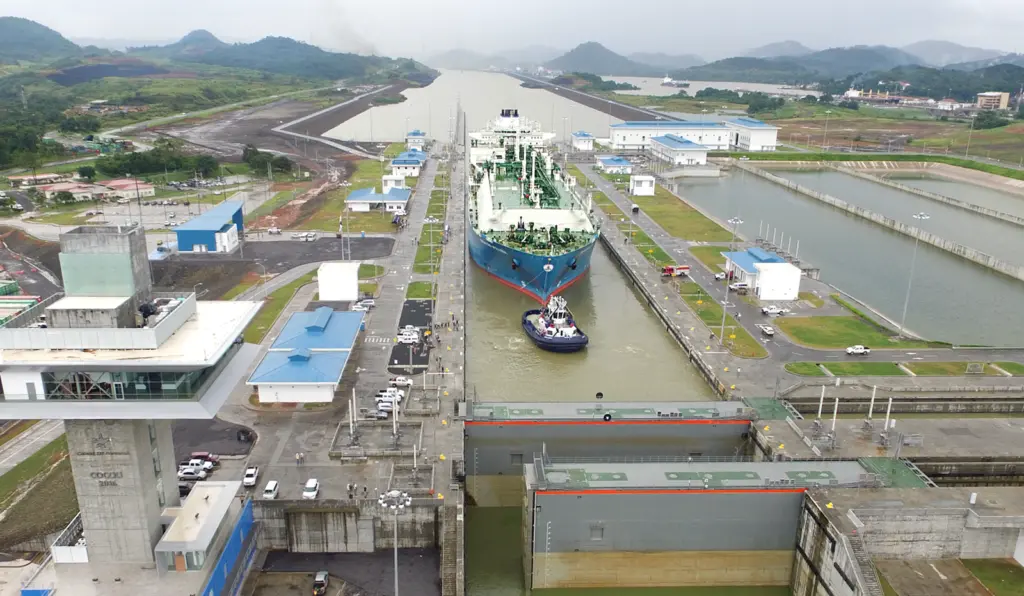
The expanded Panama Canal was inaugurated on June 26 with much fanfare as the neo-panamax COSCO Shipping Panama passed through the new locks. By August 1, 68 transits had taken place, made up of 39 containerships, 24 liquefied petroleum gas tankers, three car carriers and two liquefied natural gas carriers
After years of delays, the Canal expansion can at last be celebrated by the long-suffering Panama Canal Authority (ACP). Vice president of planning and business development, Oscar Bazán points out that the expansion is the largest enhancement project since the Canal opened in 1914. It included the construction of a new set of locks on the Atlantic and Pacific sides of the waterway, creating a third lane of traffic, doubling the cargo capacity of the waterway.
“Since neo-panamax vessels can now take advantage of the Canal’s vast benefits, new routes, liner services and other maritime changes are expected to emerge,” said Mr Bazán. “The transit of the first-ever LNG carrier, for example, which took place on July 25, has ushered in a new era for the segment and global LNG trade.” More LPG tankers are also now making use of the new locks.
“With the Expansion now open, an estimated 90% of the LNG world fleet will be able to transit the Canal, which will have a major impact on global LNG flows and offer numerous benefits to shippers, such as significant time savings,” he says.
He explains that the new Canal will now service segments that were unable to use the smaller original waterway. Previously, the largest container vessels that could transit were 4,400 teu, whereas the Canal can now accommodate ships up to 14,000 teu.
The dry bulk world is also expected to benefit, with mini-capesize bulk carriers of around 95,000 dwt expected to move grains from the US Gulf Coast to Asia.
Last but not least, larger car carriers can also transit the new locks, raising capacity from 6,000 car equivalent units (CEU) to 8,000 CEU, although Mr Bazán says that it is expected that most car carriers will continue using the original locks as there are fewer neo-panamax vessels in their global fleet.
Far-reaching
“The Expansion of the Panama Canal is expected to have an effect on entire nations’ trade patterns. Shipping lines, rails, distribution centres and ports from different regions have been preparing to take advantage of effects of the expansion since the ACP broke ground in 2007,” he says.
“Ports on the US East and Gulf Coasts, some of which only served vessels up to 9,000 teu, have adapted, and are currently adapting their infrastructure to allow even larger ships to use their facilities.”
He cites the case of PortMiami, which has made major investments over the last nine years to widen its channel in order to accommodate neo-panamax vessels, in parallel with the expansion.
Similarly, ports of the east and west coasts of Central and South America are preparing or have prepared to keep, or even increase, their share of the commercial trade to take advantage of the expanded Panama Canal.
Many liner services, notes Mr Bazán, have already taken advantage of Panama’s ports, which are strategically located at the entrance of the Panama Canal, both in the Caribbean and the Pacific Ocean.
In the specific case of the ports in the Caribbean, ships from 8,000 teu to 9,000 teu transiting the expanded Canal have called at ports in Freeport, Bahamas; Cartagena, Colombia; as well as Manzanillo and Cristóbal in Panama.
“Based on that, we can conclude that changes in the patterns of trade and transhipment will continue developing gradually, although the real impact of the expansion will be measured more accurately in the coming years. It is indisputable that the inauguration of the third set of locks is not only impacting Panama, but also to countries that are the source and destination of cargo transiting the waterway, lowering the unit transport costs of goods and generating more business opportunities related to cargo handling and the ability to add value to this in its transhipment point,” notes Mr Bazán.
Asked about the projected rival canal project mooted by neighbouring Nicaragua, Mr Bazán suggests that any infrastructure and transport project would be beneficial to the region, because it would increase its competitiveness.
Nevertheless, he notes: “The Panama Canal is well-positioned to continue to capitalise on its privileged geographic location through strategic planning, exemplary customer service, dedicated employees, world-class management and continual investment for decades to come.”
Win some, lose some
Although many ports in Central America are trying to cash in on the opening of the expanded Canal, not all are doing so successfully.
In Guatemala, for example, Quetzal Container Terminal (TCQ) has been at the centre of a serious financial scandal.
Earlier this year, the Guatemalan government announced that it was investigating bribes worth $30m associated with the project, $24m of which were allegedly paid to local officials by representatives of the Barcelona-based TCB group, which had originally been awarded the original $255m concession. Not only are former TCB employees implicated, but also the former vice-president Roxana Baldetti and Guatemala’s previous president Otto Pérez.
APM Terminals, which acquired TCQ from TCB on March 6, 2016, did not identify the anomalous payments when it sent its external advisors into TCB as part of due diligence. However, it is now offering to pay the state of Guatemala $43.2m in civil damages as the result of irregularities that have subsequently come to light. In addition, it has agreed to annul the original contract and sign a new one, which will have to be approved by both Congress and the Attorney General.
“We are hopeful that the authorities accept the terms of the proposal, so we can reach an agreement to start operating this much-needed modern Pacific Ocean gateway terminal, which is important to Guatemala’s economic growth and competitiveness and alleviates the current port congestion,” says Susanne Marston, vice-president of APM Terminals.
The company emphasises that it is not in any way associated with any allegations of corruption, which have prompted an internal investigation.
“We appreciate it has been acknowledged that APM Terminals did not participate in any of the wrongdoings. We are committed to take economic and moral responsibility in this case,” says Ms Marston.
Better distribution
The expansion is expected to bring more traffic to the Central American region, as a higher percentage of US imports move via the US East Coast ports, rather then through more traditional US West Coast Ports.
“Panama’s Pacific coast has had ships as large as 13,000 teu call at ports there for some years now; however these do not cross the Canal,” notes a source in the region. “With the expansion, more of these should now be distributed across the region.”
All five container terminals in Panama – Balboa and PPIT on the Pacific coast and CCR, Manzanillo and Cristóbal on the Atlantic – can now accommodate these, offering draft of at least 15.2 metres. Studies, nevertheless, suggest there is still something of a capacity shortage, particularly at the Pacific end of the canal.
PSA’s Panama International Terminal (PPIT), which currently receives calls from vessels of up to 9,000 teu, is implementing a Phase 2 expansion designed to boost the upper limit to 18,000 teu, as well as increasi ng its own capacity from 450,000 teu to 2m teu by mid-2017.
When the upgrade is complete, it will feature 1,140 metres of berth with alongside draft of 16.3 metres, which will be equipped with 11 quay crane s, i ncluding 24-row outreach unit s capable of handling n eo-panamax ships. Asked what impact the opening of the new locks on the Panama Canal would have on Panama Ports Company’s (PPC) two Panamanian terminals at Balboa and Cristóbal, commercial director Edgar Pineda notes that the Pacific terminal of Balboa already gets a lot of deep-sea container vessel traffic.
Total volume
“With the Canal expansion, these ships will pass directly through the Canal to a port that is closer to their final destination. In this scenario, volume will decrease at Pacific ports, but increase at those in the Atlantic, though this will probably not affect the total volume in Panama as a whole. Indeed, we don’t predict a notable increase in cargo movement in Panama, although it will continue as regional leader in the transfer of cargo.”
As for the deployment of larger vessels, he notes that a lot of cargo is a currently being transhipped on the Pacific coast of Panama, from the west coast of South America to the east coast of the US.
“With the expanded channel, we could see a decrease in the transhipment volume currently handled in Panama,” Mr Pineda says.
“Nevertheless, at PPC, we trust that volumes will keep growing at the annual rate of 5% as predicted by most important financial analysts. We are prepared for this, since we are the best equipped terminal in Latin America and have sufficient capacity in our stacking yards,” he says.
In 2015, Balboa port handled 3.8m teu, although it has an annual capacity of 4m teu. Meanwhile, Cristóbal port registered throughput of 812,783 teu, although could handle up to 2m teu.
“In 2015, we inaugurated expansion at Balboa, which was the result of a $25m investment, increasing the port’s total capacity to over 78,000 teu,” he says. “Now, Panama’s Pacific ports have enough capacity to handle the existing cargo in the region. Together, PPC and PPIT have a combined 5.5m teu capacity.”
According to Mr Pineda, PPC is working on its new ‘Park Garage’ project, which aims to optimise storage areas to allow it to further increase storage capacity, giving it opportunities to get into new markets
MAKING PREPARATIONS FOR FUTURE GROWTH
During upgrade work on the Panama Canal, many regional ports invested heavily to ensure that they could accommodate neo-panamax tonnage, which essentially meant deepening draft to around 15 metres.
Ports now equipped include Cartagena, in Colombia; Manzanillo, Lázaro Cárdenas and Veracruz, in México; Caucedo, in the Dominican Republic; and even Santos in Brazil. Cartagena, which was one of the first to handle this new class of vessel, invested around $1bn, essentially on dredging the access canal and acquiring five larger quayside gantry cranes, bringing the overall complement to 16. The forecast is that, for 2017, it will handle around 5m teu, thanks to weekly calls of 15-19 neo-panamax vessels. This represents annual growth of 12%.
However, some ports in the region have yet to complete infrastructure investment and lack the draft to receive larger ships, for example Guayaquil, in Ecuador, where current draft is just 9.6 metres, and the main Chilean port of Valparaíso, which offers up to 12 metres. However, DP World’s new Posorja development at Guayaquil should eventually address the draft problem, while a wholly new deep-water port is definitely part of the Chilean government’s mid-term plans.
TAKING WATER RESTRICTIONS IN THEIR STRIDE
In order to maintain the Panama Canal Watershed and water levels of the waterway, the expanded Panama Canal features 18 massive, state-of-the-art water-savings basins that recycle 60% of the water used per lockage. While the expanded locks are 70 feet wider and 18 feet deeper than those in the original Canal, they use 7% less water per lockage.
In the case of a drought, caused by inclement weather, the Panama Canal issues periodic draft restrictions. These temporary and preventative measures are taken to ensure the continuous and safe operation of the Canal, and they are put in place until the water level of Gatún Lake returns to normal.
Asked about El Niño-linked draft limitations, Panama Ports Company’s commercial director Edgar Pineda points out that these tend to cause water levels to drop in the Gatún and Alajuela lakes, which supply water to the Panama Canal.
Recently, these have been very low, prompting decreases of between 11.8 metres (39 feet) and 11.7 metres (38.5 feet).
“The restriction on vessel draft obliges ships to travel with a thousand ton reduction in cargo to ensure safe passage. However, this restriction will not affect the volume of cargo entering the country, because when a vessel comes to Panama, it has to offload cargo in ports on the Atlantic or the Pacific, and it is these ports that generate transhipment traffic. As a result, irrespective of water levels in the Canal, the amount of containers arriving in Panama is unaffected,” says Mr Pineda.
Related Articles
 SOUTH AMERICA
 PORT & TERMINAL NEWS
 PORT & TERMINAL NEWS