

Back to the future
Big name suppliers to the port industry are adopting business models and working alliances to enhance development of product ranges and service packages. It’s a well-used and successful strategy, as AJ Keyes reveals in conjunction with Kalmar and Konecranes
“To improve is to change; to be perfect is to change often,” said Winston Churchill. This is a quote that is certainly applicable to two major port industry suppliers, Kalmar and Konecranes.
These two companies have continued to develop new product ranges and service packages by adopting similar strategies based on:
• Developing and adapting business models – structural company changes to better position themselves for the future.
• Leadership changes – different approaches and focus.
• Working alliances – linking up with other companies in a product development context and/or offering an expanded product range and service package.
Table 1 offers an historical summary of the historic development of these two leading port industry suppliers. A clear approach has been taken by both companies involving long-term and continued geographic expansion and product development, as well as regular merger and acquisition activity.
| Kalmar – history dates back to 1940s Finland and Lidhults Mekaniska Verkstad (LMV) | Konecranes – history dates back to 1910 when electrical repair shop, KONE, founded |
|---|---|
| 1974 – LMV acquired by the state-owned company Kalmar Verkstad AB, | 1933 – starts to build Electric Overhead Traveling Cranes for pulp & paper cargoes |
| 1976 – first container straddle carrier prototypes introduced | 1936 – starts to manufacture Electric Wire Rope Hoists |
| 1980 – introduced first electric forklift | 1962 – first crane Preventive Maintenance Contract is signed |
| 1985 – first prototype reachstacker | 1973 – begins to expand internationally and makes an acquisition in Norway (Wisbech-Refsum) |
| 2000 – acquired Swedish container spreader manufacturer, Bromma | 1983 – established foothold in the U.S. through R&M Materials Handling in Springfield, Ohio |
| 2001 – purchased Dutch ship-to-shore crane and straddle carrier manufacturer Nelcon, plus maintenance company Groot-Hensen | 1988 – crane operations are put into the KONE Cranes Division – focus on establishing technical leadership increases |
| 2002 – Finnish lift and escalator company Kone acquired all shares of Partek. | 1994 – Konecranes is formed via the listing of KONE Corporation on the Helsinki Stock Exchange (and on Helsinki Stock Exchange in 1996) |
| 2005 – restructure of material handling businesses into Cargotec Corporation (of Kalmar, Hiab and MacGregor) | 2000 – launches a new CXT wire rope hoist for up to 80t lifting capacity range that immediately becomes an industry benchmark worldwide |
| 2005 – first fully automated straddle carrier terminal in Brisbane, Australia, (equipped with the Kalmar AutoStrad™ system) and established manufacturing plant in Shanghai, China. | 2002 – enters Chinese and Japanese markets |
| 2011 – acquired the US-based terminal operating systems provider Navis, which was part of Kalmar until 2021. | 2004 – reachstackers and lift trucks are added to the product range through the acquisition of SMV Lifttrucks AB of Markaryd, Sweden |
| 2021 – Kalmar launched its fully electric portfolio | 2006 – MMH Holdings, Inc acquired and expands its product range |
| 2022 – exited heavy cranes business (passed to Rainbow Industries Co. Ltd. (RIC) – shift of focus to current portfolio | 2007 – strengthens its position in the machine tool service (MTS) business by acquiring Kongsberg Automation AS in Norway and Reftele Maskinservice AB in Sweden |
| 2023 – introduced the Electric Straddle Carrier Charge Family, which includes battery technologies, charging solutions, and software to support straddle carrier operators in their transition towards decarbonised operations. | 2009 – introduces an industry shaping industrial crane, SMARTON®, which can reduce power consumption and energy costs by up to one third |
| 2023 – confirms a new partnership with CES Srl, an Italian manufacturer of super-sized heavy-duty material handling equipment. | 2011 – buys WMI Cranes Ltd. (WMI) to strengthen its position in India & first TRUCONNECT® remote services products launched |
| 2024 – signed a joint development agreement for autonomous terminal tractor solutions with Forterra (formerly RRAI). | 2013 – launches Agilon, a materials management solution for managing, storing, picking and replenishing components in manufacturing & presents the world’s first hybrid reachstacker for container handling |
| 2024 – Kalmar listed on Nasdaq Helsinki after demerging from Cargotec | 2017 – grows significantly by buying Terex’s Material Handling & Port Solutions business |
| 2019 – reinforces its lifting leadership by launching three new products: the S-, M- and C-series | |
| 2023 – announces a refreshed purpose, ambition and financial targets | |
| 2024 – acquired the business of German crane and service supplier Kocks Kranbau, | |
| 2024 – establishing a network of partners to build a full range of port cranes in the US to satisfy domestic manufacturing criteria including “Build America Buy America” (BABA) requirements. |
IF IT AIN’T BROKE…
So, what are these two companies currently doing to support their future aims and objectives? Well, more of the same and as the old saying goes, “if it ain’t broke, don’t fix it.”
The following represents highlights of selected Kalmar partnerships and new offerings to the container handling industry:
- In May 2024, Kalmar announced planned changes to its leadership team, which were further advanced in October 2024. The aim is to deliver faster decision-making, supply chain and process optimisation together with clear end-to-end responsibilities to bring efficiencies, reduce complexity and enhance competitiveness as well as quality. This will allow Kalmar to invest in sustainable innovations and make better use of growth opportunities as part of gaining €50 million gross efficiency improvements and reaching a 15% comparable operating profit margin target by 2028.
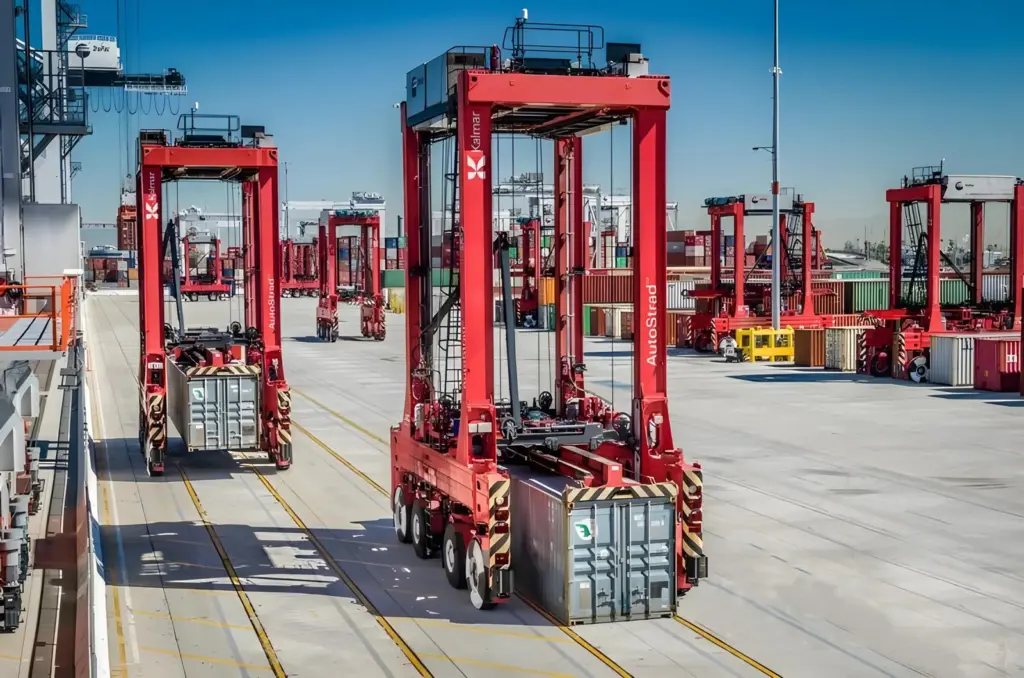
- There is an ongoing joint-venture collaboration with Nokia supporting new solutions for port and terminal operators to further automate operations and improve productivity. Previously, Kalmar incorporated Nokia 4G and 5G private wireless and digital platform into straddle carriers, automated stacking carriers and rubber-tyred gantry cranes.
- Earlier in 2024, Kalmar signed a joint development agreement for autonomous terminal tractor solutions with Forterra (formerly RRAI). Kalmar will be responsible for developing the automation-ready terminal tractor (with the Kalmar One fleet management system), with Forterra responsible for the integration of its AutoDrive platform for autonomous operations for the terminal tractor.
- In Q3 2024, a new partnership was confirmed with CES Srl, an Italian manufacturer of super-sized heavy-duty material handling equipment. The deal encompasses the distribution and servicing of CES reachstacker units, which are over 125 tons, on a global basis. Until this new arrangement, Kalmar’s reachstackers were limited to a 125-ton capacity upper limit. As part of the agreement, Kalmar will also provide training and support to its customers on CES products.
It is a similar story for Konecranes too, with its range of initiatives with recent highlights including:
- As of January 1, 2025, the company is amending its operating model to support “strategy deployment and growth ambitions” to have three Business Areas: Industrial Service, Industrial Equipment and Port Solutions, instead of the current two, Industrial Service and Equipment, and Port Solutions. This change does not impact any financial reporting, as the three Business Areas currently are separate reporting segments because Konecranes combined Industrial Service and Equipment into one Business Area under same leadership in 2022. Since then, the company’s industrial business model has been simplified and harmonised.
“For over two years, we have successfully managed the Industrial Service and Equipment Business Area as one unified entity. This has allowed us to effectively simplify our Industrial go-to-market model and harmonise our product offering, and we feel that we have largely reached the benefits we were seeking when combining the businesses. As we expect our business to grow, we want to ensure that we have the right operating model in place to support our growth ambitions especially in Industrial Service,” says Anders Svensson, President and CEO of Konecranes.
- In mid-October 2024 Konecranes acquired Rotterdam-based Peinemann Port Services BV and Peinemann Container Handling BV. Peinemann is a significant port services provider in the Netherlands with a wide customer base, and it has long-term maintenance relationships with several of Konecranes’ key customers. The turnover of the businesses being acquired was over €40 million in 2023, with its 100 employees joining Konecranes once the deal is closed in Q4 2024. Peinemann Container Handling BV has been a Konecranes Lift Trucks distributor in the Netherlands since 2009 and been in the sales, rental and service business of lift trucks in the Rotterdam area since 1954. The value of the acquisition is not being disclosed.
“This agreement gives us the chance to further expand our services and equipment offering in the Netherlands and, with the new sales channels the Peinemann businesses will accelerate our plans to transition to battery-powered electric vehicles in a critical market,” stated Andreas Falk, SVP Lift Trucks, Konecranes.
LOCAL INNOVATIONS INTO GLOBAL PRODUCTS
Kalmar was listed on Nasdaq Helsinki on 1 July 2024, following the demerger from Cargotec. The company has a clear mandate combining sustainable material handling around the world, with a strong focus on electrification across its equipment range and increasing lifetime value as well as maximising uptime through a global services network. As the company itself states, “Kalmar’s story has been built on local innovations that have evolved into global products.”
In its interim report, January-September 2024 Konecranes confirmed that “global container throughput continues on a high level, and long-term prospects related to global container handling remain good overall.” The company is predicting a healthy industry position and using its ongoing strategy, which builds on a continued familiar approach, the future is bright, as long as it continues to evolve and maximise partnership opportunities.
Related Articles
 OPERATIONS
 OPERATIONS
 OPERATIONS