

Chancay takes shape
Rob Ward runs the rule over progress with the mammoth China-backed Chancay port project and the competitive implications
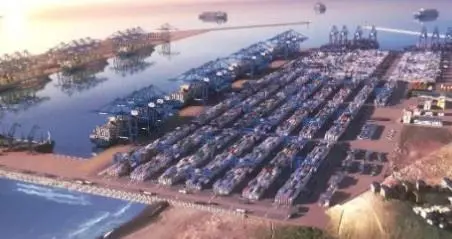
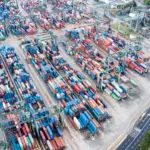
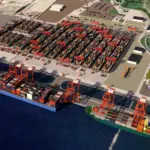
After years of huffing and puffing, and competitors asking, “Will they or won’t they?”, the Chinese state-owned conglomerate Cosco Shipping Holdings is finally building – almost from scratch – a US$3billion deep-water port which aims to become THE hub port for all West Coast South America.
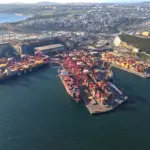
Congestion in the key port of Callao, just 55 km to the south, is one of the driving forces of the Chancay project which at full build-out will comprise 11 container berths, to serve up to Triple E size ships, and four more berths for other cargo. Also identified as a main development catalyst is the desire of the Chinese government to crack on with its Silk Road initiative in Latin America, and especially in Peru, which is one of Beijing’s principal trade partners in the region.
Phase one alone of Chancay project will add one million TEU and six million tons of general and bulk annual cargo capacity to the Peruvian port network.
After a tortuous tender process, China Communications Construction (CCCC) company and China Railway Group won the right to put Chinese state-owned conglomerates, along with Volcan (a Peruvian mining group, owned by Swiss trading group Glencore, with a 40 per cent share, after selling the rest to the Chinese for $225million) at the front of the race to develop South American transport infrastructure. Together, the bid winners appointed China Harbour Engineering Company – CHEC (which also owns TCP in Paranagua, Brazil) to build the huge 141-ha complex.
CHINA INC.
So, why China and why now?
Well, China has been steadily building its relationship with Latin American countries and none more so than Peru. Trade between the two countries totalled close to US$40 billion in 2021, of which 66 per cent was Peruvian exports to China.
Peru is one of the few countries in the world – regional giant Brazil is another – which actually has a trade surplus with Beijing. Key exports include copper, which initially won’t be exiting via Chancay, fish, fertilisers and various fruit and vegetables (including avocados, grapes and blueberries).
Since Peru and China signed a Free Trade Agreement back in 2010, overall trade has doubled and it is nine times more than 2005 when China first started focusing on increasing ties with Peru. In 2014 China overtook the US as Peru’s top trading partner, both for imports and exports.
CAPACITY AND COMPLEXITY
Various eye-witnesses report that several of the Chancay infrastructure projects have been completed and others are progressing well – including an 1.8km tunnel to bypass the town of Chancay – and it seems now that the only factor that might slow down an opening up for business, by early 2024 or even late 2023 according to some parties, is Peru’s “very complicated politics”.
“We urgently need the capacity at Chancay, which will have 16m depth and be able to handle the next generation of box-ships coming to WCSA such as the Triple-E type ships, but I fear that our very messy politics might yet delay matters,” states one Lima-based shipping agent who spoke under condition of anonymity. He was, of course, referring to the fact that Peru’s leftist president, Pedro Castillo, is being investigated for corruption having survived two impeachment calls. He has already gone through dozens of ministers in his short, one year, tenure so far, and he himself is the fifth president in five years!
Other voices – including IntelligenceOnline.com (IO), a Paris-based research company – believe that the opposite is true: that the political turmoil is allowing China to use its close ties with the Peruvian military, which hasn’t seen such changes in personnel, to keep the Chancay project rolling forward, albeit a little behind schedule. IO points to the fact Gonzalo Rios and Carlos Tejada, former Peruvian Navy commanders, and Jason Guillen, ex head of logistics for the Peruvian Navy, are working for Cosco on the Chancay project, and smoothing the path regarding environmental and operating licenses.
A small semi-portable village has been set up outside the town of Chancay to house the thousands of workers who are already breaking up rock and re-arranging the landscape for new roads to be built, including a 1.8km “ultra-high” tunnel that is being gouged out of the Andes foothills. It will be used exclusively for trucks and other port traffic.
Although Cosco operates in 35 ports worldwide, Chancay will be the state-owned company’s first foray into South America, and one shipping agent believes the first service it will switch away from Callao will be the WCSA to Far East service, including CMA CGM, Evergreen, OOCL and PIL; possibly as early as the winter months of 2023.
“Peru’s ‘most favoured partner in South America’ status with China will certainly pay off for both sides once Chancay is completed and Cosco start expanding their services,” underlines one optimistic shipping agent based in Callao.
Related Articles
 OPERATIONS
 OPERATIONS
 OPERATIONS