



Kazakhstan looks west
Kazakhstan is looking to consolidate its niche position as an exporter of steam coal to the EU. As Oleksandr Gavrylyuk reports, establishing a secure route to market is key to this
Kazakhstan, the Central Asian largest country, has doubled monthly exports of its steam coal to the EU, from 200,000 tonnes per month before the Kremlin’s invasion of Ukraine, in late February this year, up to 400,000 tonnes after it, as per Eurostat data. In the first five months of this year, the Asian nation supplied more than 1.6 million tonnes of the fossil fuel to the EU, almost twice the entire 2021 volume.”
Semi-landlocked Kazakhstan has traditionally delivered its commodities to Europe via Russia. Thus, during the first five months of 2022, the bulk of the country’s westbound coal exports, 782.000 tonnes (as compared to 240,000 tonnes during the 12 months of 2021), were first railed through the Russian territory to the eastern shore of the Baltic Sea and then shipped to the EU.
The second largest amount, 635,000 tonnes (versus 540,000 tonnes in the course of 2021) was transported solely by rail through Russia, Belarus and Poland. Seemingly quite simple and straightforward, however, this method has a big drawback, namely the necessity to switch from the Russian (1520mm) to the European (1435mm) track gauge at the Belarusian-Polish border stations.
Finally, the smallest volume, 90,000 tonnes (as opposed to 8200 tonnes in 2021) was hauled to Germany by trucks. Being the most expensive option, this is only taken up on a limited basis.
The usage of the Black Sea harbours was impossible during the period due to the Russian navy impeding international commercial navigation in the region. Furthermore, many Russian coal producers hold stakes in their home country’s port terminals and thus can, according to Nikolay Radostovets, Head of Kazakhstan’s Association of Mining and Metallurgical Enterprises, influence the handling arrangements to the detriment of the Kazakhstan’s exporters.
This situation has pushed Kazakhstan into closer cooperation with the Baltic States’ harbours, which are ready to handle coal, grain and other Central Asian cargoes in growing volumes.
Thus, last autumn, Kazakhstan resumed its coal deliveries to the Latvian ports of Riga, Ventspils and Liepaja after a long pause, during which it used Russian Baltic harbours.
Also looking to capitalise on the opportunity, Eesti Raudtee, Estonia’s national railway operator, voiced its willingness to offer a preferential rate (equal to that in neighbouring Latvia) to Kazakh coal exporters, in order to attract their cargo to the Baltic country’s dedicated marine terminals at Muuga and Sillamae.
POTENTIAL AND PROBLEMS
Kazakhstan can export up to 30 million tonnes of coal and 10 million tonnes of grain and flour each year, according to its Prime Minister Alikhan Smailov. Therefore, expanding its westbound exports would be a logical and reasonable step in the current global environment of soaring demand for and slumping supply of commodities.
However, Moscow’s continuous attempts to dictate terms to Kazakhstan are making the transit of cargoes via its territory increasingly problematic. For example, the Kremlin has been hampering Kazakhstan’s coal exports to Ukraine and restricting its grain supplies to global markets.
“This is not in compliance with the spirit of the Common Economic Space with Russia and Belarus [launched on 1 January 2012]. This is to be able to take advantage of these countries’ transit potential, to get access to the sea,” complains Nikolay Radostovets.
In addition, using Russia’s rail network implies growing technical and legal risks for the Central Asian nation in view of the sanctions imposed on Moscow by the EU.
Under the circumstances, Kazakhstan, a Caspian Sea littoral country, has been compelled to look for alternatives. The main option is to focus on developing its export traffic through the Trans-Caspian International Transport Route (TITR). Also known as the Middle Corridor, TITR travels through China, Kazakhstan, the Caspian Sea, Azerbaijan, Georgia, and further to Turkey and Europe, in such a way totally bypassing Russia.
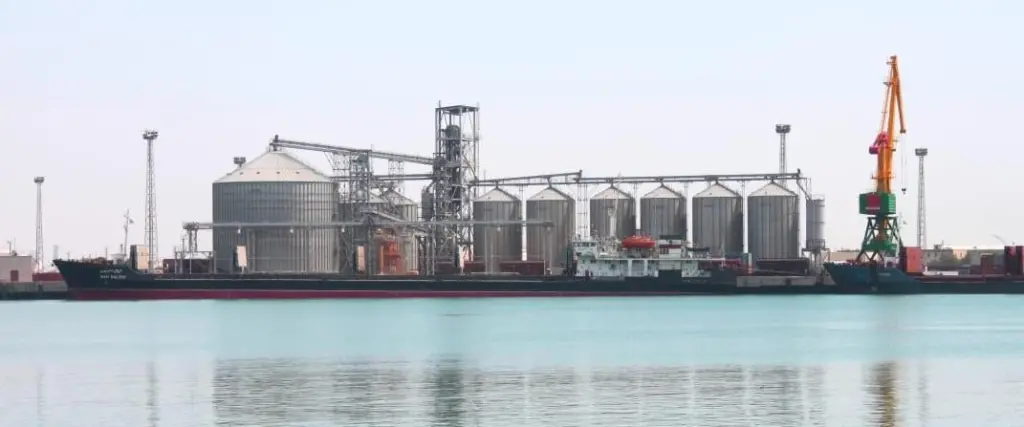
Kazakhstan has already been intensively developing its Caspian ports of Aktau and Kuryk. Aktau has seen berth redevelopment along a 550m quay with capacity provided for the handling of bulk goods including grain and general cargoes. Kuryk has so far pitched itself more at multimodal, ferry and liquids traffic but does have large land areas available for new developments.
Related Articles
 OPERATIONS
 OPERATIONS
 OPERATIONS