



More Capacity Required
Will there be sufficient container port capacity developed in the North Atlantic region moving forward? Are intermodal rail capabilities at the region’s ports effectively competing with facilities elsewhere? These two key questions are addressed by AJ Keyes
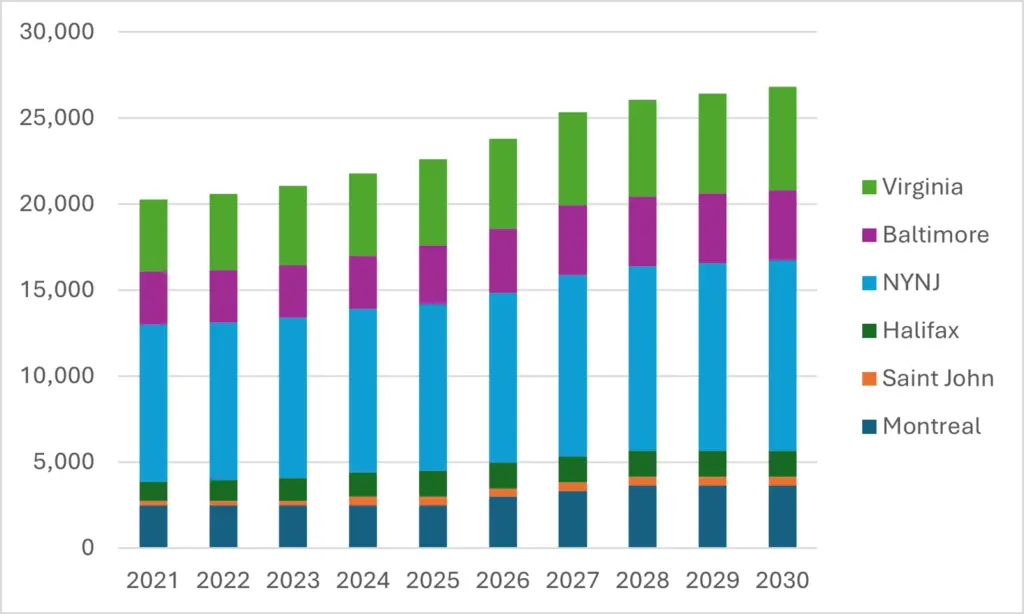
There are a range of confirmed expansion plans at existing ports in the North Atlantic region of North America. As part of these developments, intermodal rail is a key part of the service offering – but is sufficient capacity being developed and what markets will be served?
In terms of existing ports with investment plans related to additional capacity, the following summary for each project can be noted:
Montreal:
- The Port Authority has long-standing plans to develop a new container terminal at Contrecoeur, a location approximately 25 nautical miles towards open sea from the existing port. There is 468ha of land and 4km of shoreline available.
- Two phases of development are planned. Phase 1 expects to offer 0.47 million TEU of annual capacity, with Phase 2 increasing the total to 1.15 million TEU per annum. Current estimates provide for operations to commence in late 2026 (which has slipped from the previously planned start date of 2023, with full build out before 2030 – assuming current timescales are maintained and rising construction costs (from C$950m to C$1.4bn) are met.
- The planned layout will consist of two berths and a container handling area, an intermodal rail yard connected to the main network and a truck entry portal connected to the road network.
- The Port Authority does not currently view Contrecoeur as a development for the relocation of existing container business but as the long-term solution to future capacity demand for the port overall.
Saint John (NB):
- This port is a key part of the critical transportation infrastructure of Canada and a cornerstone of the New Brunswick economy – investment has been undertaken to improve the overall competitiveness of the facility, from both the marine and terminal perspectives.
- The terminal covers 82 acres and has recently completed a largescale modernisation programme, which operator, DP World Canada, confirms includes the following:
- New 345m berth, with a draft of 17.1m
- Two additional Post-Panamax cranes
- The ability to handle ships in the 10,000 TEU – 14,000 TEU size range
- The C$205 million modernisation project, completed for the start of 2024, entailed a three-way partnership between the Government of Canada, the Province of New Brunswick and Port Saint John.
Halifax:
- At the end of 2023, PSA Halifax unloaded two new Ship-to-Shore (STS) cranes for its Atlantic Hub terminal at the south end of the port.
- This new equipment is playing an important role in expanding PSA Halifax’s capacity from 1.1 to 1.4million TEU by the end of 2024.
- “With an outreach of 24 container rows wide and a lift height of 52 meters above ground, the new STS cranes will add significant muscle and capacity to Atlantic Hub,” said Jan Van Mossevelde, CEO of PSA Halifax. “We will now have three STS cranes that are fully capable of handling vessels larger than 20,000 TEUs in size with no limitations. This means higher vessel productivity and faster turnaround times for mega vessels.”
- Sparrows Point Container Terminal is a proposed, a 330-acre redevelopment project within Sparrows Point, Maryland consisting of 168 acres for a new container terminal and intermodal yard, with an additional 162 acres for support facilities to complement the operations of the terminal.
New York / New Jersey:
- As the largest volume port on the US East Coast and serving a local population of 27 million people, and over 60 million inhabitants within a 250-mile radius. Consequently, this port must continue to add capacity to keep pace with demand.
- There are several ongoing, short-term, expansion projects at the port:
- The addition of 1.8 million TEU of additional capacity at GCT USA facilities between 2023 and 2033, generated through doubling the capacity in Bayonne (while also enabling ships up to 22,000 TEU to call from the current maximum size of 18,000 TEU) and raising NYCT facility capacity by 65% – according to CMA CGM.
- A further 500,000 TEU of new space at PNCT from 2027.
Baltimore:
- This new facility will add one million TEU of annual capacity from 2028 (with construction occurring between 2025-2027) and then a second phase of the same amount in 2034.
- This project is a joint venture between Tradepoint Atlantic and Terminal Investment Limited (TiL) and represents a major growth opportunity for the State of Maryland and the Baltimore region.
Virginia:
- Virginia International Gateway (VIG) recently expanded to 2.2 million TEU capacity and has scope to increase further to four million TEU per annum, if required.
- For the longer-term, the port authority could eventually develop the five million TEU per annum Craney Island site. This very long-standing projects has slipped back and is not expected to be operational during the current decade.
- Modernisation plans at Norfolk International Terminal (NIT), with 36 new automated stacking cranes ordered as part of raising the North Berth capacity to 1.4 million TEU per annum by 2027, which ensures 3.6 million TEU is available when combined with the South Berth.
The impact of these various port expansion plans is summarised in Figure 1. Capacity in 2021, of around 20.3 million TEU will surpass 26.8 million TEU by 2030 – growth of 3.2% per annum. This is only slightly below the long-term regional growth of total port throughput of 3.7%.
Related Articles
 OPERATIONS
 OPERATIONS
 OPERATIONS