



Shortsea renaissance
With uncertainties over the vector of deepsea container flows in the wake of political upheavals, the emphasis is increasingly focusing on shortsea shipping. How will this develop and what are the key issues for maximising demand? Andrew Penfold takes a look…
Shortsea shipping has been the poor relation of the container trades for many years but shifts at the macro level – political and environmental – are increasingly focusing attention on this sector. Of course, by definition, shortsea markets are local and factors impacting on the European trades may not be directly replicated in other major regions. Despite this, certain key trends are emerging that will shape the future markets. There are major barriers to maximising demand, however.
DIFFERENTATION
When analysing shortsea flows, it is vital to differentiate between feeder containers and direct intra-regional flows. Feeder operators are extensions of the deepsea players and will always wait for the arrival of the deepsea vessel if there is a service delay. This places pressure on schedules, with the feeder operator having little direct influence over schedule reliability. On the other hand, lines and shippers focusing on direct intra-regional flows will be primarily competing with efficient ro-ro ferry services where regularity of service and minimised journey times (along with costs) are the key drivers of market share.
Several operators have sought to combine these market sectors – a superficially attractive idea – but have repeatedly seen uncertain volumes and forced reliance on lower value commodities in the intra-regional container trades where time pressures are not so acute.
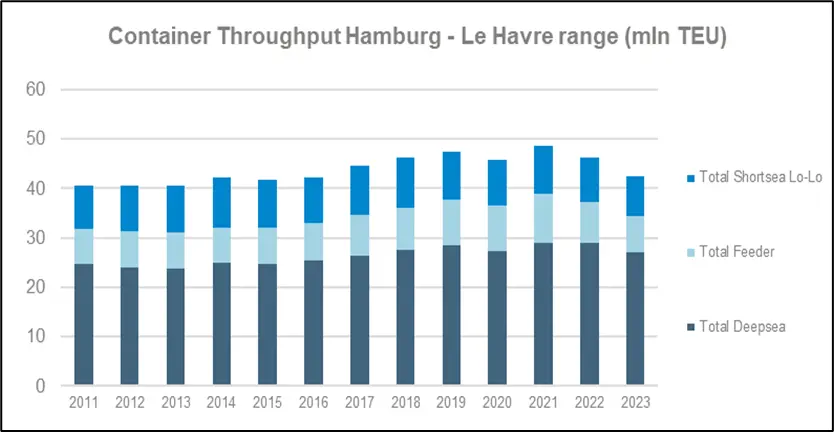
Figure 1 summarises the split in container traffic by type in the Hamburg-Le Havre range in the period between 2011 and 2023. Up to 2020 container demand growth was largely funded by transshipment, with shortsea traffic restricted by the pace of globalisation and (in the European market) by the post-Brexit slowdown. There is, however, currently renewed interest for shortsea demand. Generally, lo-lo suffered in 2022 and 2023 as a result of Russian volumes dropping out, macro-economic uncertainty and destocking.
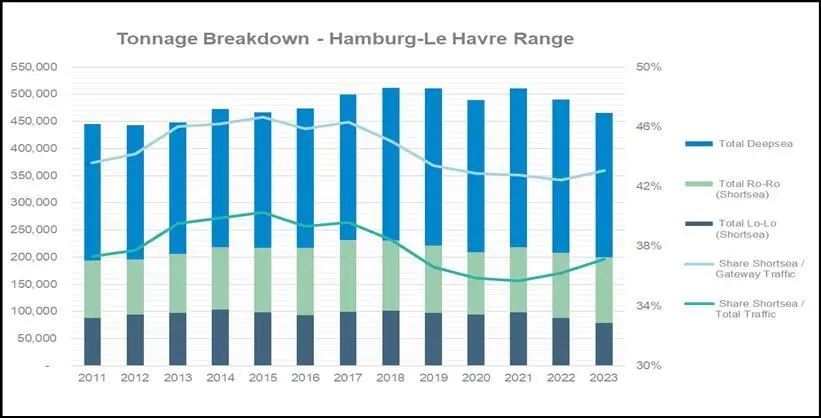
The role of Ro-ro is further summarised in Figure 2. Total shortsea volumes were squeezed as globalisation went from strength to strength prior to 2018 but this downward trend was reversed temporarily during the Pandemic. In 2022 and 2023 the share declined because of Russian lo-lo volumes dropping out, but ro-ro trades with the UK remained stable. The share of shortsea is, however, now picking up again and this is expected to continue as a result of renewed interest in diversified and shorter supply chains and improving trade relations between the UK and Europe.
The last two years have seen surprisingly strong shortsea demand in NW Europe. For example, at Rotterdam the increase in ro-ro traffic has more than compensated for the loss of in Russian trade.
So, the picture is complex but new trends are emerging. How can these be maximised?
CRITERIA FOR SUCCESS
At the centre of market positioning for successful shortsea development – be it for terminals, shipping lines or forwarders – is the acceptance that this is a highly competitive market. Shortsea container operations represent a single link in a supply chain where existing ro-ro operators already offer a very efficient and reliable service. A terminal operator developing in this sector must focus attention on key deliverables:
- Offering competitive facilities. It is vital to provide port and terminal facilities that are suitable for current and future needs. This means berthing the vessels that are currently required and that will be a feature in the coming years. Here, the focus will increasingly be on the size of feeder vessels deployed.
- Moving towards long term commitments from customers. The more that long-term contracts that are entered into – with both lines and cargo owners – will be a critical mark of success. The fixing of durable contracts in a highly structured market will add comfort for volumes and expansion investment.
- Effective transport costs. Of course, this is a critical test. For shortsea Lo-lo operators the key competition will be with accompanied and unaccompanied ro-ro ferries. In contrast to deepsea/feeder shipping the margins are very tight in the shortsea markets, with the build-up of inland delivery, port/shipping costs and final delivery often resulting in very limited differentials. When inventory costs are factored-into the equation then delivery time becomes a key competitive factor. Generally speaking, containerisation can offer a cheaper transport cost but usually loses out on delivery times and flexibility. The cost differential in the UK (for example) can be very limited at 15-20 per cent between higher cost-ro-ro and shortsea containers. There is little that the terminal operator or line can do to overcome this situation, but it underlines the narrowness of the market, with some cargo owners preferring to pay more for ferry flexibility.
- Investment in supporting infrastructure. As a shortsea terminal operator there is a great temptation to invest in supporting infrastructure – for example, barge lines, trucking or other shortsea terminals. As part of a ‘one stop shop’ strategy this can make sense, with the terminal offering a single transport solution, for example, between the Ruhr and Manchester. However, margins can be very slim for these projects and the amount of potential management time required for marginal gains can be excessive. Detailed analysis of the synergies available from these options is essential.
- Focus on attracting industry related investment to (or near) the port estate. Successful shortsea terminal operators have focused on locking-in major customers by assisting with on, or near, dock investments. This ‘Port Centric’ approach is well suited to the shortsea container sector and serves to provide further certainties to volume projections – although there are always counter-party risks with such an approach. The attraction of Lidl’s UK supermarket business near to the Moerdijk terminal in Rotterdam is a good example of this strategy.
- Environmental perspective. In the current markets environmental issues are coming to the fore. The provision of environmentally friendly facilities for shortsea shipping are clearly consistent with policy developments. Shortsea terminals will offer clear advantages from this perspective versus ferry and other modes, and this will boost market share. Provision of ‘green’ bunkering facilities will further add attractiveness.
DEMAND OUTLOOK
In the short term, the first half of 2024 has been positive for shortsea flows, but as the process of restocking goods slows there will be some lower growth over the rest of the year. In the narrow NW Europe market, the modality has shifted in favour of lo-lo in the UK markets as routes to/from the north of the UK open up. In the near-term, demand will be primarily dependent upon the pace of underlying growth in the economies, but the general trend is favourable.
In the longer run the stars are aligned for stronger and sustained growth. The shift in favour of nearshoring seems certain to continue as a result of macro-economic and political shifts and this will continue to favour both ro-ro and lo-lo shortsea volumes. Any reopening of the Russian markets would provide a further upside to demand.
The situation is positive and will certainly require further investment in modern well formatted shortsea terminals. With a growth rate of 3.5-4 per cent per annum the existing (modern) shortsea terminals in NW Europe will come under capacity pressure in the medium term. This will require further investment (where space is available) and a strong focus on increasing productivity within existing port estates.
RISK FACTORS?
In contrast to many port investments around the world the downside for modernisation and expansion of shortsea capacity is limited. The key risk is at the macro-economic level. If the economies slow over a sustained period, then demand will fall back. At the same time, the formatting of the proposed investment must be very carefully considered. Any rapid increase in the size of vessels deployed on the shortsea trades could see a significant redeployment of capacity if terminals do not offer the required access capabilities.
In addition, the market is highly complex and subject to numerous policy requirements from the EU and national governments. Careful monitoring and anticipation of these issues will be vital.
TREND LINES
As the world moves in the direction of shorter supply chains and intra-regional development there will be a clear need for expanded capacity in the shortsea sector. The large deepsea terminals will not easily compete for this business and the feeder sector will remain distinct. This demand will be accelerated by modal shifts, with lo-lo and ro-ro fighting it out on the shorter haul (high volume) trades.
At the same time, it is clear that much of the shortsea fleet comprises older vessels. There will be a need not just for terminal investment but also for new vessels – optimum sizing of these units will be a major issue.
At the policy level subsidies and permitting will continue to feature, but the basic argument for this sector will remain competitive cost and service issues. Governments need to facilitate the growth in the shortsea sector to capture the benefits. This will also be essential to unlock environmental gains.
Considerable investment must be focused over the next five years, or so, to maximise the potential in this sector.
Related Articles
 OPERATIONS
 OPERATIONS
 OPERATIONS