

THE MANAUS YO-YO SPINS…
Superterminais has stepped up the battle for market share in Manaus, the Amazon port city, with the implementation of a new investment plan. Rob Ward reports
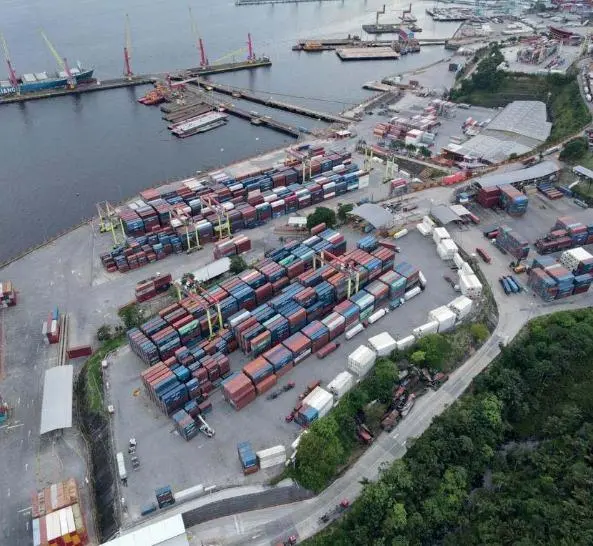
Against a background of political, covid and economic uncertainty in Brazil, and a Yo-Yo-ing rise and fall in volumes over the past decade, the Superterminais container terminal in Manaus, the city of 2.65million people in the middle of the Amazon jungle, is pushing ahead with its expansion and investment plan.
One of only two box terminals in Manaus – its bitter rival Porto Chibatão occupies the site adjacent to it – the switch of one service can have a dramatic effect on the fortunes of one or the other in the battle for market share. Overall volumes in the jungle city have fluctuated between 440,000 and 700,000 TEU over the past 10 years serving to up the competitive mix.
Management at Porto Chibatão has used a legion of lawyers over several years to try and stop the Superterminais’ expansion plan but the project was finally put into action from November of last year with final details added in recent months, according to Julio Almeida, Commercial Manager, Superterminais.
Superterminais, which handled 126,652 TEU in 2021 (about 11.93 per cent more than the previous year, according to Antaq, the Brazilian waterways regulatory body), has been an ever-present operator on the Rio Negro (which feeds into the Amazon River system) since the firm was founded back in the early 1990s.
In 2021 Porto Chibatão, part of the Grupo Chibatão transport group, handled an impressive 624,484TEU (7.21 per cent over 2020 and 83 per cent of Manaus overall volume of 751,136TEU, a record haul). Yet as recently as 2017 there was a 51.8 per cent; 49.2 per cent split, in Chibatão’s favour, with the Manaus total that year just 521,530TEU.
The Manaus Free Trade Zone (ZFM) is the engine that generates massive imports into the region, mostly of components and raw materials which are then turned into white goods, TV’s, motorcycles, etc, for re-export to the populous south of Brazil and/or other South American consumers.
SUPERTERMINAIS INVESTMENT PLAN
Superterminais has ordered three Konecranes GHPT 8500s with a boom of 74 metres, a vast improvement on the five Liebherr FCCs, which have a boom of just 37 metres and lifting capacity of 25t. It also operates Kalmar reach stackers and top loaders and handles project cargo as well as containers, with BBC Chartering a regular caller. The depth alongside is an incredible 40m during the rainy season and 25m during the so-called “dry season” [hence the need for floating pontoons], but ships are restricted to an 11.5m draft due to lesser depths downriver.
Almeida explains that Superterminais’s new cranes will be delivered in stages, with the first shipment arriving in July. He adds that the three cranes will be assembled between October and December so that they are ready to be deployed in January of next year, by which time he hopes a new service will be added to the rostrum.
“It is all part of our Reais200m (US$43m) total investment plan for new cranes, reach stackers, terminal tractors and new floating pontoons,” Almeida told Port Strategy. “It is also part of our policy to increase capacity and bring in new services,” he explained. He says that capacity will increase to around 260,000TEU per annum, and hopes that the Yo-Yo can swing back in favour of Superterminais.
Given that Superterminais does not at present have any coastal or cabotage services and its rival has several (Mercosul Line, Log-in Logistica and Alianca Navegacao), the most likely services to jump ship – from Porto Chibatão – will be those of Log-In which is now controlled by MSC Line, which participates in a weekly deep-sea service to the Far East (Via Panama) along with ONE. Mitsui OSK Line (the old MOL and part of the merged trio that form ONE), has always been the dominant player in Manaus for Far East trades, and ONE today has a weekly service to Asia, with transshipment in Panama, with MSC chartering slots.
CMA CGM and Maersk/Hamburg Sud dominate the box movements out of Porto Chibatão, the former with its Brazex service to the Caribbean with transshipment to the Far East and the latter with transshipment via Santos, using its Alianca shuttle services as a feeder.
“After a blip, four years ago, the Manaus ZFM is picking up again and container throughput is hitting record numbers,” said one veteran executive of a shipping agency with interests in the Amazonas box trades. “More capacity is needed so Superterminais’s move to add some is a shrewd one.”
Related Articles
 OPERATIONS
 OPERATIONS
 OPERATIONS