

Key Italian ports have long expressed the ambition to extend their hinterlands. AJ Keyes reviews progress, plans and what obstacles remain.
The establishment of effective and reliable rail intermodal and haulage links to/from ports to north Italy and further afield to Switzerland, Austria and South Germany offers potential for increased cargo for many Italian ports, but only if there is suitable intermodal rail.
Currently, the need to serve these more distant locations via Italian ports is paramount because the country’s own demand is insufficient due to stagnating and limited economic growth (as evidenced in the preceding article).
While this has long been a priority for the Ligurian ports in particular, there is now added impetus for the need for to reach additional discretionary markets accessed via rail, despite acknowledging that freight moving by road remains the dominant activity. Intertwined with this ambition is recognition of the need to fight back against the established trend of sizeable volumes of Asian cargo moving to Milan and Turin, for example, via transit through Rotterdam.
ROAD DOMINATES FREIGHT USE
In Italy, approximately 90 per cent of goods and passengers move by road, confirming the importance of this mode of transport to ports and cargo shippers. It is nevertheless widely recognised that limitations exist in terms of viable distances covered by truck. It is widely accepted that areas beyond 500km are more economically viable via rail, despite the fact that the environmental benefits of rail over truck kick in over shorter distances.
On a national basis, the north of Italy is the heart of the country. It is thus no surprise that the motorway system is very busy and often congested with freight trucks, due to the presence of many industrial areas, complemented by local demand from the Veneto, Emilia Romagna and Lombardy areas.
This geographical region also has a high concentration of logistics infrastructure (freight villages in Bologna, Verona, Padua, Torino and Orbassano – see Panel), linked to major ports, such as Genoa, Trieste, Venice, etc. These importexport facilities are all needed to help cargo flows, but also confirm that the shorter distances mean that it is road and not rail that is the dominant transport system.
Of course, there have been ‘bump’s in the road recently. In August 2018, a heavy storm engulfed Genoa and its port and the Morandi bridge, which crosses the Polcevera river in the centre of the city and represents a vital section of the highway system connecting France and Italy. A supporting tower and a 210m (690ft) section of the bridge were destroyed. The tragedy caused a large loss of life and subsequently impacted freight flows for two years until the replacement was constructed.
There are also impediments with regard to rail. For example, the rail from Milan to the north through the Alps carries both freight and passengers with the line only splitting before the Monte Olimpino tunnel plus there is a change in voltage at the border. Clearly, rail freight potential is restricted by capacity and efficiency, promoting freight to stay on the road.
LIMITED RAIL FREIGHT ACTIVITY
The Italian rail network consists of 24,227km of track but only 16,723km is currently active. Of this total, approximately 45 per cent (around 7505km) is double-track line and electrified. Rail freight movements in Italy currently account for just 14 per cent of total rail activity and there are long-standing investment and operating issues across the Italian rail network.
One local freight forwarder, who did not wish to be named, explains: “The better quality rail facilities are all in the north, but the high shunting costs remain a big issue for cargo wanting to move via the rail network. This is a major disincentive, especially when a marine terminal invests in good facilities but as soon as cargo leaves the terminal it gets held up in an inefficient rail system.”
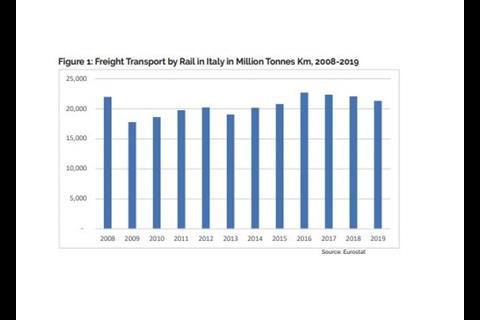
Clearly, there are both physical capacity and operational issues. This scenario may help to explain why overall use of rail for freight movements in Italy is seeing little, if any, growth. As Figure 1 shows, based on million tonnes kilometres, Italy saw a drop in demand due to the Global Financial Crisis in 2009 and despite some subsequent growth, activity has been declining since 2016.
Greater use of rail is definitely desired by most major ports in Italy. One known target of the new AP Moller-Cosco joint-venture Vado Gateway (Vado) terminal is to become a hub for cargo moving to the northern part of the country, as well as transit markets to the north of Italy.
To meet these aims, there is a core need for effective intermodal rail services in Italy. The target for this new facility is to transport 40 per cent of all containers arriving or departing to/from the facility via rail. It is understood that initially around four or five trains are expected to connect Vado with several intermodal hubs in the North and East of the country, including Milan and Padova but subsequently the number is forecast to ramp up progressively.
This objective is reliant upon having access to efficient rail infrastructure which is currently under development in Vado and the surrounding areas. APM Terminals/Cosco claim that “rapid access” to inland North Italy regions and into Central Europe is possible. However, this is denied by local industry sources in Italy who state that this “is not particularly true” at the present time.
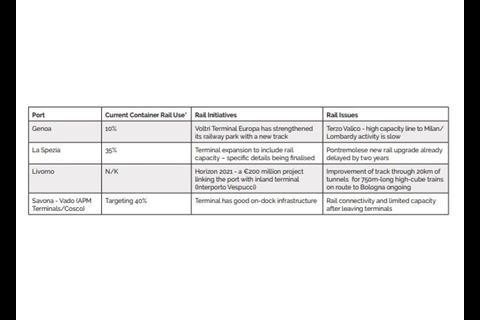
Table 1 offers a summary of rail investment/improvement projects that benefit key ports in Italy which are well positioned, shown to target the north of Italy and cross-border destinations in Central European countries.
The desire on behalf of port and terminal operators to extend their respective hinterlands beyond Italy remains manifest. When new facilities are developed, such as the Vado Gateway, or expansion investment is made, such as in La Spezia or Livorno, rail is an integral part of the process. These plans ensure that containers are handled efficiently at the port or terminal, but then the issue is the speed and general efficiency via which cargo can move to distant locations in the hinterland.
So, is it a lack of spending that is the impediment? Well, possibly not. Italy’s Inter-ministerial Committee for Economic Programme (Cipe) approved €28bn in additional funding for infrastructure investment by Italian State Railways (FS) in 2019 and the national infrastructure manager Italian Rail Network (RFI) update of its 2017-2021 investment programme was approved with an additional €15.4 billion for rail investment – with €12.5 billion promised for the road network.
There are some positive developments being made. Livorno is, for example, gaining a rail link between the port and the adjacent inland terminal (Interporto Vespucci) that will ensure access through 20km of tunnels for 750m-long trains with high-cube containers on the network to Bologna. However, similar projects coming to fruition are slow.
There are strong levels of investment in the Italian rail network but at the same time there are delays to projects coming to fruition. With a need to successfully target more distant discretionary hinterlands, these are delays that the country’s ports can ill afford.
The freight village catalyst
There are other initiatives that rely on good inland access, which also present strong potential to increase cargo volumes for ports. One of these is the Freight Village System. A freight village is a defined area within which all activities relating to transport, logistics and distribution of goods, both for national and International transit, can be undertaken.
A freight village location is, ideally, served by a multiplicity of transport modes - road, rail, deep sea, inland waterway and air. The location of freight villages is based on a range of factors, but connections with major ports is definitely an influential part of the decision-making process.
Italy is one of the biggest proponents of the Freight Village concept within the European Union region. There are 23 freight villages in Italy, with the most significant segment located in the North, particularly in Veneto (Verona, Rovigo, Padova), in Emilia Romagna (Parma and Bologna) and in Piedmont (Torino, Rivalta Scrivia).
It is clear that freight villages have a positive role to play in consolidating and expanding Italian port throughput.