

Reality check
Bigger ships are now a reality for West Coast South America ports. Alex Hughes reports
Nobody should be surprised that the opening of the expanded Panama Canal is having a major impact on vessel sizes now being deployed on the South American West Coast. It was forecast and the theory is now the reality.
Take Mediterranean Shipping Company’s New Andes Service. Starting in Shanghai, it connects China with Manzanillo and Lázaro Cárdenas in Mexico, Balboa in Panama, Buenaventura in Colombia, Callao in Peru, and then the Chilean ports of San Antonio, Coronel, Lirquen and Angamos. Although the service does not pass through the Panama Canal, the vessels deployed on it are neo-panamaxes.
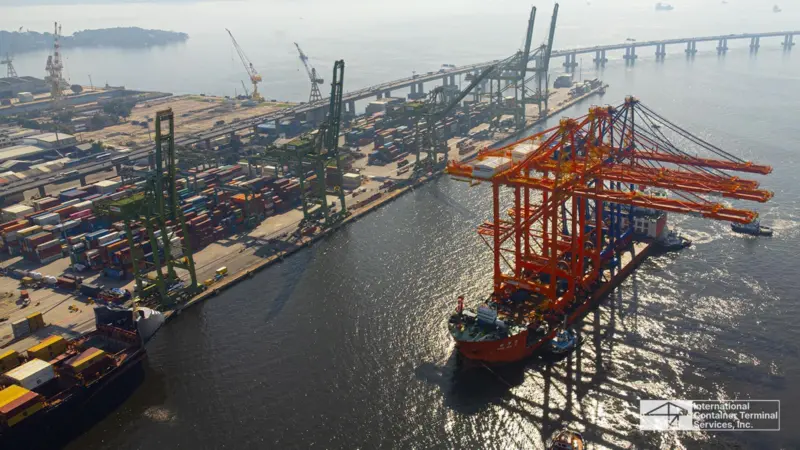
In Buenaventura, a recent call by the MSC Flavia was worked by four quayside gantry cranes, performing around 1,500 moves. The call was only possible through the extensive investment in container handling at the port “ both in terms of infrastructure and terminal equipment, where there has been an investment plan of $156m, which includes the latest generation of specialist equipment”, says port company (SPB) commercial manager Jorge Gallegos.
“We are also building a completely new quay and reinforcing the old quays, giving them alongside draft of 15 metres to allow them to handle vessels with similar characteristics,” he adds.
MSC says that this size of vessel will be the new normal on the Asia-South America service, as cascaded 13,000 teu ships are released from the Asia-Europe service by the deployment of new 16,000-19,000 teu vessels on that route. Mr Gallegos adds that for 2017, the port has already received confirmation that other shipping lines will be bringing 10,500 teu vessels to the port via the expanded Panama Canal.
The only vessel larger than the Flavia to ever call at Buenaventura was the Maersk Edinburgh, a 367-metre long ship with a capacity of 13,102 teu, which docked at APM Terminals’ TCBuen terminal on December 17, 2015.
Monster call
Flavia’s call on August 10 was at Berth 1 of San Antonio Terminal Internacional (STI). During its 35-hour visit, it offloaded 1,600 boxes and took on 1,900 others.
Gabriel Aldoney, the mayor of the Valparaíso region, which includes San Antonio, said: “This shows that San Antonio is able to compete not only within the region, but also on the west coast of Latin America. In th at sense, is also [contradicts] what some have claimed: that Chile is losing competitiveness and that there is a risk that these vessels will not come to Chile, but reach only Callao. This is [patently] not true.”
When Port Strategy asked STI commercial manager Cristóbal Kulczewski what the arrival of the Flavia meant to the terminal, he said: “ The arrival of the MSC Flavia is another new milestone and reinforces the capacity that STI has, not just in terms of infrastructure and equipment, but also in the experience of our workforce.”
“Furthermore, we now have eight quayside gantry cranes, of which six have post-panamax capabilities that help us to reach higher levels of efficiency compared with other ports in the region. For the past several years, we have weekly received two post-panamax vessels at the same time, which shows that we have the operating capacity and logistics in place to deal with this size of vessel.”
He acknowledges the trend in the industry for the deployment of ever-larger vessels and notes that STI has everything in place to handle them. However, for the time being, the MSC Flavia is expected to be the largest such vessel used on South American West Coast services, he says. “For the rest of the year, we are hoping for the arrival of between six and eight neo-panamax vessels at STI. Rather than speaking about this being the new norm, it is actually the trend as a whole in the industry, whereby shipping lines are looking for efficiencies through the use of larger vessel sizes, thereby generating economies of scale,” he says.
Attracting neo-panamaxes
Empresa Portuaria de Valparaíso (EPV), which oversees Chile’s other main gateway port, says that with the expansion of Terminal 1 and the construction of the new Terminal 2, Valparaíso will also be in a good position to attract services worked by neo-panamax vessels, which it predicts will be ever more common in the region.
According to EPV, to date, 77 operations involving 5th generation and super-post-panamax vessels have been undertaken by its main box handling facility, Terminal Pacífico Sur (TPS). This compares with 130 operations of a similar kind performed by STI.
By the end of the year, Valparaíso hopes to be able to accommodate two neo-panamax vessels simultaneously once its berthing line is extended from 220 metres to 740 metres.
On August 12 th, the Flavia moved from San Antonio to Chile’s Puerto Coronel, docking at the 400-metre long south quay at 15.00 hours and undertaking 2,000 moves, which took around 28 hours to complete, involving four shifts. This year, five similar vessels have called at Puerto Coronel, reinforcing the knock on effect the expanded Panama Canal is having on vessel sizes in the region.
According to Coronel’s operations manager Christian Prieto, accommodating vessels larger than the Flavia represents a major challenge for all maritime terminals. “It could be that two lines call on consecutive days, even though in today’s market we are not that close [to such a situation occurring],” he says.
The problem at Coronel is that the north quay is not yet equipped with gantry cranes, with vessels currently worked with mobile harbour cranes. However, Mr Prieto says that new investment in this area is under consideration, which would remove the need to provide new infrastructure elsewhere.
Lirquén calling
MSC’s neo-panamax later moved even further south and entered Puerto Lirquén. By the following day, around 800 containers had been loaded, mostly cellulose, wood and perishables bound for the Asian market, with a similar amount of boxes offloaded.
Lirquén’s managing director Juan Alberto Arancibia notes that at least a further five similar sized vessels are also due to call at the port by the end of the year. Previously, the largest vessels to call at the port had a capacity of just 10,000 teu. Lirquén is currently lengthening Quay 2, which already has the deepest draft in South America, by 92 metres to 628 metres, particularly with the neo-panamax market in mind.
Beyond Lirquén , the MSC Flavia headed north again, this time to Angamos port at Mejillones, being the last Chilean port of call.
Angamos now has the capacity to receive such large vessels, but managing director Phillip Schaale concedes that handling a vessel of those characteristics efficiently and in line with world class standards can a challenge.
HAULAGE STRIKE CRIPPLES BUENAVENTURA
Had the MSC Flavia arrived at Buenaventura any earlier, its efficient handling might well have been compromised by a hugely damaging road haulage strike in Colombia, which started on June 7 and ended 45 days later on July 22. It was the most costly and longest lasting strike ever undertaken by the country’s truckers and resulted in shortages of key foodstuffs.
The dispute revolved around government policy to hike cargo tariffs and introduce a programme to remove old and obsolete vehicles from the road, which was eventually withdrawn. However, demands for fuel prices and motorway tolls to be reduced were rejected.
There are some 330,000 trucks in Colombia, which between them handle the majority of import-export traffic to and from the ports.
During the strike, cargo began backing up at all the ports. At the main Pacific port of Buenaventura, the build up of cargo was so severe that vessels could no longer offload containers.
Coffee exports were also disrupted. Normally, around 1.2m 60kg sacks are despatched each month; as a result of the strike, this dropped to 600,000-700,000 sacks. Claims were that the road haulage strike cost the country $690m.
But not all ports were hit equally. At Cartagena, for example, 40 days into the strike, port operations were reported to be down by just 4%. International operations were not greatly impacted, although domestic consignments were slightly down.
Box terminal Contecar, comparing July 7 with July 14, noted a 17% drop in truck movements. In contrast, Cartagena Port Company (SPC) reported a 13% increase, suggesting that the combined reduction was around 4%. However, around 70% of the container trade handled by Cartagena is transhipment; of the remaining 30%, only 10% is moved by road.
In the same 40-day period, Víctor Julio González, director of Buenaventura Port Company (SPRBuen) reported losses of $6.8m, with 200,000 tons of cargo and 14,000 containers effectively stuck in the port, along with 1,600 imported finished vehicles.
Towards the end of the strike, SPRBuen had only 5%-8% of its storage capacity still available, with the box terminal 98% full. Export traffic all but ceased, as exporters chose not to despatch consignments, leaving the port to handle purely imports.
Truck movements fell dramatically to 600 daily from the 3,000-4,000 that the port would normally expect.
CHILEANS DISMISS ANTI-BOLIVIAN ACCUSATIONS
Following mounting criticism by politicians in Bolivia regarding the treatment of its truck drivers at Chilean ports, Chile’s representative at the Hague, José Miguel Insulza, recently visited the Port of Arica.
Afterwards, he noted, “Bolivian truck drivers have all basic services available to them for free, such as showers, baths, surveillance and parking, something no other port in the world has.”
At the end of his visit to Arica, Ambassador Insulza emphasised that Chile is meeting all its obligations in respect of the 1904 Treaty signed between Chile and Bolivia.
“T here is no basis for the majority of the criticisms that have been made against [the port]… Not everything works perfectly , there are always a few details, but we are meeting the [requirements] of the treaty in spades,” he said.
He pointed out that Chile is under no obligation to build roads between the port and Bolivia, although has done so anyway, stressing that he wanted the Bolivians to make proper use of the port of Arica.
Iván Silva Focacci, managing director of port company Empresa Portuaria Arica (EPA) added that a 4ha parking area for 240 trucks and covered by CCTV was available in the pre-port area. A further 3ha in the Port Support Zone are also being used as parking for empty trucks.
“In both areas, we have invested around $11m, which allows us to offer added value to the service that we already provide daily for the Bolivian truckers,” he said.
According to Mr Silva: “It is not right that the port of Arica is looking into the possibility of cutting services that are provided at the Bolivian terminal, nor are we retaliating against truckers that use terminal and pre-port services. To the contrary, our main concern is to provide the best possible service to continue fulfilling the free movement [of Bolivian cargo].”
Nevertheless, he stressed that the Treaty does not imply that the port has to offer operating services free to the Bolivians, who already receive preferential tariffs.
In respect of the proposed 10.72% tariff hike, Mr Silva pointed out that this only applied to consignments undertaken via the Bolivian Port Services Administration (ASPB). For the most used services there would be only a minimal increase. In terms of containers, for example, this would add a further 4.4% to the handling cost. This cost, he noted, had been agreed with the previous executive director of the ASPB and was bi-lateral in nature.
However, the decision by ASPB to cancel all services provided by the terminal for import cargo would result in Terminal Puerto Arica taking a serious financial hit. Indeed, ASPB has already run up a debt of $700,000 with TPA, since it is refusing to pay any invoice charging the new prices, despite the fact that around 75% of this debt actually applies to cargo charged at the old prices.
Related Articles
 SOUTH AMERICA
 PORT & TERMINAL NEWS
 PORT & TERMINAL NEWS