



Renting in the full Operational Concept
Patrik Wheater and Alex Hughes talk to customers and manufacturers about the reachstackers suitability, leasing options, price, and more.
Richard de Braak, a project manager from Dutch project secondment and interim management company, Yacht, working with European Container Terminals (ECT), is currently looking at ways to optimise the layout of container stacking in Rotterdam because the safe and speedy handling of increasingly heavier containers are becoming major issues. Yacht has been hired to manage a number of projects including buying new reachstacker capacity, which means replacing eight old machines.
De Braak is looking at ways to optimise the layout of container stacking: “Reachstackers are normally very safe and reliable, although there is a change in capacity in the second stack due to the far outreach of the stacker and therefore heavier containers in the second row is becoming an issue.” As a consequence there is an option of rearranging the terminal’s four- stack layout to accommodate a two-stack arrangement. “A two-stack arrangement will have a reduced number of ground slots, but it affords more effective container handling. If you have containers stacked in twos as opposed to fours, you can switch to a top-lifter and they’re cheaper than reachstackers. We are calculating what the benefits can be and looking at what the effect is concerning terminal ground slots capacity, ” says de Braak.
According to de Braak reachstacker manufacturers can be divided into two categories: those that supply high maintenance but relatively inexpensive units, such as Fantuzzi, and those companies such as Kalmar, Liebherr and Hyster that produce the hi-tech, highcost but low maintenance kind. Both have their place in the container world he explains: “Cheaper versions can be an option if you have capacity problems or temporarily change operation or need an additional machine quickly, but you normally hire these units, ” says de Braak, who believes the cost of reachstacker ownership is becoming a major issue for container terminals. “Everything is about reducing costs, ” he insists.
TAKING IT ONE STEP FURTHER ECT, which operates 15 reachstackers from one supplier (Kalmar), no longer buys the machines outright, preferring instead to rent in a full operational concept, which it has been doing for about ten years now.
However, new types of agreement are studied and the operator is now looking to take the lease concept one step further in order to achieve greater “guaranteed availability”.
This would mean that the leased reachstacker is in tip-top working condition for an agreed percentage of the time during day, evening and night shift operations. This would allow both parties, lessee and lessor, to optimise their operations whilst reducing costs. For example, if six machines are required during the day shift but only four at night, then a total of six machines are required as two can be taken out of service each night for maintenance purposes. This type of accord would also take into account the unforeseen problem of mechanical breakdown or failure; should a reachstacker fail then the supplier would be contractually obliged to provide a replacement within a matter of hours.
Of course such guaranteed availability would be expensive, acknowledges De Braak, but long term the advantages are clear: no downtime due to laid-up machines, thus optimising the flow of container traffic; negligible maintenance and repair costs; and there would be no the need for spare parts. De Braak says reachstacker manufacturers are also considering the provision of both machine and driver, which would not only slash terminal operating costs even further but also give the union representative something to ponder.
BETTER PICTURE OF COST DEVELOPMENT From a reachstacker manufacturer’s perspective, rental agreements are undoubtedly more lucrative but Kalmar Industries’ product manager Per Rosengren also considers the rental agreement to be the most effective solution for the operator. “The best result is when we, within Kalmar, rent out the units and keep the costs in-house.
Rental is frequent in many markets and we can get a much better picture of cost development.
He says that because reachstackers are used in various operations – as the main unit in small or medium sized terminals; as supporting units in larger terminals; or in terminals that undertake a lot of special cargo handling – a general advantage is that the investment cost for this type of equipment is low.
He highlights that Kalmar’s DRF series, which soon will have had three years on the market, is still one of the most advanced units.
“The ‘nerve’ system is the redundant CAN (Controller Area Network) bus that makes possible efficient use of a distributed control system.
This means that we control functions close to their physical placement, again giving a very good possibility to think in modular terms. One main benefit is that the control system gives extremely good input for real time diagnostics; also with possible Remote Maintenance Information (RMI) functions.”
“From a structural point of view, Kalmar has always been very good; the basic design is sophisticated and proven to be very reliable.
The best indicator is of course pricing on the second-hand market, where a Kalmar always gets a premium, ” he insists.
A buoyant second-hand market may result from maintenance intervals that allow basic Kalmar reachstackers to operate with 250hour intervals, but DRS and DRF units can operate with up to 750hour intervals. “In the long run we see that ‘observant’ maintenance programmes are giving better results than scheduled ones. So we operate extensively with diagnostic systems to be able to be early on both preventive maintenance and repairs, ” says Rosengren.
“OPTIONEERING” AT IMMINGHAM The container and ro-ro terminal at the UK port of Immingham, known as ABP Connect Terminal, currently operates a fleet of six DRD and two DC Kalmar reachstackers, of which two are hired from the manufacturer and the rest owned outright. However, the terminal is increasingly moving towards greater lo-lo operations. A second Liebherr ship-to-shore container gantry became operational in June, for example, while the terminal is awaiting the imminent entry into service of two RTGs. As a result, it is planned to reduce the reachstacker fleet in the near future to just six machines, with those hired from Kalmar being returned.
According to the terminal’s general manager, Robert Hambleton, in terms of manning, there is little difference between RTGs and reachstackers, since each require around 4.5 operators for aroundthe-clock working. Instead, economies are derived from increased stacking capacity. As an example, Immingham’s reachstackers operate with stacks three high and four across, while the RTGs will stack five high and seven wide. This additional stacking capacity is expected to be enhanced further as demand increases in the future, with a bay layout intended to facilitate the introduction of further RTGs.
Rather than complicating operations at the terminal, the mixed use of RTGs and reachstackers should enhance overall operational flexibility once the current re-engineering programme is complete.
Significantly, Hambleton reveals that, prior to taking the decision to switch part of the yard to RTG operation, Immingham had looked seriously at expanding its reachstacker fleet to handle rising throughput at the terminal.
“We seriously considered several manufacturers, including Kalmar, Linde, Fantuzzi and CVS-Ferrari, and sought competitive tenders from each. Our consideration focused not just on the up-front purchase costs of the various options, but also the transitional costs of running a mixed fleet versus the additional cost of moving to a single supplier for all of our various container handlers. We also considered the ongoing support costs and operability of each option, all of which would have influenced the effectiveness and cost of the terminal’s engineering maintenance provision. As with any exercise of this nature, there were ‘pros’ and ‘cons’ associated with each supplier’s proposal and these had to be carefully evaluated. Indeed, we did extend our evaluations to mainland Europe, considering, for example, the German market to assess the quality of product and the support available. We were particularly interested in suppliers whose business had hitherto been concentrated in mainland Europe.”
Although the reliance on reachstackers at Immingham will be reduced somewhat by the arrival of the Liebherr RTGs at the terminal, within the ABP Group, reachstackers will continue to provide a vital service at other facilities. Reachstackers, for example, are used at the intermodal railfreight terminal at Hams Hall, as well as container handling operations in Ipswich and Southampton. Future procurement plans may well seek to draw on this wider requirement with a move towards a “corporate” deal to secure best value from suppliers, rather than today’s more devolved approach, which sees terminals striking individual agreements with suppliers. “By doing this, we would again look at all the available options, with the aim being to achieve more bang for ABPs buck, ” concludes Hambleton.
THE BIG BANANA In spring last year Liebherr introduced its LRS 645, claiming to have “understood customer needs by offering a revolutionary reachstacker model to an astonished customership”.
A little over 12 months later and Liebherr are reporting the sale of 16 units, with further contracts pending for deliveries to companies that include Empresa Portuaria do Lobito, Angola, Africa;
TRW, Belgium; Shulze Holz-und Baustoffrecycling GmbH, Germany;
BolognaGru, Italy, and the Gydnia Container Terminal, in Poland.
This impressive sales record for a completely new product line, let alone a new product, has also demonstrated the company’s success in dealing with the recurring customer requirement of reducing through-life costs, as Liebherr’s Thomas Bachmann highlights.
THROUGH-LIFE COSTS “Whilst we cannot provide significant figures on a reachstacker’s through-life costs, we can say that with the evolutionary integration of a fully hydrostatic transmission and a step-less speed control our reachstackers allow for an optimization in engine rpm which is clearly reflected in a very low fuel consumption.”
He explains that because the hydraulic pressure is at a lower level compared to conventional reachstackers a long lifetime of power pack components can be taken into account. “Design lifetime is up to 50% above conventional machines and maintenance intervals of 1,000 hours clearly demonstrate the economic benefits of this reachstacker, ” says Bachmann.
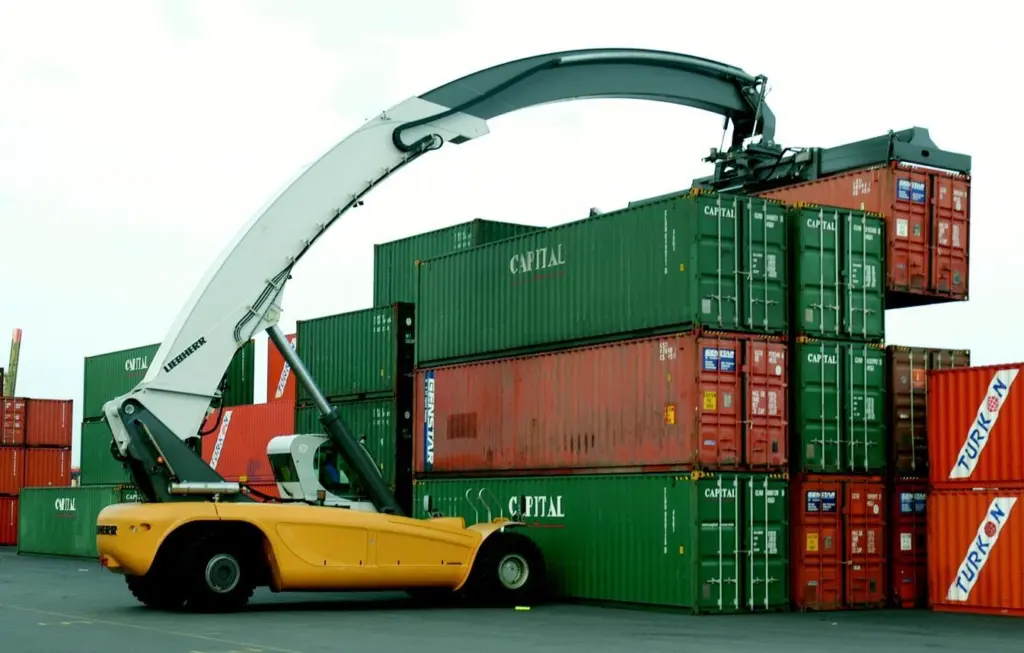
The LRS 645 has been designed to operate especially in container terminals with limited space. Being able to stack six containers high in the first row, it is also cited as offering “unbeaten” reach into the second and third container row. And due to a curved boom, can lift the fourth container in the second row and/or the third container in the third row without any removal of first row containers.
Consequently Liebherr claim the efficiency in container handling can be substantially improved as “unnecessary intermediate stacking of interfering containers is history”.
Another feature of the curved boom is the possibility of loading/unloading containers to and from below quay level without any extra boom extension, allowing it to be considered also for barge handling operations. Indeed accessibility and the ability to quickly and safely handle heavy containers from the second row in a four container stack is an increasing concern of terminal operators.
Related Articles
 TERMINAL OPERATIONS
 CONTAINER & CARGO HANDLING
 NEWS
NEWS