

Riding the concessioning wave
Privatisation and acquisition top Australasian port agendas, as Dave and Iain MacIntyre explain
Money is talking in the ports industry in Australia and New Zealand. In Australia, it is the state governments looking to privatise their port assets (usually via long-term leases) in order to raise money for other infrastructure projects. In New Zealand, it is about one container port investing in a feeder operation in order to enhance its hub status.
The Australian privatisation experience has spread from Queensland, where it made its mark first in Brisbane, to New South Wales, where it has found a home at Sydney’s Port Botany, and is now gaining major traction in Victoria.
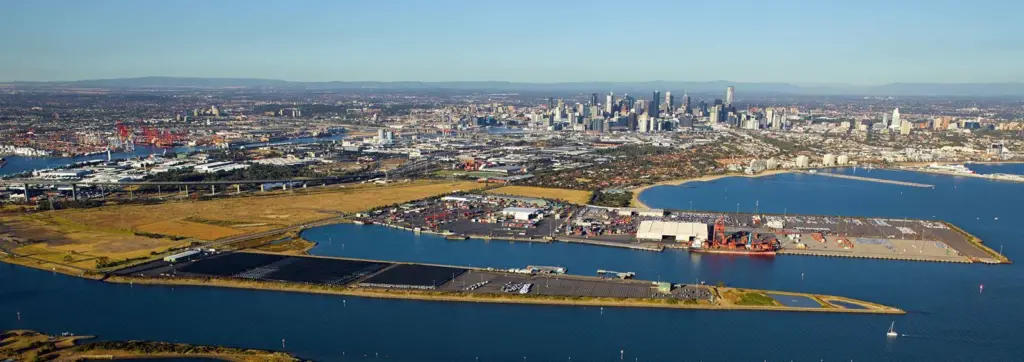
Towards the end of 2013, the Victorian Government announced the successful bidders for one of the major Webb Dock redevelopments comprising Melbourne’s A$1.6bn Port Capacity Project.
The contracts for operation of the port’s new automotive pre-delivery and inspection hub have been awarded to Asciano’s Patrick AutoCare and the Toll/K-Line/QUBE joint venture, PrixCar.
The bigger cherry which awaits picking is the long-term plan for the Victorian container ports – not just Melbourne but also Hastings.
Hastings’ claims to be part of the mix have been strongly debated, particularly given its geographic separation from the logistics companies with bases to the city’s west. However the government has still plumped for Hastings as the preferred option to handle the predicted growth in container traffic, in its freight and logistics planning blueprint entitled ‘Victoria the Freight State’.
Lease option
Whatever the scale of container port development, a key element in the mix will be whether to realise the potentially-lucrative returns from selling a long-term lease in Port of Melbourne.
Although the government has not been persuaded towards this policy, the opposition Labor Party has made it a centrepiece in its transport strategy. This is important given that the next state election is in late 2014 and the current government only has a majority of one.
The New South Wales Government has no qualms about privatisation, having confirmed it is definitely going ahead with the privatisation of major coal port, Newcastle. The model will be a 99-year lease, as were the agreements for the ports of Botany and Kembla.
It appears there will be strong interest from investors, according to a scoping study done by the port.
Indeed, investors seem to be actively looking for port opportunities: Canadian financial institution La Caisse de dépôt et placement du Québec has recently acquired a 26.7% stake in the Port of Brisbane from Global Infrastructure Partners.
Running parallel with this privatisation has been increased competition between stevedores, as Hutchison Port Holdings has established bases in Brisbane and Sydney and is attempting to gain access to the stevedoring market in Melbourne.
HPH group managing director Dr John Meredith is in no doubt the moves have been positive, saying the prospect of new competition in the stevedoring industry has already had the effect of prompting additional investment in Australian ports.
The fear of losing market share to the new rival had spurred on stevedoring companies to make some significant technology changes in Australian ports, he added.
Regional reshuffle
It is not just the container sector that is going through change in Australia.
The need to gear up regional ports to serve the massive energy and mining industries is also paramount, given the ongoing criticism from the project forwarding and heavy lift sector about the lack of facilities, particularly lay-down areas for out-of-gauge cargoes.
In a bid to get more efficiency in the port sector, the Western Australian Government is merging the ports of Broome, Derby, Wyndham, Cockatoo Island and Koolan Island under one Kimberley Ports Authority.
Three other regional port authorities, for the Pilbara, Mid-West and Great Southern regions, will amalgamate seven of WA’s eight port authorities. The four state regional port authorities will also control 13 smaller ports. Fremantle will remain a stand-alone port.
While New Zealand is not going through the same privatisation issues as Australia – the regional councils which hold the majority of port shares are extremely reluctant to ease their grip – nonetheless changes are in the wind in the country’s port scene.
Growth terms
In general terms, both the top two container ports – Tauranga and the Ports of Auckland – are showing efficiency gains. Tauranga is reporting record productivity following a 170-metre extension of its container terminal and ancillary equipment and infrastructure upgrades.
Comparing year-on-year for the first quarter of its financial year, the port’s waterline net crane rate increased 20.5% to 37.1, its ship rate lifted 25% to 73.5 and vessel rate rose 24.6% to 60.8.
Ports of Auckland is also on the up, and doing its best to defuse the perception that constraints on adding to its land footprint are limiting its opportunities to increase productivity.
Ministry of Transport Quarterly Container Handling Statistics show the port hitting 86 moves an hour on the ship rate – 50% better than the port was doing just three years ago.
Auckland chief executive Tony Gibson says the company has a number of projects underway that have the potential to significantly lift productivity, such as the Navis N4 terminal operating system to optimise vessel and yard planning.
“Labour productivity has improved markedly now that over half our workforce is on the new flexible shift and roster system and there is further upside to be gained once the entire workforce is on the same shift system,” he says.
Future options
Auckland is convinced that its current footprint gives significant scope for productivity gains.
“We have resource consent for expansion of Fergusson Container Terminal and work is progressing as planned. In early 2014 we will complete paving an additional hectare of reclamation, which will allow us to optimise our truck grid.
“Also in 2014 we expect to start construction of a 50-metre extension to Fergusson wharf and we plan to order an additional quay crane for the terminal. This will give us greater flexibility in operations and the ability to berth and service two 300-metre long container ships at the same time.”
Achieving productivity gains has been remarkable, given the simmering of tensions between Ports of Auckland and the Maritime Union of New Zealand, following the repeated strike action which crippled the nation’s supply chain in 2012.
The parties have yet to sign a new collective employment agreement but work at the port continued without any disruption for the past year.
Elsewhere in the New Zealand container sector, Port Otago is in the throes of a multi-faceted NZ$100m (US$83.8m) ‘Next Generation’ project which will see it dredge to 14 metres and then progressively to 15 metres to ultimately cater for 8,000 teu ships.
The project also includes extending the multi-purpose wharf, commissioning a newbuild tug and acquiring two newbuild straddle carriers.
Outside the container market, energy hub Port Taranaki is understood to have become New Zealand’s second-largest export port by volume following the going live of a third Methanex production line.
Having handled about 3.5m tonnes of exports in the 2012-2013 financial year, the port is forecasting an expansion to 4.5m tonnes and then 5.0m tonnes over the next two financial years.
Related Articles
 WORLD
WORLD
 PORT & TERMINAL NEWS
 PORT & TERMINAL NEWS