



PEMA recently released its 8th Annual Yard Container Survey report. AJ Keyes looks at the results off ered from this association of port equipment suppliers
According to information recently released by the Port Equipment Manufacturers Association (PEMA), there was a 34 per cent increase in RTG deliveries in 2019 on a global basis compared to 2018. There were more units delivered in every geographic region, with the (perhaps surprising) exception of China.
However, RMG deliveries for 2019 were down by a substantial 40 per cent, indicating that there is a potential shift occurring towards RTGs over RMGs. PEMA said that it gathers its data from 12 port equipment manufacturers around the world, with the objective of the annual survey to “determine market size and scope by equipment delivery volumes for yard container gantry cranes.” Providers of the information include Kalmar; Konecranes, Liebherr, Sumitomo/Mitsubishi, Mitsui and ZPMC
In more detail, the items of equipment reviewed include:
- Rubber-tyred gantry cranes (RTGs)
- Electrified rubber-tyred gantry cranes (e-RTGs)
- Rail-mounted gantry cranes (RMGs)
- Automated stacking cranes (ASCs)
MORE YARD GANTRIES – TRENDING AWAY FROM RMGs
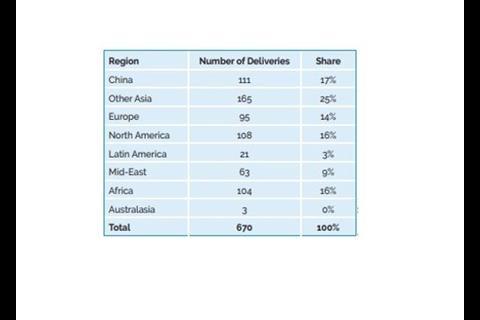
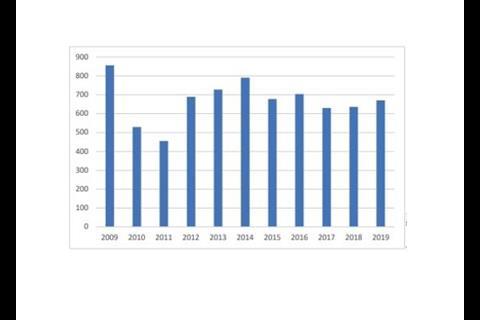
Studying the information released in more detail, PEMA says that in 2019, a total of 670-yard cranes were delivered overall, which compares to the 636 for 2018. Interestingly, the figure for RMG units supplied to terminals around the world was just 144, whereas for 2018 the number was considerably higher at 243 items. A trend away from RMGs is evident.
Further insight from PEMA relates to Automatic Stacking Cranes (ASCs). Here, manufacturers were asked to specifically iden¬tify these items, with confirmation provided that a total of 68 ASCs were delivered in 2019, which compares with the higher number of 124 provided in 2018.
Specific deliveries of these items, according to PEMA, were undertaken in Europe, North America, the Mid East and Africa (and, notably, Morocco – the Tanger-Med expansion), but not to Asia. This indicates that these other regions are more heavily targeting greater use of ASCs, whereas Asia is investing less in this equipment due to a combination of factors including less emphasis on automation in countries where employee costs are competitively priced.
Special attention was also placed on the investment in eRTGs. Here, PEMA reported that of the 526 RTGs delivered, a total of 53 cranes were identified as eRTGs. However, an important note was also added by the organisation. “It is possible that the number of ASCs and eRTGs is understated because some manufacturers did not identify ASCs in their RMG numbers or eRTGs in the RTG totals.” PEMA explained.
DEMAND IN 2019 UP - AGAIN
Table 1 provides a summary of the share of deliveries made by geographic regions identified by PEMA in its new publication. A longer-term profile of the volume of yard gantry crane deliveries is also presented in the report. A summary is shown in Figure 1. It can be seen that the impact of the Global Financial Crisis was noted in the 2010 and 2011 years, followed by a subsequent rebound.
More recently, the trend has been for growth in units, with the 2017 total of 630 units rising to 636 in 2018 and rising again in 2019 with 670 new yard cranes introduced globally. The potential impact of COVID-19 on deliveries is not expected to occur in 2020 figures, due to order lead times but a possible decrease in 2021 cannot be ruled out.
Founded in 2004, PEMA has more than 120 member companies representing a broad cross-section of organisations active in the design and supply of equipment, systems and technology that support port and terminal operations with cranes, equipment and component manufacturing, automation, software and technology. Further information about PEMA and its other publications, including ship-to-shore container cranes and mobile port equipment, is available via www.pema.org
Confirmation of yard deliveries for 2019 offered by PEMA, sourced directly from manufacturers.