COMMENT: The UK didn’t waste any time in releasing its Clean Air Strategy in 2019: it was published on January 14, writes Charles Haine.
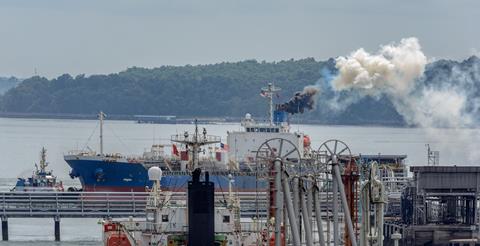
We’d seen a draft suggesting major ports have their Air Quality Strategy in place by May. That has since been pushed back to December but ports are not exactly jumping for joy. While they all appreciate the importance of addressing air pollution that kills seven million humans globally, the supply chain is complex, their contributions relatively small, and the programme too tight. A meaningful response requires proper planning, the collection of a decent set of baseline data and some budget — because that’s how ports operate.
The Department for Transport has promised guidance in May, leaving just six months to sort everything out and posting the strategy to Westminster with your Christmas card. What could possibly go wrong?
It is understood that “ports” (define a port, I hear you muttering) handling 1m tonnes of cargo, per annum, since 2016 fall within scope. Is that a port authority (some of which carry out their own cargo activity), or the terminals within? It’s not yet clear and any delay in providing a definitive list will likely hamper in-scope ports’ from commencing for fear of getting it wrong.
Just as established carbon footprinting methodologies do, one important foundation stone is to build-up an ‘inventory’ of their emission sources and explain who is responsible for each contribution. For instance, there are emissions from visiting ships, a terminal’s own equipment, an HGV picking up a box, a third-party civil works’ contractor, maintenance dredging vessel and the linesmen’s minibus! This will show that the port is inherently connected to multiple cogs in the supply chain yet demonstrate that they have limited influence over controlling, or taking responsibility for, many of the contributors.
At the same time, ports and terminals have to be measuring baseline air quality but unfortunately most are behind the curve. A relatively inexpensive way of gaining a snapshot of air quality is via the deployment of passive diffusion tubes. Fixed outside for up to four weeks, the subsequent lab analysis will offer a single reading of say, nitrogen dioxide, in that month. Somewhat useful, however, they have a +/- 20% accuracy rating. Also, how can a port squeeze in a (minimum recommendation) six-month programme — to include three months of both summer and winter — to meet a December 2019 deadline? To gain a better understanding of the ambient air in a port, a variety of measurement and monitoring equipment will need deploying.
Lord Kelvin’s — a Scots-Irish mathematical physicist and engineer famous for his Kelvin scale — quotation that “when you cannot measure it, when you cannot express it in numbers, your knowledge is of a meagre and unsatisfactory kind” has never been truer.
Target-setting, taking tangible action and ongoing monitoring can only be meaningful when used in conjunction with a viable baseline and cross-referenced with that up-to-date inventory.
Remember, once you’ve seen one port …you’ve seen one port. Each cargo-handling facility’s emissions to air are a product of the mode of operation, age of equipment, fuel base, size and type of visiting vessel, cargo mix (e.g. containers, dry bulks), not to mention proximity of local traffic and windblown pollution. Getting to the bottom of who contributes what to the cocktail above and around the port has no simple fix.
What should be happening is a smarter process of ascertaining which ports are located near local authorities’ formal Air Quality Management Areas and those with the most sensitive receptors nearby. The latter is primarily residential areas. After all, ‘exposure’ to pollutants is acknowledged as a key factor in the Government’s Strategy. So why on earth aren’t we prioritising those terminals and port-cities that face the most pressing air quality challenges and then seek to assist them on a fast-track to continual improvement?
Charles Haine is technical director of maritime at WSP.