



SHOAL project launched to monitor pollution
Luke Speller, lead senior scientist, BMT Group
SURFACE POLLUTION WATER is a serious issue with a high ecological impact that can endanger aquatic ecosystems. With numerous sources of pollution from both the landside and the waterside, identifying the source and the extent of pollution can be a challenging task.
Monitoring pollutants is hugely important because it allows us to assess the extent of pollution, the effect of any mitigation strategies and identify sources of pollution under certain circumstances. Currently European ports are required to carry out pollution monitoring under the Water Framework Directive. This testing is often carried out at designated points within a port, at specific times and requires divers to extract samples of water and send them back to the lab for testing. The approach is challenging in that the sparse measuring of pollution does not give a robust, continuous view of pollutant levels within a port. This makes it much more difficult to determine the source and identify the appropriate action to take in order to stop further pollutants being introduced.
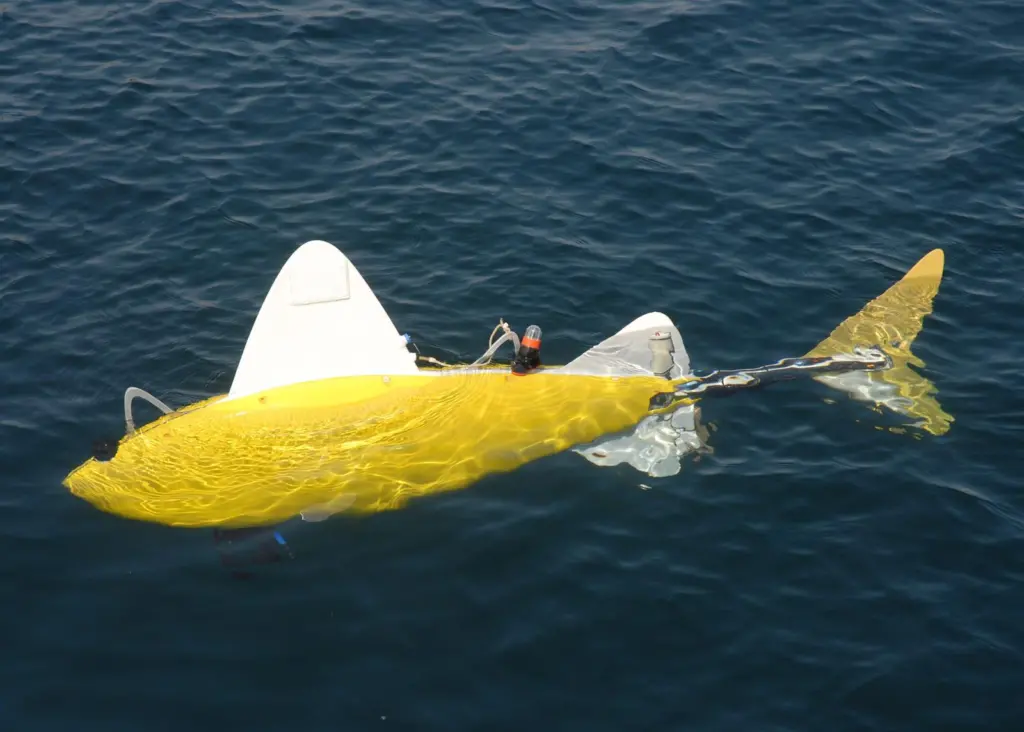
To help address this issue, the SHOAL project was created. SHOAL was a European Research Project under the Seventh Framework Programme for ICT (FP7). The aim of SHOAL was to develop a team of robotic fish that could collaboratively monitor and search for pollution. Managed by BMT, the project comprised scientists and engineers from Thales, Tyndall, Essex University, Strathclyde University and the Port of Gijon, Spain.
Robotic fish were designed to be able to swim in ports and coastal waters with enough power to overcome tides and currents. Relying on an undulating tail rather than a powerful propeller, the fish could navigate coastal waters with a low impact on the environment. Communications systems were also developed so that the robots could work in shoals and share information between themselves and the port.
Chemical sensors were developed to allow for the in-situ sensing of pollutants, and a robotic architecture was designed to enable the system to safety navigate within the port. Finally, algorithms were developed to allow robots to efficiently monitor the port for pollution and, if present, find the source of the pollution.
The system was trialled at the Port of Gijon, where the robots were able to measure and monitor pollutant levels within the port. Three robotic fish worked together to monitor the port for pollutants, as well as water quality measures such as salinity and dissolved oxygen.
The SHOAL project demonstrated that it is possible to monitor pollution in real-time and identify sources of water pollution, but the system is not without its drawbacks. The fish need to be removed from the water in order to be recharged and infrastructure needs to be installed on the seabed for the system to work. There are also challenges that arise from operating in a busy shipping terminal.
In order to make the system feasible, these drawbacks need to be addressed, but they are not insurmountable.
Developing a docking and charging station for the robots would deliver true autonomy meaning continuous operation of the system could become a reality. While infrastructure will always be necessary, it should be installed in areas that allow easy access and maintenance rather than the seabed, so as to avoid disrupting the environment. This means that sensors on the fish rather than those in the environment would need to be used to determine positioning. Sonar data and multi-robot SLAM (simultaneous localisation and mapping) could be used.
In order for the solution to operate in a busy port without causing disruption, the system must be accepted and trusted by the maritime community. This can be achieved by sharing case studies of successful UAV operations and also demonstrating how UAVs can work safely within the port infrastructure.
We hope to develop these solutions through future collaborative projects in order to make the process of monitoring and reducing pollution much more robust.
Related Articles
 ALTERNATIVE FUELS GREENPORT