



SIMULATOR SCOPE BUILDS
The scope for the application of crane simulators is extending, including for remote operations, scenario building and across high and low throughput applications. John Bensalhia reports.
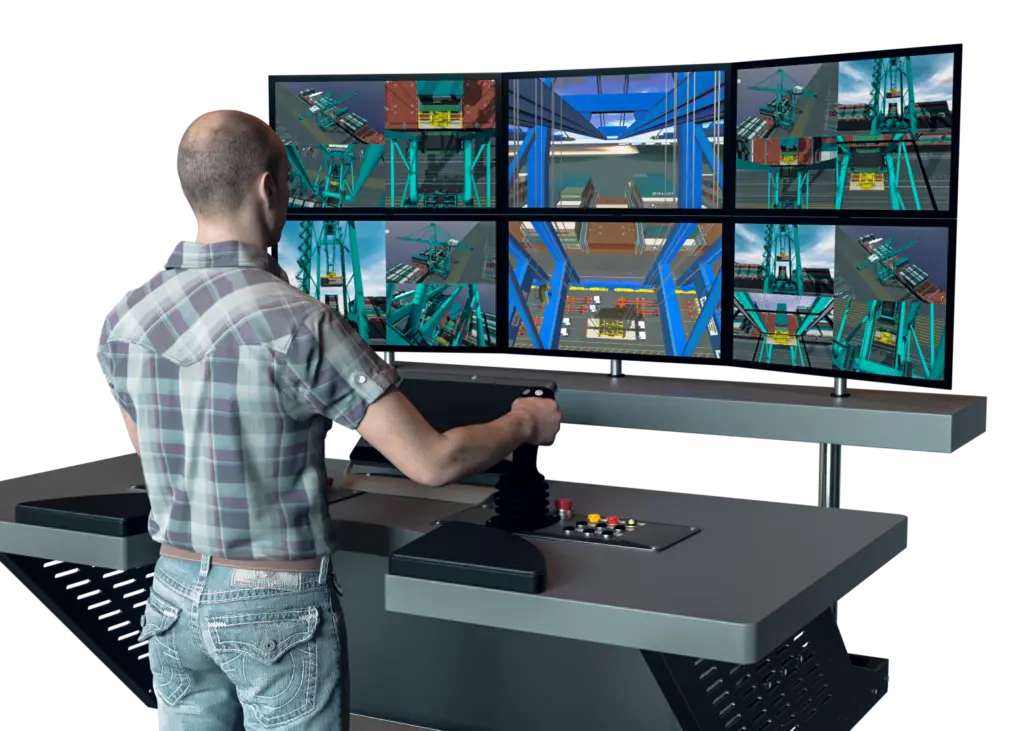
“As well as the military, ports are the primary buyers of GlobalSim simulators as they have a need for a premium level simulator,” says Brad Ball, VP of Sales and Marketing, GlobalSim, Inc. “We focus on higher-end systems that provide accuracy and realism. Although we do have smaller, desktop simulators, our “bread-and-butter” products are the larger simulators which include motion platforms and multiple displays and are configured to mimic a real crane cabin.”
The demand for crane simulators ties in with ports becoming immense logistical power houses, explains Tom Bremer, Managing Director, RelyOn Nutec Simulation. “In order to handle the huge numbers of containers and throughput, ports have to go ‘digital’, where crane simulation-based training is a key part of their logistics success. For these ports, implementing a Learning and Skills Management Strategy utilising crane simulation is key to increasing productivity.”
Bremer adds that the increased use of RelyOn Nutec crane simulators is a beneficial tool in helping ports to screen and assess large numbers of potential crane operators before hiring. Further, regular training and competence programmes, using simulators, ensures continued logistical efficiency and personnel safety.
David Clark, Senior Product Marketing Manager, CM Labs Simulations, reinforces the scope that exists for simulator use: “The main market requirement for crane simulator products revolves around a need for continuous training, whether for novice operators or for experienced operators who may be looking to cross-train on other equipment,” he says.
EXPERIENCE BRINGS ADVANTAGES
Clark explains that the advantage of using a simulator is that it is always available for training (unlike, for example, a shipto-shore crane which is likely to be loading/unloading vessels or undergoing maintenance/repairs).
Equally important, simulators are available 24 hours a day, whatever the weather. “This helps prepare new operators for night-time or inclement conditions,” says Clark. “Conditions which can be hazardous for new operators to experience at the training stage.”
New crane operators benefit considerably from the versatility of simulators. Training in a simulator environment can prepare them for harsh weather conditions as well as potentially difficult situations (for example, heavy or awkward loads).
Clark underlines that training in a simulation environment makes a big difference. “It is far less stressful, so the trainee operator acquires skills faster. It also allows them to experiment in ways they would not be able to experiment with real equipment, so they really get to understand the limits of what is being operated and gain the proper respect for the equipment.”
The role of simulators also extends to when terminals are looking to prepare operators for new equipment, prior to commissioning. “As an example, this is how the Port of Corpus Christi Authority trained its entire complement of operators to proficiency on a new Liebherr LPS 550 crane, several months before the port took delivery of it,” says Clark.
RelyOn Nutec Simulation’s major port operator and terminal management clients cite two main reasons for purchasing its port crane simulators, as Bremer records. “Either the port has high cargo/container volumes that require a large number of skilled personnel to operate the cranes or their port crane operations involve a large number of complex lifts. Complex lifts can be linked to speciality, difficult to lift cargo, such as un-balanced sections of offshore windmills, or difficult to stack cargo.”
All of RelyOn Nutec’s port clients use its simulators for the assessment and training of new crane operators, to ensure their competence prior to deploying them quayside, or for continued training and competence assurance throughout their careers.
“We have port operating clients in the USA, Europe, Mid-East, Africa and Asia, and they all see the value of investing in advanced simulation technology to improve and maintain their personnel skills and capabilities,” says Bremer. “All of our clients quickly achieve a Return of Investment (ROI) through higher operating efficiency, higher service levels and faster turn-around, as well as ensuring safer operations with less downtime and damage to people, facilitates, cargo or the environment.”
REMOTE ROLE
The move to remotely operated equipment and vehicles in terminals further builds the case for simulators. Clark suggests it makes even more sense to use simulators in such situations as most operators have zero experience with the slightly unsettling process of operating a crane with no tactile feedback.
“No motion in the seat, no sounds, and only a camera eye’s view of the visual environment,” he confirms. “In this scenario,” Clark elaborates, “Remote Operating Station (ROS) simulators, integrated with original equipment manufacturer (OEM) controls, are a relatively new innovation that prepare operators for the transition. They incorporate scoring and reporting features that help terminals understand which operators are finding it more difficult than others to make the transition and who will benefit from extra training as a result.”
RelyOn Nutec is experiencing increased requests for Remote Operated Systems applications. “This simplifies operations and makes them far more flexible and efficient,” says Tom Bremer. “However, it is a very different way to operate your crane, so training and practising on a crane simulator mimicking these operations becomes even more critical.”
Also included in the RelyOn Nutec simulators are an integrated Automated Student Evaluation (Eva) solution, which can be delivered with the company’s Learning Management Solution (LMS). “This enables our port clients to methodically build each employee’s career path, as well as suggesting where to invest their training budgets to improve their competence,” says Bremer.
“This can be further integrated with our competence management system and e-learning solutions based on client’s operational procedures and Key Performance Indicators (KPIs), allowing us to offer a fully turn-key digital competency solution where we quickly identify and fill competency gaps.”
SCENARIO BUILDING
Two notable trends have been observed by GlobalSim. The first of these is in conjunction with Sandbox Scenario Editor. Ball explains that when a training administrator needs a specific lesson or scenario, he/she can easily create a new one in “sandbox” mode that gives them control over a variety of factors.
“They can build a scenario with certain objectives and create the environmental conditionals at their discretion. An example of an advanced scenario for a ship-to-shore crane might be: load a vessel with 20 containers onto a Panamax vessel during a rainstorm with a 15-knot wind with a sea-state of three. The administrators can then monitor and grade each student and review a recording of their session in an ‘After Action Review’ module which shows a timeline of their training session, including any errors they made (time stamped). The administrator has a lot of flexibility and control over the training environment.”
Recently, RelyOn Nutec has been energetically working on linking specific Terminal Operating Systems (TOS) with its simulators, allowing port/terminal operating companies to simulate a more realistic working environment for the crane operators while they are training. “These digital-handshakes between a client’s TOS system and our crane simulators is fast becoming the norm,” notes Bremer.
LARGE AND SMALL
Recent experience confirms demand for simulators from a wide range of terminals. Clark says that CM Labs’ best-selling products vary according to market segment. Larger clients gravitate to CM’s custom simulators, which replicate the experience of their operating environment.
“Smaller port terminals,” he elaborates, “are more interested in some of our “all-in-one” simulator solutions, such as the desktop Vortex Trainer, which can run our full catalogue of port equipment training packs. In conjunction with a feature we call the Exercise Builder, this essentially gives port terminals access to unlimited exercises for a wide variety of equipment, so of course this is a very budget-friendly proposition.”
GlobalSim’s Full Mission system is the company’s most popular and known system, engineered from the ground-up to better simulate a container crane. “Real-life crane operators have provided ample amount of testing and feedback on our Full Mission system and it’s an ideal match for any port crane training centres that require a full-cabin simulator where the motion base is under the entire cabin (not just under the operator chair),” says Ball. “Crane operators constantly tell us it ‘feels just like the real crane cabin.’”
GlobalSim’s Full Mission Systems is installed in locations throughout the world, including training centres in Antwerp, New York, Duisport and Felixstowe. Going forward, Bremer expects demand to increase: “We expect crane simulation to be more widely adopted by smaller seaports and inland terminals, to help them run safer and more efficient lifting and logistical operations. The cost of just one accident along with downtime is far higher than the costs of implementing a site-specific digital training and competence solution based on advanced dynamic simulation.”
Related Articles
 DIGITAL
 PRODUCTS & SERVICES
 PRODUCTS & SERVICES