

The UK needs a properly thought through network of container terminals around its coast. Burgeoning trade and the need for fast, just-in-time delivery; road congestion and rising road transport costs (the Working Time Directive alone will add 20% to the cost of road haulage it is estimated); the need to reduce carbon emissions?. The UK presents an obvious case for modal shift to get more goods moving in and out of its regional ports and around the coast. But will it get the network it deserves? Nick Elliott reports.
"We want to see Britain's port sector prosper in a growing world market, " proclaimed UK transport minister Alistair Darling after a recent visit to Hunterston on the Clyde. Fair enough. But following the government's rejection of the Dibden Bay container terminal development at Southampton last April - six deepwater berths were planned - the question of whether the country has or is intended to have a joined-up national ports strategy or not, has been asked in many quarters, including in the pages of this magazine. It would be easy to conclude that the answer is no. The UK's labour government unashamedly follows a course dictated by the principle that freedom of choice by the market is a more effective way of delivering positive change than state intervention. And by and large this is what industry wants too. Couple this with the government's policy of devolution, decentralisation and regionalisation and it becomes difficult to see where there is room for any overarching national strategy. The growing regionalisation of government means that Regional Development Agencies (RDAs) and local authorities, not central government, look to ports as economic regenerators. And, devolution has moved large areas of responsibility for ports away from Whitehall.
Another issue is that new developments can come into conflict with environmental designations such as the Habitats Directive. This has also led to calls for a better defined ports strategy which identifies areas for development. Despite this, applications continue to be examined on a case-by-case basis.
So there are important political and ideological issues at stake here which complicate the question of just what sort of national ports policy will serve the country best. It would however be a mistake to imagine that there is no government position on this. The government's Future of Transport White Paper published last July by the Department for Transport (DfT) is worth examining. Chapter 7 deals with ports and states in part:
"By autumn 2005 we expect to have taken decisions on the outstanding proposals for major container port developments (they are referring to London Gateway, Felixstowe South and Bathside Bay).
At that point we will take stock of how the ports industry is set to meet the country's overall needs in the longer term. We will therefore review our policy framework to keep track of wider changes affecting ports and to ensure we continue to have the right basis for their sustainable development. The review will clarify the Government's role in the ports sector, and address key issues such as:
how we should respond to forecast global growth in shipping traffic by providing new port capacity;
how the pressures on capacity are set to vary at the aggregate national level across key sub-sectors such as containers and ro-ro, and the ease with which such pressures might be addressed; and how to ensure that the road and rail improvements needed to serve future major port developments are brought on stream effectively.
WHO PAYS?
As far as a national strategy's concerned, it's watch this space then.
But within this last section lies the key to another important question facing port developers and operators such as Hutchison Ports UK (HPUK), P&O Ports (P&OP) Associated British Ports (ABP) and Clydeport plc, part of Peel Holdings. Exactly how will government apply its policy of requiring port developers/operators to pay for road and rail infrastructure links adjacent to, but not part of, the actual port development? A DfT spokesman told PS there will be a ports policy review once the present round of applications has been decided and is out of the way. "The review will look at precisely this kind of issue such as infrastructure support links, " he insisted.
He expected decisions to be announced on all of three major container port development applications by the autumn and added: "It is very difficult while those decisions are still being made and still in the inquiry process for us to start reviewing policy, and in particular issues like the degree to which operators are required to support infrastructure, in the middle of that process."
It would seem that port developers already have more than an inkling of what to expect. One developer told PS he had heard that the DfT had already written to ABP indicating that it would cost an estimated £52m to upgrade the rail link to ABP/P&OP's Southampton Container Terminal (SCT) and they, the government, were not going to foot the bill. The same source said HPUK had committed to around £75m to upgrade the rail link to the Midlands and £10m in connection with Bathside Bay if that gets the go-ahead.
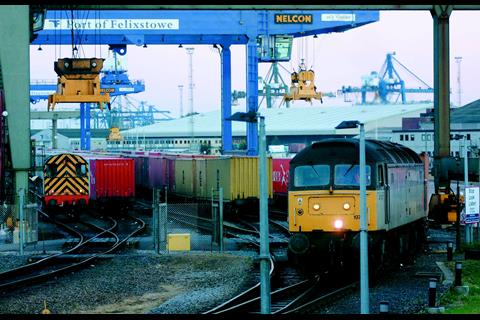
(This includes the £5m Ipswich tunnel upgrade, a key milestone in the project to upgrade the route between Felixstowe and the West Coast Main Line for hi-cube containers. ) HPUK stated to PS: "Government policy, as set out in the recent Transport White Paper, is clear in that, when ports expand, the Government now expects them to contribute to the cost of surface access improvements. HPUK has for many years supported calls for a more level playing field within Europe when it comes to port financing. We are aware that consideration is being given by the Government to subsidies for rail connections to/from other ports in the UK, which, if granted, would place them at an unfair advantage, given that we, along with other existing port operators, are facing a requirement to fund road and rail infrastructure outside our perimeter. In addition to the road/rail infrastructure improvements that we are being asked to fund as part of our proposals for Bathside Bay (BB)/Felixstowe South Reconfiguration (FSR), we are also going to have to implement some intensive and costly schemes to maximise the throughput through our existing deep-water berths in Felixstowe, given the shortage of capacity that is inevitable between now and when the developments can be brought on stream. Unfortunately, we will be looking to recover these capacity and infrastructure costs through additional charges.
"The importance of the issue of state aid has once again been highlighted by the European Commission in the latest proposal for a Directive on Market Access to Port Services. The decision by Government to require UK port operators to fund surface access improvements will lead to a further deterioration in the competitive position of UK ports. However, having made its decision, it is now imperative that the Government applies its policy consistently within the UK to ensure that competition is not distorted nationally."
On a national ports strategy, the statement continues: "HPUK does not believe that a centrally planned port development strategy is likely to be able to respond to market demand in such a way as to deliver the type of facilities demanded by shippers, in the places that they are needed, and within the appropriate time scales. We would further question whether central planning is appropriate for a privately financed industry. We do, however, acknowledge that a joined-up approach to transport planning is needed, and are pleased to see that this is being progressed through the development of Regional Transport Strategies and other planning policies."
THOSE EUROPEANS HPUK's Paul Davey warns that government policy may exacerbate the difficulties the British industry faces when it is already at a disadvantage in funding terms. "We have to be pragmatic and work within the rules and policies set by the UK government. But it remains to be seen how they are to be negotiated. It is a developing process."
Bill Burns, md of Clydeport's Hunterston hub project, expresses it like this: "If you contribute to infrastructure do you get your money's worth? If you make that contribution and the dynamics change meaning that someone else takes advantage of that infrastructure, then can you get some recompense? How do you know that you're not providing finance for some other project? There has to be clarity there.
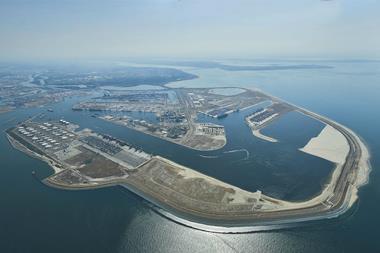
"Secondly, we're already at a disadvantage in trying to attract foreign investment into the ports industry in this country. If you look at Europe the Dutch government is contributing millions to Maasvlakte 2. (The project will cost ?2.575 billion with the state taking a 33.3 per cent interest in Port of Rotterdam as of January 2006). The state governments in Germany contribute to their port developments also. That does not happen in this country so we're at a disadvantage as regards dredging and other work. My view is that that's fine. We will take care of the dredge and the construction but why should we then be expected to provide the infrastructure leading to the port when we are already at a disadvantage. That's certainly not a level playing field so how to address it?"
CROSSING THE RUBICON?
So is government being reasonable or is it going one step too far? If we consider such a connecting road or rail link as an economic artery which encourages the smooth flow of goods for the overall benefit of society and the environment, then surely it is for government to deal with and this is what we pay taxes for - to facilitate these broader infrastructure networks. If a toll or road tax is subsequently levied on the user, then fair enough.
If indeed port developers are to pay, then are we witnessing a new paradigm, a crossing of the Rubicon possibly not anticipated by government? What were Mr Darling's words? "We want to see Britain's port sector prosper in a growing world market." Let's hope so.