The Smart Port is seen by many as the fifth-generation port management model – a ‘new kid on the block’ that together with automated container handling holds the promise of much more to come as new technologies advance. Mike Mundy assesses the trend lines
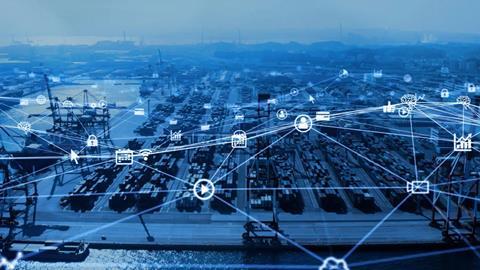
Word is that the next big IT revolution is just round the corner – what precisely this will be is not entirely clear yet but there are some candidates: spatial computing, quantum computing and generative AI for example.
Spatial computing holds the power to alter how humans interact with technology by merging the virtual and physical worlds.
Quantum computing employs qubits, which can exist in multiple states at once, to deliver huge processing power. This can lead to positive step changes in diverse fields of application.
Generative AI is progressively coming of age this year and is expected to have a growing impact over the near term.
Advances in these fields and others will have implications for container terminal operations in both a front-line and back-up context.
IN THEIR INFANCY
The Smart Port and container terminal automation are in their infancy – there is much more to come. Yes, both concepts have now been around for a while but in terms of industry take-up they are still quite limited. A recent survey estimates that automated container terminals today only account for around five per cent of annual container handling capacity.
The adoption of the fully automated container terminal concept has to-date mainly been in developed economies – where the cost of container handling operations is high with the labour component being a major factor in this respect. The industry tends not to like to say it straight out, but it is nevertheless the case that ‘replacing man with machine’ can drive cost down. It is a positive economic equation, a higher initial system cost versus labour cost, which in the end delivers more economic operations. There are other bonuses – greater accuracy and overall efficiency which can contribute to raised value-added service levels and supply chain optimisation overall.
Traditional manual processes are, in high volume situations in particular, no longer fit for purpose against a background of emerging supply chain needs – real time tracking etc.
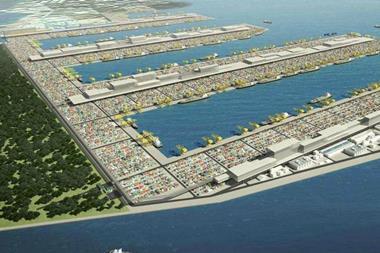
A leading example of a Smart Port is Singapore’s Tuas Port set to be the largest automated terminal in the world. The first phase of his interesting new terminal complex opened in September 2022 with development set to take place through to 2040.
The port has on its agenda some ambitious plans – the progressive application of artificial intelligence, data analytics, robotics and other cutting-edge technology. To facilitate this PSA has introduced what it describes as an event-driven architecture (EDA) platform – supported by Solace, the immensely powerful and flexible message broker platform. The EDA platform essentially masterminds the port’s operations and support activities such as maintenance. It processes data as events occur optimising inter-related operations and providing real-time data processing and live communication abilities. EDA is, in effect. ‘the glue’ that holds together and enables the seamless operation of the Smart Port and its interfaces with the supply chain.
Physical handling at Tuas Port is via high-spec ship-to-shore cranes on the quayside offering a handling capability equivalent to an 18m water draught and the ability to reach across 24+ rows of containers on deck. Landside operations are fully electric with automated guided vehicles (AGVs) comprising the main handling units.
And, of course, as part of the terminal operation there are various key other smart/automated components – automatic gate operations, remote reefer monitoring, remote equipment monitoring and so on.
Bottom line, however, PSA cites the successful integration of EDA AT Tuas Port as a definitive step in the advancement of highly efficient container handling. A step that it considers sets a new industry standard for port automation and that offers unparalleled connectivity with stakeholders along the supply chain.
Tuas Port stands as a top-of-the-range Smart Port, using automated instead of manual processes and featuring diverse sustainable characteristics. The fact that it is also a transshipment hub, as opposed to a gateway port, also adds another level of challenging complexity.
WIDER PRESPECTIVE
There is no uniform model for a smart port or an automated container terminal – as is normally the case with port or terminal design there are always bespoke elements, sometimes tailored to the circumstances of a given facility and/or the approach decided on by the developer. Some parties define a smart port quite simply as ‘a connected network’ or a logistics platform. A recent evolution of the original smart port concept is seen as ‘a port that not only places emphasis on its customers but also cares about the community.’ This, in turn, is seen as the fifth-generation port management model.
It is further interesting to note that a smart port is not necessarily one that has a cargo handling dimension, it can achieve this status purely in an overall port management context.
Whether there is a cargo handling element or not common denominators of a smart port are the use of technologies such as IoT, Big Data, blockchain, 5G and others.
A selection of smart port initiatives at a port management level are featured in Table 1.
Table 1: Smart Port initiatives at a Port Management Level
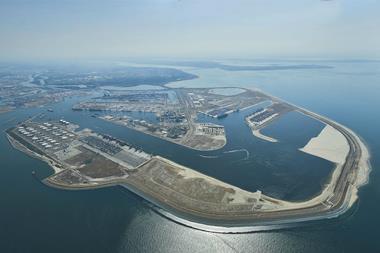
Rotterdam, The Netherlands
- Employs a digital twin of the whole port and IoT sensors for measurement of water movement, turbidity and pressure to ensure compliance with environmental standards.
- The port is introducing renewable and green energy sources and electrification initiatives as well as optimising vessel call and departure management.
Los Angeles, USA
- Setting up a cyber résilience centre
- Together with GE developing a digital platform to “boost supply chain effectiveness.”
- A digital twin enabling management to monitor all processes in real-time.
- IoT sensors monitor water flow, turbidity and pressure.
Hamburg, Germany
- The Port of Hamburg utilises an IoT platform for managing traffic congestion, pollution, and road safety which consists of the three pillars, Smart Port infrastructure, intelligent traffic flows, and intelligent trade flows.
- Initiatives include: an IoT project to track different kinds of pollution, a focus on reducing water acoustics, the introduction of low emission vessels, weather sensors installed around the port, IT systems for all maintenance and intelligent solutions for real time navigation
Valencia, Spain
- The port of Valencia identifies connectivity, efficiency and responsibility as the foundation stones of its smart port concept. A lot of work has gone into maximising the connectivity of the logistics chain through cooperation, information AI, transparency and cyber security initiatives. At an operational level optimising intermodal in the logistics chain is a primary area of attention and generally maximising space availability.
- There is a commitment to zero emissions, the circular economy, community integration, the fight against climate change and the blue economy.
Port of Shanghai, China
- The Port of Shanghai has launched a fully automated and intelligent port in its new Yangshan Harbour zone, running 24 hours a day, seven days a week. The vision was to have a port intelligence system that could control all aspects of container handling, from ship traffic coordination and automated cranes to autonomous container vehicles. Human interaction is limited, monitoring video feeds of container traffic and ensuring the port intelligence software is operating correctly. For this a data centre was required to power the mission-critical software. The intelligence software simultaneously controls the cranes and vehicles, while also collecting and analysing data to make millions of decisions per second. Cisco HyperFlex was chosen to provide the necessary infrastructure for the data centre.
THE AUTOMATED CONTAINER TERMINAL
According to an estimate made by Prof. Luis Pedrayes of the Autonomous University of Barcelona in June this year, there are now around 60 fully or semi-automated container terminals in operation with another 100 automation projects under implementation.
There is no doubt that in both a port management context and at the terminal operating level there is building interest in smart/automated technologies. As the powers of new generation technologies are unleashed, interest is growing and especially where labour costs are high and rising. There is resistance from unions of course – in locations such as the USA and Australia – but suffice it say over time it will be a hard job to resist the inevitable march of technological progress.
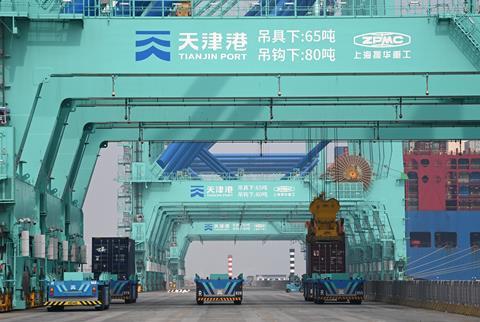
Experience in China, which now has significant know-how with established automated terminals and a large number under development, suggests that the overall productivity gain for an automated terminal is in the order of 20%, the reduction in personnel costs up to 70% and in energy consumption 20%. These figures maybe somewhat inflated for public relations purposes but the margins over a conventional terminal operation remain attractive even if scaled back.
The attraction of partial areas of automation – remote ship-to-shore crane operation, gate operations, remote reefer monitoring, automated maintenance systems, container tracking, enhanced communications etc – is also manifest, possibly accounting for the area of greatest activity.
The direction of travel is set – the digital revolution is fast establishing new rewarding methods of port management and terminal operations. The impact of new technology is potentially far reaching generating fundamental changes in the business of port management and terminal operations.