



A new lease of life
The prospects for DP World Santos have improved with the potential demise of the Superterminal plan opening the way for new investment
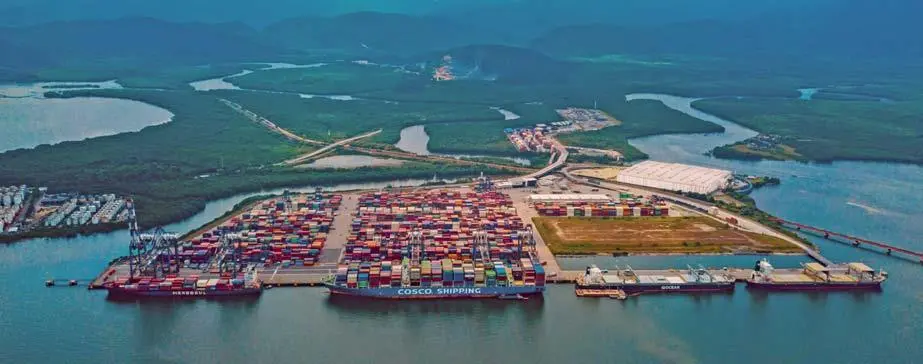
Apart from Ecoporto, the company likely to suffer the most if the STS10 project for a third major box terminal at the Saboo, “Superterminal” site in Santos – with around 600,000 sq m had gone ahead would be DP World Santos.
With 1.067m TEU handled in 2022, DPW Santos is not exactly a David in the Santos panoply of terminals, but nor is it a Goliath; it is somewhere in between, maybe a ‘Daviath.’ It is outside the organised SPA area and operates as a Terminal de Uso Privativo (Or TUP) and so does not have to use the costly OGMO casual labour pool, but which it nevertheless chooses to use for part of its breakbulk operations at Suzano Terminal. That throughput gave DPW a 19 per cent share of the Santos market in 2022 but that’s less than half its two rivals (BTP and Santos Brasil with 40 per cent each).
Despite being assiduous in carving out its own niche in terms of boxes – serving mostly the various carriers not aligned with MSC and Maersk – it would probably have ended up losing many of its services to the three bigger terminals (the current BTP and Santos Brasil, plus the future incumbents of STS10 in Saboo, on the right bank).
DIVERSIFICATION POSITIVES
However, by diversifying into handling other types of cargo – namely cellulose and paper for Suzano – and by working hard with its commercial activities the future looks bright for DPW Santos which took over 100 per cent from Embraport in 2017. When Embraport started up its construction phase in 2010 (and also when it opened its container operations in 2014), DPWorld had a 33 per cent share. It handled (as Embraport) 546,000 TEU in 2014, taking a 14 per cent share of the market during its second year of operations.
And now, with the demise of the STS10 project (See preceding article), and the likelihood that it will be downsized, the future looks even brighter, and the chances of the non MSC and Maersk carriers – such as ONE, Hapag Lloyd and CMA CGM – staying with DPW Santos are positively glowing.
“DP World has done well to hold on to between 15 and 20 per cent of the Santos market while BTP and Santos Brasil dominate, but if a third “big” terminal came into play they might lose their main ‘Non-Big Two’ carriers – such as Hapag Lloyd, Cosco and ONE – and then they could really struggle,” says a well-known port consultant based in Sao Paulo. “Therefore, they are one of the main beneficiaries of the rethink on STS10 and the reason they are announcing investments and expansion plans is probably as a result of this good news, at least it is for them.”
DP World underlined how it is playing an important role in the “container mix” for Santos as it crashed through the 1m TEU barrier for the first time in 2023, and as it heads towards its 1.2M TEU capacity. It has announced it will add more capacity to the terminal; up to at least 1.4M TEU per annum.
Marcio Medina, Commercial Director, DPW Santos, says that another 5 per cent growth can be expected for this year, and he adds that the paper pulp handling totalled 3.7M tonnes in 2022 which was 15 per cent more than in 2021.
“Cargo diversification is a consolidated strategy at DP World and is the main approach to supply chain reconfiguration and here in Santos it started with the inauguration of the pulp complex in 2020,” explained Medina. “Today we operate the largest multipurpose terminal in the country, but still with container handling as our core business.”
The partnership with Suzano, opening operations in April 2020, has seen more than nine million tons of pulp shipped.
The complex received investments totalling Reais700M and has a warehouse of 35,000 sq m and static capacity for more than 150,000 tons of raw material.
“Our investments aim to continue this cargo diversification strategy, in addition to increasing our container handling capacity, thus supporting the sustainable growth of Brazilian foreign trade,” added Medina.
In terms of containers DP World will spend Reais200m in Santos to expand and modernise its terminal; adding 130,000 sq m to the existing 845,000 sq m facility and expanding the piers from 1100 m to 1300 m, which would be enough to accommodate the 366 m boxships soon to be coming to ECSA.
Related Articles
 SOUTH AMERICA
 PORT & TERMINAL NEWS
 PORT & TERMINAL NEWS