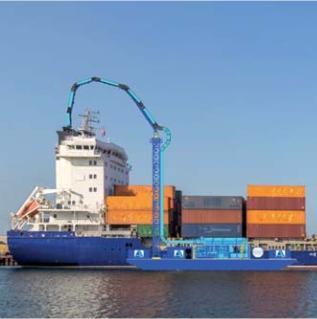
AERAS Technologies is introducing its solution to meet the demanding requirements of a CARB Approved Emission Control Strategy (CAECS) for vessels in port. The system, the first of its kind, will go into service in the Port of Long Beach and is designed to provide an alternative to shore power when this is not economically or technically viable.
The California Air Resources Board (CARB) regulation: the “Airborne Toxic Control Measure for Auxiliary Diesel Engines Operated on Ocean-Going Vessels At-Berth in a California Port” (aka the At-Berth Regulation) requires that vessel operators connect to electric power from the shore or, when this is impossible, reduce emissions by using a “CARB Approved Emission Control Strategy” (CAECS). A CAECS system, in addition to demonstrating reductions in defined air pollutants, must achieve compliance with the GHG emission provisions of the Regulation, CCR Section 93130.5(d)(1) which states that strategies approved after 2020 must be grid-neutral using the grid emission rate for the year the technology is granted.
In effect, a CAECS system is an alternative system to shore power when this option is not feasible. One such system, developed by AERAS Technologies, is now under construction in the port of Long Beach and will go into service there during 2022.
The AERAS system is designed to “nearly eliminate” particulate, NOx, and reactive organic gas emissions from vessel engines. The company states: “the system represents a proprietary marine integration of proven emission control technology that is already the standard for stationary sources such as power plants.”
The company further points out that its systems have the capacity to treat the flue gas of a diverse range of vessel engines ranging from 250KW to 2200KW engines. A single AERAS system can simultaneously extract emissions from multiple engines and boilers.
Greg Alexander, SVP-Engineering & Compliance, AERAS Technologies, explains that its systems are mounted on barges and attach directly to the exhaust stacks of vessels, with a system of flexible ductwork mounted on a tower with an articulating arm, and that no shipboard modifications are needed.