Barry Parker takes a comprehensive look at green corridors – thinking on definitions, routes to implementation and the obstacles to overcome
At the recent COP27 event held at Sharm el-Sheikh, Egypt there was a great deal of buzz surrounding “Green Corridors”, a concept hatched 13 months earlier, at the COP26 conference, hosted in Glasgow. At COP26, nineteen nations signed on to the “Clydebank Declaration”- where they made commitments to “facilitate the establishment of partnerships, with participation from ports, liner operators and others along the value chain in order to accelerate the decarbonisation of the shipping sector and its fuel supply through green shipping corridor projects.” The objective set was a target of six such projects by 2025, and an “aspiration to see many more corridors in operation by 2030.”
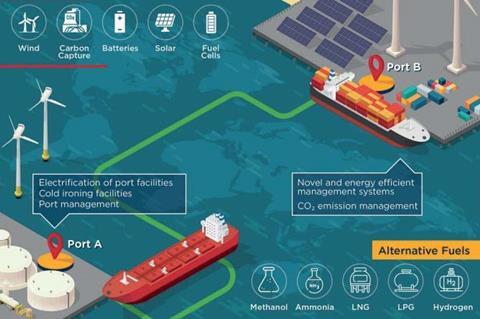
Essentially the idea is based on establishing discrete trade routes where the vessel fuels, the port infrastructure supporting the cargo and fueling operations (along with the cargo production and consumption) are all “green”.
The challenges involved in creating lower carbon, or completely carbon free pathways for shipping trade are daunting; consider that shipowners, cargo providers, fuel producers and sellers, as well as regulators must also climb aboard. Ports are integral because of their geographical positioning at the opposite ends of disparate corridors. Over time, though, ports could evolve into fulcrums and network connectors, if many more corridors emerge – as envisioned by those who signed on at COP26.
Fast forward to the World Leaders Summit at COP27, in November 2022, which featured a proclamation from the U.S. Department of State that the U.S., in conjunction with Norway, was organising the “Green Shipping Challenge”. Projects mentioned, as this initiative was inaugurated, included, among others: Australia-Singapore cooperation on green shipping corridors, Gulf of Mexico green shipping corridor, Los Angeles-Shanghai Green Shipping Corridor partnership and implementation plan, and Alaska British Columbia Washington Green Cruise Corridor.
Besides these inchoate efforts on the U.S. diplomatic radar, there have been numerous other expressions of intent to set up corridors. Most recently, U.S. and Canadian maritime authorities were outlining a corridor within the Great Lakes, linking multiple ports.
Interestingly, though the Clydebank signatories attempted to lay out the parameters of what, exactly, constitutes a corridor, there is no precise formula.
DEFINITIONS AND IMPLEMENTATION
To grapple with the Green Corridors concept, and to get port planners thinking about how their participation might be framed, this article looks at several efforts to provide definitions, and to map out plans for how stakeholders might begin their implementations of new corridors. Besides the other issues of shipping decarbonisation (looking at vessel’s kit, and fuel types), seaports are central, in every approach.
The Maersk McKinney Moller Center for Zero Carbon Shipping (MMM), has issued several publications on the subject, working with the Global Maritime Forum (GMF) and consultancy McKinsey. The GMF, in its own discussion paper, “Green Corridors: Definitions and Approaches” puts the “Port- Centric” approach at the top of its list in defining the pathways. In detailing the nuts and bolts, the authors note that ports will look at: “…decisions about which activities will be greened, with decisions about system boundaries, relevant cargo and voyages and even prioritised technologies likely to follow from the ports’ priorities.” In their discussion of one corridor, a liner shipping route between Shanghai and Los Angeles, they write that the corridor’s blueprint: “…sets the system boundary at the port gate, so that port operations, cargo- handling, etc. are in scope. The importance of air quality issues and local community and environmental interests in both port cities are likely to have an influence on priority- setting and fuel choices.”
Ports are also prominent in the GMF’s suggested steps for establishing corridors. GMF says, “Port readiness assessments – both the International Association of Ports and Harbors (IAPH), and the US government (within the Zero-Emission Shipping Mission) have advanced the notion of ‘port readiness’ assessments as an input to determining which Green Corridors might be feasible. These may assess operational readiness (IAPH) related to issues such as safe handling of new fuels, or they may attempt to determine the potential to develop suitable bunkering infrastructure based on potential for energy supplies, available land or infrastructure that can be repurposed (US/ZESM suggestion).”
The MMM/McKinsey publication, described as a blueprint for a phased implementation approach, highlights the important role of “Port Logistics and Bunkering”. It points to the need to estimate the demand for specific (alternative) fuels, and then to carefully investigate the feasibility of fuel storage and infrastructure early on – including regulatory and financial parameters.
The American Bureau of Shipping (ABS), a leading Classification Society, has issued a report “Green Corridors: Leveraging Synergies”, which presents very similar ideas, noting that: “The ports and fuel producers need to come together to detail the green corridor’s storage and bunkering demand profile based on vessel type, voyage and fuel characteristics. Ports need to focus on the storage requirements based on the fuel volume and the physical state of the fuel.” ABS adds that: “They will need to map the current and expected storage and bunkering ports/regions and their infrastructure capacity, and understand the regulatory requirements for handling alternative fuels, permitting processes and safety standards.” The ABS report also discusses the requisite analytics, keeping in mind questions of whether cargo moves will stimulate demand for the new fuels, or, perhaps, vice versa. Importantly, ABS conducts an analysis of port readiness for more than a dozen ports that are likely to be endpoints of corridors (or perhaps the nexus of a bigger seascape).
Though the Clydebank drafters envisioned a mere handful of corridors in coming years, others are already girding for the dozens (or perhaps hundreds) that might coalesce. The Zero Emission Shipping Mission (ZESM) a coalition of countries led by the United States, Denmark and Norway - and also tied to the GMF and MMF) with the stated aim of providing commercially viable alternative fuels by 2030, has created “The Green Shipping Corridors Hub” – an online toolkit centered around an interactive “Matchmaker” which “…enables stakeholders interested in developing green shipping corridors globally to find collaborators across the maritime/ energy value chain.” The hub also includes an interactive mapping application tracking announced initiatives, as well as an online repository of relevant “major analyses, frameworks, guides and assessments” on the subject.
The hub, launched at COP27, comes out of work on the Blueprint for Future Ports Program, which, in turn, was launched by the ZESM, in September 2022 at the Global Clean Energy Action Forum, held in Pittsburgh (U.S.). Ports are prominent players in ZESM’s “Action Plan,” published at this time, not surprisingly, as “fuelling infrastructure” is one of three pillars supporting its objectives. Consider item “D98” in the action plan – which lists the action “Create new business and operating models for ports” – without providing further details.
NOT CLEAR SAILING
None of the architects cited here envision totally clear sailing. The GMF authors identify several issues that port-led initiatives will likely encounter; these are anti-trust questions (is “cooperation” legally appropriate?), unilateral versus bilateral cost sharing arrangements (who pays?), and, perhaps the most vexing, issues concerning data sharing. The GMF says that: “Governments will have an especially important role in enabling this framework, though transparency requirements on government agencies may hinder them from acting as the actual brokers of the data,” and goes on to suggest that innovative, industry-led, data sharing programmes may be the way to proceed.
MMM/McKinsey expresses concern that: “Stakeholder engagement may be more complex for network and point-to-point corridors as it can involve more port authorities and governments and span different countries and continents.”
September 2022 also saw a GMF Global Summit, held along the waterfront in New York; two months later GMF issued a summary of this three day meeting, which included a session focused on maritime finance. The authors note that: “Participants suggested that Green Corridors would imply a new ownership model, with green shipping services provided in a utility model, underwritten by long-term contracts and government guarantees.” Additionally, they talked about a risk sharing model for Green Corridors, saying: “The group discussing how to support first movers emphasised the operational expenditures associated with Green Corridors – i.e., fuel costs. Given the high costs associated with zero- emission fuels in the first years of these corridors, both public and private support were deemed necessary.” In their thinking, the public sector, where ports generally fall, would backstop whatever decarbonisation solutions are devised.
The MMM/McKinsey approach hints at an integral aspect of the corridors - that of fuels. Facilities for providing clean energy to vessels are, not surprisingly, closely intertwined with the corridors. “Clean Energy Marine Hubs” were the subject of a joint project that the IAPH launched along with the International Chamber of Shipping and the Clean Energy Maritime Taskforce at the Pittsburgh conference, in early October 2022. A few weeks later, in a keynote speech at the SHIPPINGInsight 2022 conference, in Stamford, Ct. USA, ABS Chair Chris Wiernicki talked about fuel hubs in the same breath as the green corridors, implicitly suggesting that one goes with the other.
Just as there are no precise definitions of what the Green Corridors are, there is not one clear-cut way to implement the concept.
Topics
- ABS
- Alaska British Columbia Washington Corridor
- American Bureau of Shipping
- Australia-Singapore
- Blueprint for Future Ports Program
- Clean Energy Action Forum
- Clean Energy Marine Hubs
- COP26
- COP27
- Global Maritime Forum
- GMF
- Great Lakes
- Green Corridors
- Gulf of Mexico
- IAPH
- International Association of Ports and Harbors
- Los Angeles-Shanghai Green Shipping Corridor
- Maersk McKinney Moller Center for Zero Carbon Shipping
- MMM
- Projects & Initiatives
- Zero Emission Shipping Mission
- ZESM