


Santos: Rethink underway
The direction of thinking on new container terminal concessions in Santos appears to be changing again. Rob Ward reports
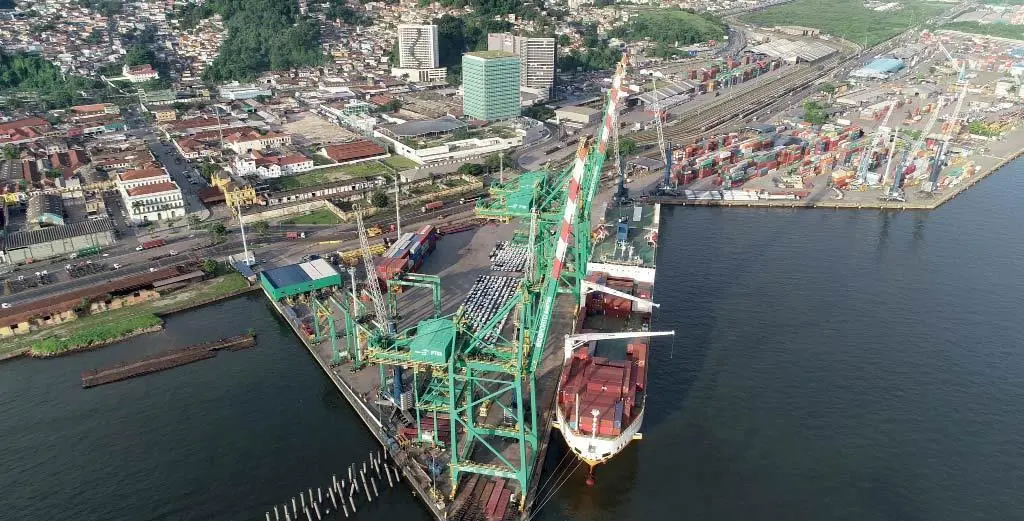
Is there enough bread for everyone at the Santos table? With Goliaths like BTP and Santos Brasil dominating with 80% of the 5m TEU market of Santos today, are the Davids, the smaller terminals, still viable for boxes without expensive expansion of capacity and longer term contracts? Or can only diversification keep them alive? Just as we went to press one of the “Davids”, Ecoporto Santos, was given a 6-month extension to its 25-Year contract that was due to expire, and now they are “optimistic” they will be granted a new 25-year concession in a new space at Saboó.
Santos, the biggest port in all of South America, has always been a key gateway for Brazil and especially the mega-city of Sao Paulo (metropolitan population of 22.5m and 47m in the state), and it is vital that it continues to grow and modernise as well as seek out its destined status as a “genuine hub port for Brazil and the East Coast of South America,” say various logistics experts.
However, there are clashes of opinion as to whether the means to that end, in terms of containerised cargo, are better served by one or two port terminal operators dominating the market or by multiple terminals. In the former camp are Brasil Terminal Portuaria (BTP, a joint venture between APMoeller Terminals and MSC’s port terminal unit Terminal Investment Limited) and Santos Brasil (a target for a Maersk or MSC to take-over). The latter camp comprises various interest including local players.
Port Strategy has written a few times about the grandiose expansion plans for BTP [and either/or Maersk or MSC individually] via the forecast STS10 tender process (for a gigantic 600,000 sq m new “Superterminal.” Since, however, the recent change in government in Brasilia (from right-wing, fairly open market Jair Bolsonaro to left-wing, statist and interventionist Lula da Silva), that process, is now under threat. On top of that the planned privatisation of the Santos Port Authority (SPA), via a master port concession has already been scrapped.
“We are now dealing with very different scenarios than under Bolsonaro and the plucky little companies, such as Ecoporto and Bandeirantes as well as others, are getting much more of a hearing from the Lula government, whose philosophy is not to let foreign, multinational companies dominate the infrastructure so much as before,” says one veteran Santos based shipping agent who possesses deep knowledge of the arcane workings of the Port of Santos, which many describe as similar to trying to work out what happens in the Kremlin. As Churchill once said; “The Kremlin is a riddle, wrapped up in a mystery, inside an enigma,” and many approach the opaque workings of Santos in a similar vein.
“Many of the smaller operators in the container sphere have struggled to survive and Libra Terminais, once a flourishing company with a 30 per cent market share, was liquidated in 2018,” notes the veteran, “and Ecoporto saw its container handling almost disappear.”
“What is known,” said the shipping agent, “is that various mergers and acquisitions – such as Alianca, Hamburg Sud, etc being bought up by Maersk and Log-In by MSC – saw fewer liner alliances, and those that were calling ECSA were becoming Verticalized and calling at their own terminals [like BTP or MSC in Navegantes or Maersk at Itapoa], creating vacuums in the White Flag operators such as DP World, Ecoporto and the various Wilson, Sons terminals around the country, namely in Salvador and Rio Grande.” He also pointed out that in Santos Maersk and MSC account for more than 60 per cent of all box moves.
“What is also known,” he added,” is that Ecoporto – which handled 363,000TEU back in 2014, when trading under the Tecondi banner – saw its container handling almost disappear and so had to diversify to survive.“
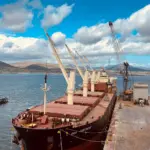
Indeed, three ZPMC Ship to Shore Gantry Cranes (SSGCs) straddle the piers at Ecoporto’s current Valongo facility, representing a living testament to the moribund nature of the container aspect to this once lively, locally owned box terminal, which now specialises in break-bulk vessels. If, under Plan A for STS10, Ecoporto had been required to give up its Valongo site to make way for the “Superterminal” it would have been compensated for the SSGCs and other (mostly Kalmar) equipment, says the company.
Ecoporto’s nadir was in 2018 when it handled just over 1000TEU (about 0.02% of Santos boxes that year) but it is now fighting back on several fronts, with breakbulk improving and it handled 44,000TEU (0.8% of Santos) via multi-purpose vessels in 2022. It also has a very good chance to get back into the container business in a much more ambitious way, if the Santos port jig-saw pieces fall into the right positions.
This would be the case if, as expected, the STS10 project is broken up into two or three lots, especially as the Concais Passenger Terminal is likely to move into part of the current Ecoporto site in Valongo, for which it will be compensated by the granting of land in the Saboó area, closer to BTP.
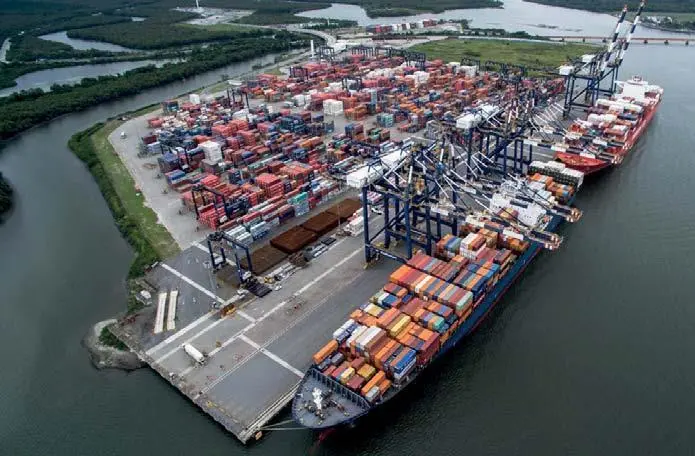
Luiz Araujo, Commercial Director, Ecoporto Santos, told Port Strategy that business has been “tough going” since the BTP project was up and running [it started in 2013 and by 2021 it was handling more than 43 per cent of the Santos box market], but last year was “the best for Ecoporto for nearly a decade”, with revenue up more than 25 per cent, at Reais630m (US$130.2m), compared to Reais500m in 2021. Although straight-forward container handling was in terminal decline – from five regular calls back in 2012 down to just one, from break-bulk and ro-ro specialist Grimaldi Line – Ecoporto has been specialising in Less Than Container Load (LCL) customers and diversifying more and more towards break-bulk and project cargo.
Regular calls from Grimaldi Line’s European service have provided containerised, break bulk and project cargoes (especially for the construction of a new facilities for cellulose producer Suzano at its Ribas do Rio Pardo plant in Mato Grosso do Sul) as well as from BBC Chartering, other break-bulk operators and various tramp vessels.
Staffing levels have been increasing again, up to 700 direct and 800 indirect, although still some way to go till they reach the levels of the halcyon days from 2013 to 16: with 1600 direct and 1600 indirect.
Despite the good news on several fronts, the lack of a concession extension has led, over the past year, to many LCL customers abandoning Ecoporto due to the “lack of certainty” over its future.
“We have been fighting to renew our long-term contract since 2014 and we are still fighting, but now we are far more confident,” Araujo states.
“We have struggled a lot since 2016 when we were hit by the triple whammy of an economic downtown in Brazil, the two new container terminals [BTP and DP World] ramping up their operations and the mergers and acquisitions among the shipping lines,” says a reflective Araujo, who has been with Ecoporto more than 20 years. “It became very difficult to try and deal with that level of competition but, thanks to the total support of parent company, EcoRodovias [which operates various toll roads in the south of Brazil], we survived and now, although not exactly thriving, we are doing well.
Some of the LCL customers lost by Ecoporto in recent months have headed for Bandeirantes which confirms that company’s status as the “leading LCL” player in the Santos market.
Washington Flores, CEO for Bandeirantes and Deicmar, says that with the flight of customers from Ecoporto it now has 70 per cent of the LCL market in Santos, and this has led to “turnover rising and a good profit for last year. The overall LCL market in Santos totalled 44,000TEU last year, with Santos Brasil now in second place, with 15-20 per cent, and Ecoporto trailing in third with 10-15 per cent.
Bandeirantes, which acquired the logistics company Deicmar (once the leading automobile handler in Santos) 10 years ago, moved into the LCL business at about the same time and, says Flores, is providing a “key service in an important part of the logistics chain”, namely for the “smaller companies who cannot make use of full container loads, so are therefore ignored by the mega carriers and terminals”.
Last year Bandeirantes handled some 20,000TEU of merchandise, about 45 per cent of the overall Santos LCL market.
A Cause Celebre for Bandeirantes – which specialises in customs clearance, separation and segmentation and delivery to customers as well as warehousing – was their handling of respirators for hospitals during the height of the Covid pandemic for which the company received many accolades from within the Santos port community and outside.
“The importers of the urgently needed respirators never had enough at any one time to fill a whole container so niche operators like ours could offer something that the bigger terminals could not,” says Flores. “We are very proud of the fact we handled 100 per cent of all the respirators in the ABC region [which includes the Sao Paulo cities of Santo Andre, Sao Bernardo and Sao Caetano] and Santos. It is situations like this that underline how important it is that there are many different companies of all sizes to serve all the needs of a major and complex port like Santos,” he contends.
Santos veterans like Flores and Araujo are firm believers that there is bread, and space, for port operators and logistics companies of all sizes, and they are hoping that Brasilia’s re-configuration of the STS10 project will see those niche operators continue in the port for a long time to come.
Related Articles
 SOUTH AMERICA
 PORT & TERMINAL NEWS
 PORT & TERMINAL NEWS