

Wing Kah-goh finds investment conditions on the ground in south Asia still hard to fathom
The truculent nature of south Asian ports still keeps investors on edge. Cancelled crane orders, delayed dredging programmes, peripatetic strikes, authorities taking terminal operators to court to try and cancel concessions - these are all regular minefields in this part of the world. Yet, belatedly the terminal build up across India and Pakistan is still one of the most vibrant seen anywhere on the globe.
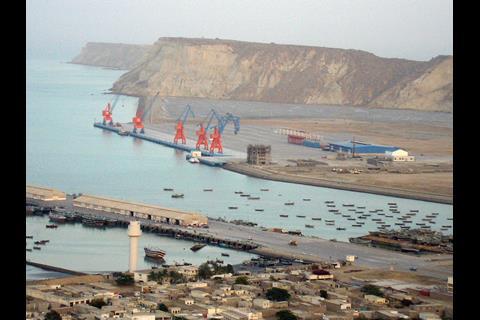
Starting in Pakistan, where PSA International started operating the "deepwater" port of Gwadar in late March. The port, a strategic investment by the Chinese to give the People's Republic access to the Indian Ocean, is not quite as deep as its backers had initially estimated it would be.
Strategically situated in the western province of Balochistan, just outside the Straits of Hormuz and near the key shipping routes passing through the Middle East Gulf the terminal was meant to have a depth alongside of 14.5 metres in order to handle post panamax containerships. This, however, has failed to arrive as has the necessary multimodal connections and now Port Strategy understands that a port just 50 km away across the border in Iran is gearing up to offer a deepwater alternative to Gwadar.
Pakistan's Federal Minister for Port and Shipping, Qamaruzzaman Kaira initiated a probe in May into what he described as the mishandled Gwadar Port project. "Deplorably, Gwadar Port is a mishandled issue as it is still lacking the connectivity network... there is no electricity there, rail route, roads nothing," Mr Kaira told the media at the inaugural ceremony of the Rs150m ($3.6m) KPT Overpass at Karachi Port on May 27.
Mr Kaira said Gwadar Port cannot be fully operational before the year 2011 as it lacks the required infrastructure, communication network and utilities.
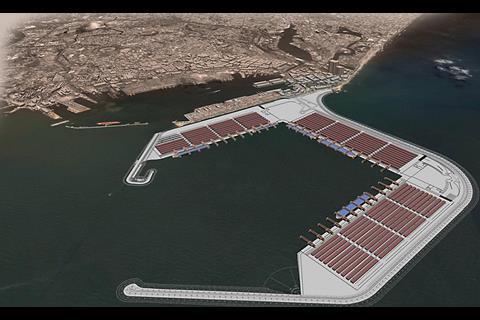
China's largesse in strategic port offerings that give it a foothold in key trade lanes also extends to Sri Lanka. Last October, the Sri Lankan government secured a 15-year loan to borrow $307m from China's Export-Import Bank to fund the construction of a new transhipment port in Hambantota, located in the southern part of the island. The giant port, which in all its phases could handle 20m containers annually, will also offer bunkering services.
"There are about 200 ships sailing close to Hambantota on a daily basis," a cabinet spokesperson told the press. "With the development of this port we can bring more business to Sri Lanka."
Hambantota, which is being built by the same state run Chinese harbour engineering firm that completed Gwadar, is expected to finish the basic works in three years.
Elsewhere on the island, new facilities, including four new container berths and more efficient handling systems, have been added in Colombo north port in the past 18 months. Colombo saw box throughput jump 10% last year.
Nevertheless, continued talk of mega hub status for Colombo port based only on location was rubbished earlier this year as "wishful thinking" by Sri Lanka Ports Authority chairman, Saliya Wickramasuriya. He pointed out that Sri Lanka was ranked 92 out of 150 countries in the World Bank's Logistics Performance Index for 2007, behind India at 39. Malaysia was at 27 and Indonesia ranked 43. Greater public-private partnership was needed, such as at South Asia Gateway Terminals if Sri Lanka is to improve its logistics competitiveness.
Across the channel in India the logistics ineptitude is very much under the spotlight.
The cost of moving a container by road from north India to Jawaharlal Nehru Port in Navi Mumbai, outside Mumbai on the west coast, has gone up by 12%-15% recently after truckers passed on the increase in fuel prices to their clients, says Priya Safaya Fotedar, director (policy) at the Federation of Indian Export Organisations, or Fieo, India's export promotion agency. Some 60% of India's export movements are on this route.
Moreover, shipping a box by rail leapt by up to 20% on August 1.
The inland transportation costs have always been high in India when compared with global standards. The cost of transporting a container over 1km in India is 50% higher than what it costs to move a container the same distance in the US, according to Kenneth Glenn, president South Asia and managing director, APL (India) Pvt Ltd, the Indian unit of Singapore-based APL Logistics.
The inland transportation costs in India are, at times, more than the ocean freight. The cost of moving a container from northern India to Mumbai is sometimes more than the cost of shipping a cargo container by sea from Mumbai to Dubai.
The increase in inland transportation coupled with rising port handling costs have added to the already high transaction costs in India. The country spends about $1,148 for handling an import container and $820 on an export container. In comparison, Singapore spends $367 on an import container while China spends $390 on an export container.
Because of the high transaction costs, small manufacturers are not able to penetrate the global market, says Sanjeev Rishi, an adviser to Worlds Window Infrastructure and Logistics Pvt Ltd, which runs an inland container depot at Loni in Uttar Pradesh.
Construction on the dedicated eastern and western rail freight corridors has started this year.
The works on the eastern freight corridor from Ludhiana (Punjab) to Dankuni, situated near Kolkata (West Bengal), and the Western corridor from Delhi to JNPT (Jawaharlal Nehru Port Trust, Maharashtra) will speed up exports for shippers. A north-south dedicated rail freight corridor is now being eyed.
Compounding the logistical cluster bomb, a report by Ernst & Young titled "Transforming Indian Ports into World Class Facilities", issued this May said that Indian ports are running at near to their full designed capacity.
The report stated that the ports are currently running at 90% of their capacity and need better information technology systems to handle current throughput, much less the volumes projected over the next five years.
Though India is planning to double its port capacity over the next five years, the report suggests that this increase may not be enough to stop the port congestion issue from hindering India's growth.
The authors also said that increased privatisation is a must to cope with India's 12% year-on-year cargo volume growth.
The merchandise exports of India have almost doubled in last three years to $127bn in 2006-07. The growth is expected to continue to remain strong despite the rupee appreciation against the dollar on the back of productivity improvement and an increasing proportion of value addition in export goods. The merchandise export is projected to increase at 13% per annum underlying the need for large investments in port infrastructure.
Up to 11 urgently needed major port projects are scheduled to be given away to private sector players this fiscal year in India. Generally foreigners have to bid in consortiums with local partners to stand a chance of winning a concession. Among the most attractive concessions on offer this year is a large fourth terminal at Ennore project on the east coast.
According to sources close to the government, the Tariff Authority for Major Ports will then enforce tariff caps that will be reviewed every five years.
Tariff caps will be indexed to inflation but only to an extent of 60% of the variation in wholesale price index occurring between 1 January 2008 and 1 January of the relevant year. Such automatic adjustment of tariff caps will be made every year. These new tariff arrangements do not apply to existing terminals.
India is likely to have a box terminal operator of some scale in the form of the nation's top shipping line. Shipping Corporation of India (SCI) Ltd, India's shipping major, will build two of the country's largest container terminals - one each at Navi Mumbai and Ennore ports. Navi Mumbai port is managed by the Jawaharlal Nehru Port Trust (JNPT).
"We are planning to set up a fourth terminal in JNPT and a container terminal at Ennore, each having a capacity of 4m teu. These will be the largest terminals in the country," said S. Hajara, chairman and managing director of SCI, earlier this year.
At present, three terminals each for both JNPT and Ennore together have a capacity of 4m teu.
SCI plans to set up the terminals through a joint venture consortium with partners such as Mediterranean Shipping Company and Concor.
Mumbai Port and nearby JNPT continue to be the leading box terminals in the country. A range of new Special Economic Zones in the area plus continued investment from DP World should ensure its primacy continues.
Over at Tuticorin port, a global tender has just been unveiled to dredge the main channel from 10.7 metres to 12.8 metres. The cost of the dredging has been estimated at Rs538 crore, which would be funded through internal resources and through a grant of Rs188 crore from the central government. Dredging is set to start early next year, due for completion within the first quarter of 2010.