



Under analysis
Ports are playing catch-up in the adoption of business analytics. Felicity Landon reports.
When compared with other industries such as retail, the ports sector is behind in the widespread adoption of analytics, according to global management consultancy Accenture. “Fewer leading companies in this industry have grasped the full potential of actionable insights that analytics can bring,” says Fox Chu, a director in the company’s infrastructure and transportation practice in Asia Pacific.
So why is that an issue? “Ports play a significant role in the entire logistics eco-system,” he says. “With the integration of the global supply chain, the role of ports has changed from ‘lifting boxes’ to ‘trade facilitator’. In the era of the internet, data is widespread and consumer behaviour is more dynamic than ever. This means that the operating models for retailers, manufacturers, logistics providers and carriers are all changing – ports must realise that they are not immune to this.”
Traditionally a port’s business thrived on economies of scale and the formula to succeed was ‘mass production’ but this has evolved and now service delivery is increasingly becoming of equal importance, says Mr Chu. That requires ports to provide more customised services for different segments of customers in order to fulfil their port function.
“This applies equally to a gateway port, a transhipment hub or a feeder port, because a port’s operating model has moved to one of ‘mass customisation’. This means that those ports seeking to deliver the highest performance must embrace the use of analytics to optimise customer profitability, determine service levels and estimate cost-to-serve.”
More please
In addition, the ability to safeguard a reasonable level of productivity and asset utilisation can benefit from the application of analytics, says Mr Chu. “Old-fashioned metrics like teu handled, berth-on-arrival, vessel operating rate, etc., are just part of the equation. The leading ports and their operators need more to determine their success.”
Accenture recently worked with Shekou Container Terminals in the Port of Shenzhen, helping the container terminal operator to improve its cost management and governance capability and enhance performance management.
This included, over an 18-month period, defining the cost ownership structure and key performance indicators; designing a cost-management dashboard to report cost monitoring, tracking and control; implementing the cost management system with the client’s IT department by customising Accenture’s Terminal Performance Management system; and providing guidance on the definitions of cost management and governance processes and workflows.
“Shekou Container Terminals now has the ability to proactively monitor and control costs,” says Michael Zhou, general manager of the terminal operator. “This capability is critical for our ability to compete successfully in today’s port environment and provides us with the cost awareness we need to sustain future growth.”
The company says it achieved double-digit cost reduction but, importantly, also gained the foundation needed to improve its cost structure continuously, not just for one-off cost cutting.
Another specialist in this field is Access Group, which designs and implements integrated business management software. The group is expanding fast, having completed seven M&A deals in the past 12 months, including Delta Software.
Cross check
“Working with both ports and marinas, we find that the use of cross database analytical tools to help identify opportunities is not widespread at present; there’s still a tendency to rely on traditional analysis tools such as Microsoft’s Excel, with manual processes in place to pull KPIs together,” says Richard Gyles, business intelligence sales manager for Access Group. “This can have a tremendous impact not only in terms of the hours consumed collating and presenting the information in a usable form, but also on a port’s responsiveness to change as a business.”
Without analytics it is hard for ports to analyse business trends such as the types of customer they are increasingly serving or changes in the products that they are dealing with and when, he adds. “As a logistics business, they need to have real-time data so that they can quickly adapt to maximise profits and schedule investment ahead of the competition.
“Having access to core data in real-time assists ports in pinpointing inefficiencies within the business and how they can become more cost-effective, refine or eliminate unnecessary processes and improve the services they provide. Spending time focusing on business improvements and better service provision is essential if ports are to gain a competitive edge.”
Access is currently working with a major distribution company to help the company understand the impact of busy periods on business profitability, using its business intelligence solution Access Insight to identify labour costs versus standard warehouse KPIs such as picking rates and put-aways. “This allows the client to see where the efficiencies change – not after the event but as they occur, so they can take immediate action,” says Mr Gyles.
He believes that by integrating business analytics into their software systems, ports can be more ‘nimble’ in their approach and service delivery. “Managing port services is a result of complex procedures and being able to take account of the unexpected. Technology can play a massive role in maintaining better control of the business, as well as unlocking the rich source of information within it and helping to support more decisive action.”
Joined-up
According to Accenture, ports must address three critical areas of business capabilities – terminal performance management, terminal enterprise management and terminal operations management.
Mr Chu says: “In our experience, we have seen many ports ‘abandon’ a big source of differentiation – their data. Unfortunately, the levels of system integration in the port industry are far behind many other industries and this leaves sets of data sitting in different isolated islands. Customer information, terminal operational information, asset utilisation and billing details are often siloed instead of being integrated. Many ports are not even able to work out a true cost-to-serve value for specific shipping lines, despite offering different service levels. Without data integration, any good intentions they have for the application of analytics will be in vain.”
The good news, however, is that ports should have the foundation for solid and productive use of analytics, using the data they have available, says Mr Chu. “Where they need to invest is the integration and application of analytics and tailor this for their port’s positioning.”
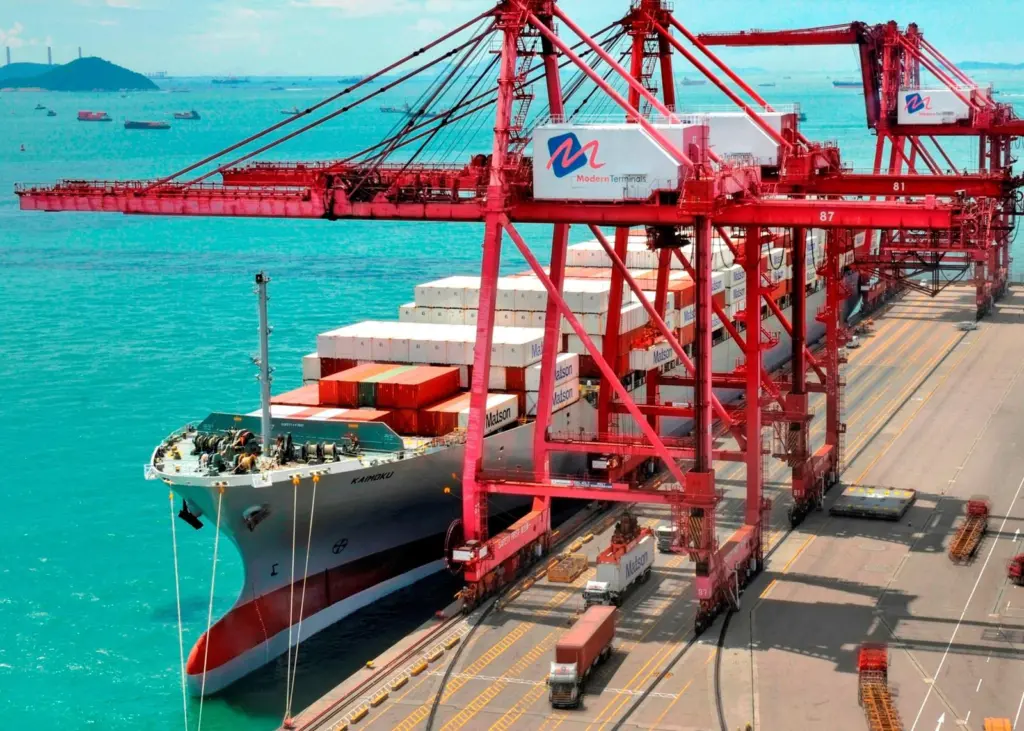
Among other projects, Accenture has worked with Hong Kong-based container terminal operator Modern Terminals on issues such as Enterprise Resource Planning implementation across multiple business units, and the design of a shared service model which enables better standardisation of best practices and drives efficiency across its ports and business units.
Related Articles
 BULK HANDLING
 BULK HANDLING
 PORT & TERMINAL NEWS