


Two key West Mediterranean ports discuss their continued commitment to long term expansion plans with Alex Hughes
Both Barcelona and Marseilles-Fos are funding major container expansion schemes in anticipation that the current economic downturn will not last, but despite this brave face, throughput at both has worryingly decreased in recent months.
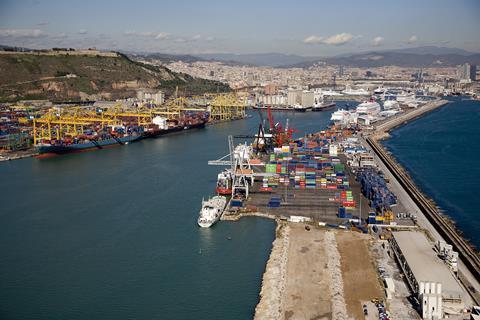
Last year was an historic year for the Port of Barcelona: for the first time ever container throughput actually decreased, falling 1.5% to 2.57m teu. According to Rosa Puig of the port authority's marketing and commercial department, traffic was actually up for the first ten months, only to plunge dramatically during November and December, with the trend continuing into early 2009.
"The impact of the global crisis was so sudden and so widespread, while at the same time completely unexpected," she says.
Although imports were down, exports performed better. In addition, traffic to markets where the port authority has undertaken marketing drives, such as China, Morocco and Algeria, continued to show growth.
"We have made great efforts to ensure that Barcelona has a good mix of both transhipment and import/export traffic, so if one area comes under pressure it will be compensated for somewhat by the other. We have also invested heavily in trade with China, going as far as to sponsor the Sinotrans trade show in Hong Kong last year and will also sponsor the Sino-European Forwarders Conference in October in Barcelona," says Ms Puig.
The port authority has also pursued a policy of expanding its hinterland, which Ms Puig says naturally extends to about 700km in all directions. In addition to holding equity stakes at inland ports near Madrid, Zaragoza and Toulouse, a new three-times-a-week rail services was launched to Lyon in 2008, which has indirectly boosted Barcelona's trade with Asia.
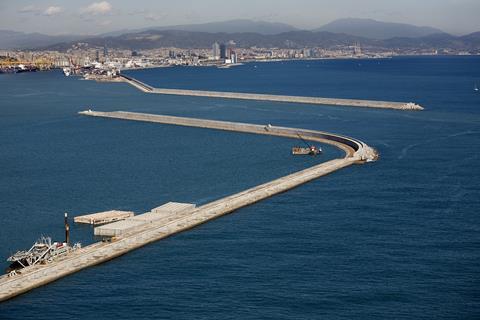
Investment, which Ms Puig stresses is guaranteed, is being poured into the development of container handling facilities in the port. The new El Prat quay will be home to the state-of-the-art Tercat terminal, a joint venture between HPH and the Mestre family. Unfortunately, construction is running two years behind schedule due to the collapse of the quay wall in January 2007. However, the 350,000 square metre operating area will mirror that at TCB, whose own terminal is being expanded to enable it to compete on an equal basis.
"Tercat had to rent some extra space in the adjacent free zone to stack containers because of the delay in moving to El Prat. The terminal is already justifiably famous for the high throughput it squeezes out of the limited operational area is currently has. However, such is the high level of productivity it offers that the world's number one and number two shipping lines, respectively Maersk and MSC, both tranship there.
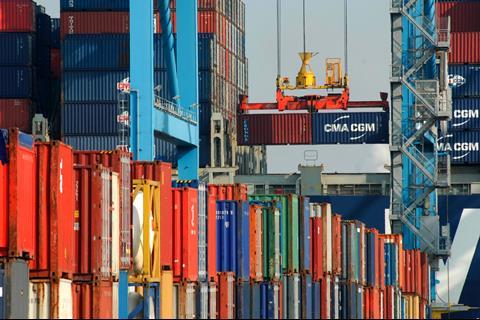
"At the same time, TCB has also recently benefited from the transfer of two new additional operating areas to its concession, where it will be able to handle growing throughput from clients such as CMA CGM, the New World Alliance and Cosco," says Ms Puig.
Nor is she particularly phased by the recent arrival of DP World at Catalonia's other main port: Tarragona.
Although barely 100km by road from the Catalan capital, incumbent box stevedore Contarsa failed to attract any major lines to its facilities for a number of years. However, ZIM, TCB's main transhipment client, has also decided to buy a stake in the Tarragona terminal and has moved its main West Med hub there. Despite this, Ms Puig believes that ZIM will have to continue to use both ports, which could mean an increase of feeder traffic for Barcelona over the longer term.
Ms Puig also dismisses any suggestions that Tarragona has any main advantages over Barcelona in terms of box traffic. Road congestion, she says, is not a particular deterrent when doing business with the Port of Barcelona. Indeed, the port community nowadays benefits from an IT system that allows road haulage companies to pre-book slots, so that trucks can get in and out of the port much faster than before.
In summary, she says that: "At Barcelona, we are implementing a policy to expand our container handling capacity in an initial stage to 5m teu and ultimately to 10m teu. This is a wholly realistic aim, especially given the arrival of Hutchison as a majority shareholder at Tercat. Being based in Hong Kong, HPH is ideally placed in terms of contacts to help attract further container traffic to our port. At the port authority, we are supporting this, by locating a sales office there, too, and making Chinese traffic a particular focus of our expansion plans."
Meanwhile, in line with other Western Mediterranean ports, Marseilles reported a decrease in box traffic last year, says Chantal Helman, the port's strategy director. A dip of 15% brought throughput below the 1m teu level to just 847,651 teu on the year.
"Container activity appears most affected by the world economic crisis and, as a direct consequence, the downturn in world trade, particularly with regard to traffic between Asia and Europe," she says.
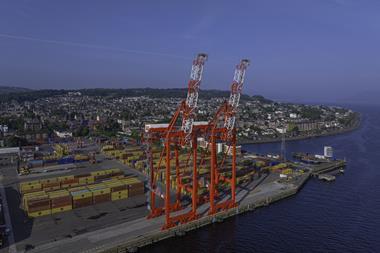
The recently announced approval of the port's strategy and ¢600m ($799m) investment plans up to the year 2013 includes the transfer of container and dry bulk cargo handling to private operators, which has become a requirement of the French port reform law passed last July.
The strategy envisages container traffic reaching 5m teu by 2020, establishing Marseilles Fos as one of the top ten box handling facilities in Europe. By 2013, the intention is to move up to at least 15th place, compared with the 20th position it reached in 2007.
Part of this increase will be made possible by the opening of expansion areas, such as Fos 2XL, which is due to open in 2010, as well as 3XL and 4XL.
"The Fos 3XL and 4XL container terminals are projects for the mid- and long-term. They are slated to open in 2015, with 35-year operating agreements to be awarded. In this context, the current world economic crisis - important as it is - can in the worst case only slow down the negotiating procedures with the potential operators, but in no case will it call into question the projects," she says.
The Distriport logistics zone will also be expanded, while a canal link between the container terminals and the inland waterways network is also to be completed. Road access to Fos will be upgraded and capacity on the Fos rail network doubled thanks to a signal modernisation programme.
In the meantime, the port authority continues development of its inland connections as a means of expanding its existing hinterland. This is considered to be central to the port's future growth. To this end, late last year, Marseilles Fos initiated a promotional partnership with eight inland ports serving its crucial north-south hinterland along the Rhone-Saone corridor.
Currently, around six million tonnes of rail and river cargo use this corridor, with in excess of 125,000 teu carried by rail, equivalent to more than 10% of the port's overall throughput. The water way system, for its part, accounts for around 60,000 teu.