COVID-19 meant that 2020 was a very challenging year for north European ports, entailing a switchback ride for trade and an array of differing results. The outlook remains unclear, so what does this tell us, asks leading analyst, Andrew Penfold?
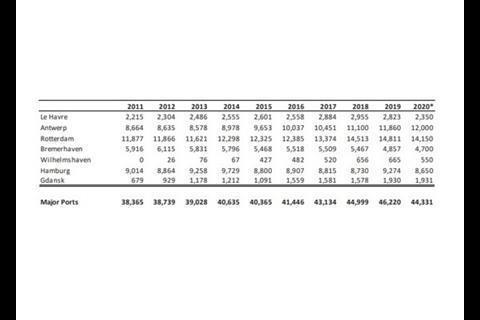
Container volumes at major North Continent ports are expected to record some 44.3m TEU in 2020, reflecting an overall drop of around 4.1 per cent over the previous year. From the current perspective this can be seen as quite a positive outcome given the depth of the crisis noted in the first half of the year. But what actually happened?
Figure 1 summarises volumes for the major ports over the period since 2011.
A ROUGH RIDE IN 2020
Initially, the focus of the uncertainty was on the Asian trades with the relative role of China being the key determinant of volumes. Thus, the first quarter of 2020 saw a shutdown in China as the impact of the virus accelerated with an immediate supply-side impact on supply chains – with liners introducing blank sailings. The impact only began to be manifested in Europe at the end of the first quarter with the greatest damage done to volumes at ports where Chinese volumes were most important – i.e., at Rotterdam and Hamburg. In addition, Le Havre was adversely impacted by strikes at that time.
In the next few months – through to the middle of the year – the position worsened. Although China opened-up again for exports there was a decline in demand in Europe as the various lockdowns slowed the economy. In this period, only Antwerp broadly maintained volumes with other major ports seeing demand declines of up to 20 per cent. Some signs of growth were noted in the third quarter, but container activity was sluggish, with deferred demand driving some growth but this was offset by supply-chain uncertainties.
The final quarter saw a strong recovery as optimism returned and pent-up demand saw a sharp recovery in overall growth and – indeed – a decline of just 4.1 per cent can be seen as positive given the position earlier in the year. More recently, renewed weakness has emerged as lockdowns once again undermine demand and increase uncertainty.
UNDERLYING TRENDS ASSERTED AGAIN
Overall, the impact of the crisis on 2020 container volumes was less than had been initially feared but some significant trends and differences have emerged. Some major ports have been particularly badly hit whilst for others the impact has been minimal. Why is this?
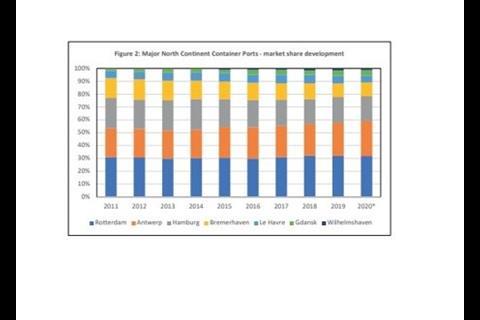
The COVID-19 crisis has underlined some trends that were already impacting the market. The process of demand concentration at the largest ports has continued with lower volume ports such as Le Havre and Bremerhaven seeing further drops in market share as lines have sought to focus activity on the largest facilities. This trend was intensified by the acceleration in the deployment of the largest vessels on the Asian trades.
As shown in Figure 2, Antwerp has continued to increase its market share in the range, rising from 25 per cent in 2018 to over 27 per cent last year. This reflects several factors relating to cost and efficiency, but it should also be noted that China is less significant for Antwerp than for other major gateway ports.
Indeed, a dependence on Far East (specifically Chinese) demand has proved to be a double-edged sword in 2020, with an over-reliance on these trades exposing vulnerability to a downturn. This will continue until alternative Asian suppliers increase volumes and substitute for an increasingly problematic reliance on China. A diversified regional cargo base is a clear advantage.
The other important point to note is that Gdansk in Poland has maintained volumes despite the importance of Asian trade in its profile. The migration of Baltic feedering demand from established North Continent terminals into the Baltic is an important and continuing trend, as was the relative robustness of the Polish economy noted over 2020. Rotterdam remains a bell-weather for the market as a whole and has broadly recovered its market share despite the sharp (seven per cent) contraction noted in the first half of 2020.
WHAT ABOUT TRANSSHIPMENT?
At present, comprehensive data on transshipment volumes at North Continent ports is only partial. However, the general shape of development is becoming clear. On the one hand, the increased penetration of larger vessels has continued to drive greater demand for transshipment to achieve acceptable load factors. Set against this has been the ability of ports to berth these vessels despite perceived constraints with regard to both length (LOA) and draught. These vessels have been squeezed-in despite constraints on several occasions.
More importantly, transshipment is most significant where the size differential between the mainline vessel and the feeder is greatest. So, transshipment is focused on the Asian trades. This reliance has amplified the impact on total volumes for those ports most dependent on Chinese trades – both negatively in the first half and in the other direction during the recovery phase.
Transshipment has thus proved highly volatile during 2020, although there are exceptions where transshipment is used to link discrete deepsea trades (‘interlining’ or ‘relay’) which in contrast to ‘hub-and-spoke’ activity has been less severely impacted. Antwerp has benefited from its role in this sector.
Overall, the impact of the COVID-19 pandemic on transshipment in 2020 has been broadly neutral, although one aspect of current developments – improved liner profitability – may well see increased pressures to bring feedering in-house rather than continue the recent trend of greater dependency on third-party providers (at least in northern Europe).
AND SO, WHAT DOES 2021 HOLD?
The position remains extremely uncertain. With overall demand showing only a limited decline in 2020 it is clear that the macro-economic fallout from the COVID-19 crisis has yet to be realised. Demand has been maintained by government stimuli and debt has increased. It is unlikely that this will be turned off in the short term but it’s unsustainable even if the level of infection stabilises and then declines.
In the short term, at least, further Chinese-led pent up demand recovery will continue. The macro-economic hit will come, but probably not until the second half of 2021. In the meantime, further demand expansion can be anticipated.
There are longer term questions being asked and these are focused by the current reliance on China as the primary source of manufactured imports. The COVID-19 crisis is just one factor calling this into question and it seems likely that a broader sourcing policy will be initiated that increases the emphasis on other Asian sources and greater near-shoring.
The port implications are unclear but overall volumes may grow more slowly in the medium term and until export terminals are developed in other Asian suppliers there may be slower take-up of demand for the largest vessel classes. Generally, trends in 2020 have accelerated shifts that were already underway.