![PortStrategy[GreenPort]](https://www.portstrategy.com/wp-content/uploads/2026/09/PortStrategyGreenPort.svg)






Eastern promise
A strong yen and rising growth have boosted cargo movements at Osaka, finds Tim Maughan
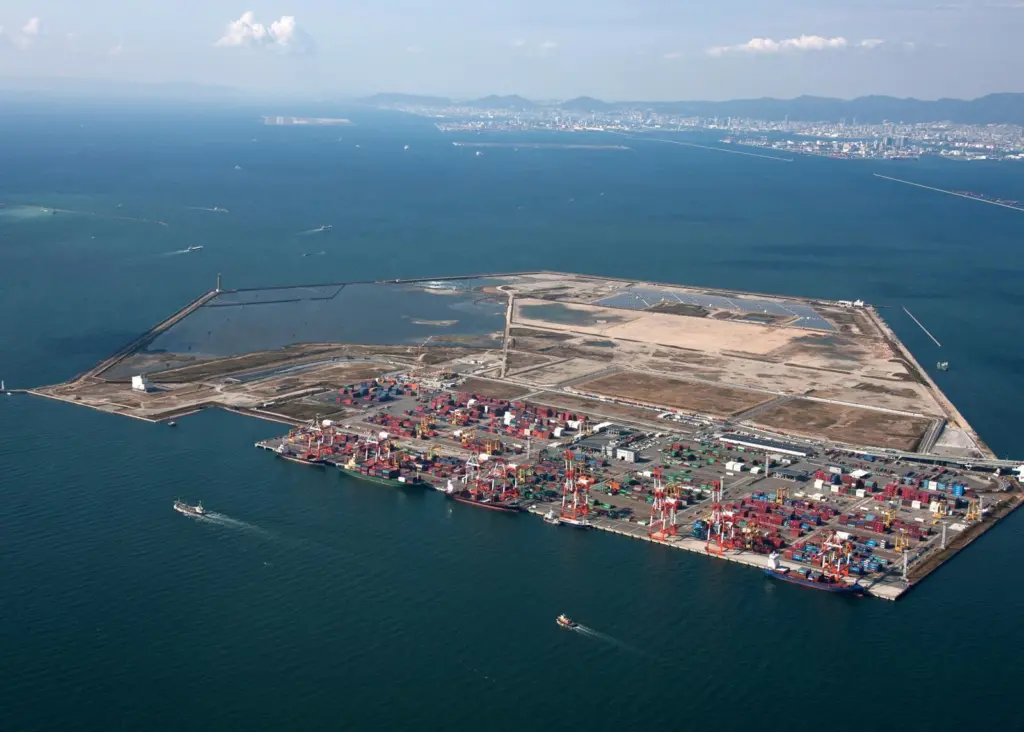
Like many industrialised countries, Japan has a trade deficit to shoulder. But, for the country’s ports, that is not necessarily a bad thing: imported goods mean steady, large-volume business, even if they overshadow exports. Plus, there is domestic cargo. Osaka Port handles large quantities of both, and is continuing to invest in major capital construction projects.
Osaka is the fourth largest port in the country, measured by foreign trade container volume. Its total area water stands at 4,684 hectares; in the calendar year 2013 it handled 2.19m teu, internationally.
The gradual changes in the Far Eastern port sector are exemplified by Osaka’s import figures. Many famous Japanese companies have moved their production overseas, Akira Sakai, chief for port promotion, tells Port Strategy. That fact, along with the rapid expansion of both manufacturing, and ports in other Asian countries, accounts for an unbalanced import/export picture.
In 1985, Osaka handled 13.5m tonnes of imports. In 2000, that figure was 24m. In 2013, imports stood at 27.5m tonnes; the same year, Osaka exported 9m of goods.
Mr Sakai points out that no new industrial complexes are being built in the Osaka area, and that, unlike other Asian cities, Osaka itself is not seeing a construction explosion. But it is the biggest city in Japan’s Kansai region.
Along with other large cities like Kyoto and Kobe, the wider Kansai area has a population of over 20m. Cars, steel, and other industrial materials account for most of the exports from Osaka Port; 56% of its total overseas trade is with China, 25% with South East Asian ports, 12% with South Korea, and 7% with the rest of the world.
Mr Sakai says: “Imports exceed exports by three times, but looking at the total figures, the port deals with a total of 36m tonnes of international cargo, which is good business. It (the trade imbalance) doesn’t mean read ink for the port management.” Domestically, the figures are larger, with 50.5m tonnes of cargo being handled in 2013.
Dream catcher
The port is run by the City of Osaka; it is not a privately-owned concern. Mr Sakai spreads a large map of the port across a table. International and domestic ferry terminals are to the south east.
To the west lays Sakashima Island. Like much of the port, which traces its roots back to the 7th century, it stands on reclaimed land. Berths C-1 to C-9 range from 300m to 350m in length, with depths of 13m to 14m. “We are shifting the centre of container handling to Yumeshima Island (meaning, in English, “Dream Island”). It will take 10 to 20 years to complete the whole area, and it will operate in addition to Sakashima.”
Increasingly larger vessels, and requests from operators for deeper water, have led to extensive dredging work. To date, a quarter of Yumeshima is operational, with three berths currently in service – C-10 and C-11, both with a length of 350m, and a depth of 15m; and C-12, 400m long and 16m deep. C-12 is currently being extended by 250m, to a total of 650m; all three wharves have been designed to be earthquake resistant. By 2020, the port’s main channel will also have been widened and deepened.
In addition to the large international container terminals, there are also more specialised wharves: Maishima Wharf, which handles car carriers and fresh fruits and vegetables; a dedicated foodstuffs and lumber facility, as well as a chemical wharf.
Osaka Port’s big projects have been subsidised by the national government over the years, and the City of Osaka has sold bonds to help meet expansion costs.
As well as shipping activities, extra revenue is generated by renting out land to logistics companies, says Mr Sakai. As the Japanese economy picks up, and prices increase, he adds, there are also plans to sell some land off.
At the same time, the port needs to look at the wider strategic picture, which is shaped by what happens overseas – and the need to cater for increasingly bigger ships, and continue its construction projects.
The Japanese government is keen to increase port traffic, nationally, and has chosen the ports zones of Keihin (Tokyo, Yokohama, and Kawasaki) and Hanshin (Osaka and neighbouring Kobe) as top of their list for investment. At the same time, the new superpower just to the west will continue to have an impact on Osaka Port, irrespective of whether that means imports rather than exports.
“The growth of the Chinese economy will increase Osaka’s cargo volumes – so that is good for us,” Mr Sakai states.
Related Articles
 CONTAINER & CARGO HANDLING
 CONTAINER & CARGO HANDLING
 BULK HANDLING