![PortStrategy[GreenPort]](https://www.portstrategy.com/wp-content/uploads/2026/09/PortStrategyGreenPort.svg)





Deeper equals cheaper
Brazils Pecem is expanding with traffic growth in mind as Alex Hughes finds out
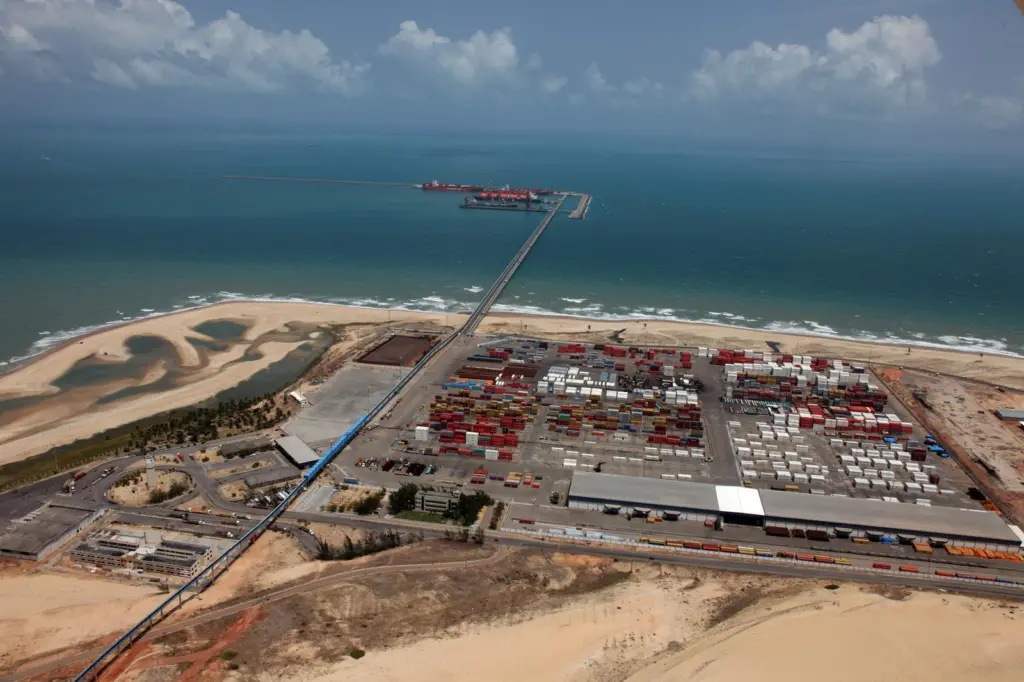
The Port ofPecém reported total traffic of 8.2m tons in 2014 compared with 6.3m tons in 2013, equivalent to growth of 31%.
Erasmo da Silva Pitombeira, president of port company Cearáportos, characterises Pecém as essentially a raw materials import-export facility.
“What makes the Port of Pecém stand out is that it has been built offshore. Being away from the coast line means it has a natural draft of 17 metres and therefore requires no dredging. Once you take dredging costs out of the equation, the port is able to offer extremely attractive port charges,” he says.
It is these tariffs, he argues, that primarily attract the major shipping lines, along with modern infrastructure and state-of-the-art handling equipment.
“We also have a lean management structure. And when you take all these factors into account, it becomes clear that not only is Pecém in the vanguard of ports in the north-east, but also in the country as a whole.”
While the current layout encompasses six berths, by 2016, the port is aiming to be operating no fewer than 16.
“Pecém enjoys a prime location. On long-haul routes, we are often the first port of call, so cargo invariably arrives on time, since there are no intermediate stops. We are six days steaming from the US East Coast and seven from Europe,” says Mr Pitombeira.
Cargo breakdown
Using figures from the first half of 2014, he explains that main exports were solid fuel (2.726m tons), minerals (171,000 tons) and fruit (23,000 tons). As for imports, solid fuel, at 1.9m tons, topped the list, followed by iron and steel products at 582,000 tons and cement at 375,000 tons.
In addition to being a specialist port for fruit and fresh fish, Pecém also sees significant movements of textiles, footwear and, increasingly, clinker for use in local cement production, where the port is now Brazil’s most important. In addition to steel products, recently, it has also seen a rise in imported coal for use in both electricity generation and latterly for the local steel industry.
Quizzed as to capacity, he points out that the port has more than enough of this to handle existing levels of traffic.
“Given the constant growth in cargo, we are pushing ahead with expansion of our facilities,” he says.
This expansion includes a new access bridge to the existing breakwater, which is also being expanded and paved. The connecting bridge will be widened and three new berths built: two for Pecém Steel Company (CSP) and one for the Nova Transnordestina railway company. It is expected that this latter will start operations at this berth as of the first half of 2016.
Mr Pitombeira explains that the government of the State of Ceará is making available $216m for the port’s expansion in the current year.
Pecém is also ramping up operations at its container terminal, Terminal Portuário do Pecém (TPP), for which two new quayside gantry cranes are on order. These will be deployed at three new dedicated berths.
“We aim to put these into operation in the first three months of 2015, which will help consolidate the port’s position as a regional hub,” says Mr Pitombeira.
TPP first began operating in 2002 and became the focus of routes serving the US East Coast, South America and the Caribbean. Today, it has weekly connections with many ports worldwide. With the new Terminal de Múltiplo Uso also coming on stream, the Port of Pecém can handle up to 750,000 teu annually. In 2014, throughput amounted to 195,350 teu, compared with 148,979 teu in 2013, a growth of 31%.
Both the road and rail networks serving the port are being expanded: the state government has completed the widening of the main highway access, while completion of the Transnordestina railway will boost the port’s cargo flow.
“We expect the rail link to be fully in place by the first half of 2016,” says Mr Pitombeira, adding that, while Pecém does not suffer from the almost chronic queuing nowadays associated with major agribulk ports, certain cargo flows to the port do still encounter delays. However, he believes that with all the improvements under way, such problems should soon be a thing of the past.
Related Articles
 CONTAINER & CARGO HANDLING
 CONTAINER & CARGO HANDLING
 BULK HANDLING