![PortStrategy[GreenPort]](https://www.portstrategy.com/wp-content/uploads/2026/09/PortStrategyGreenPort.svg)






A fruity mix
Hueneme’s dominance in perishable goods handling kept the US labour dispute at bay. Martin Rushmere reports
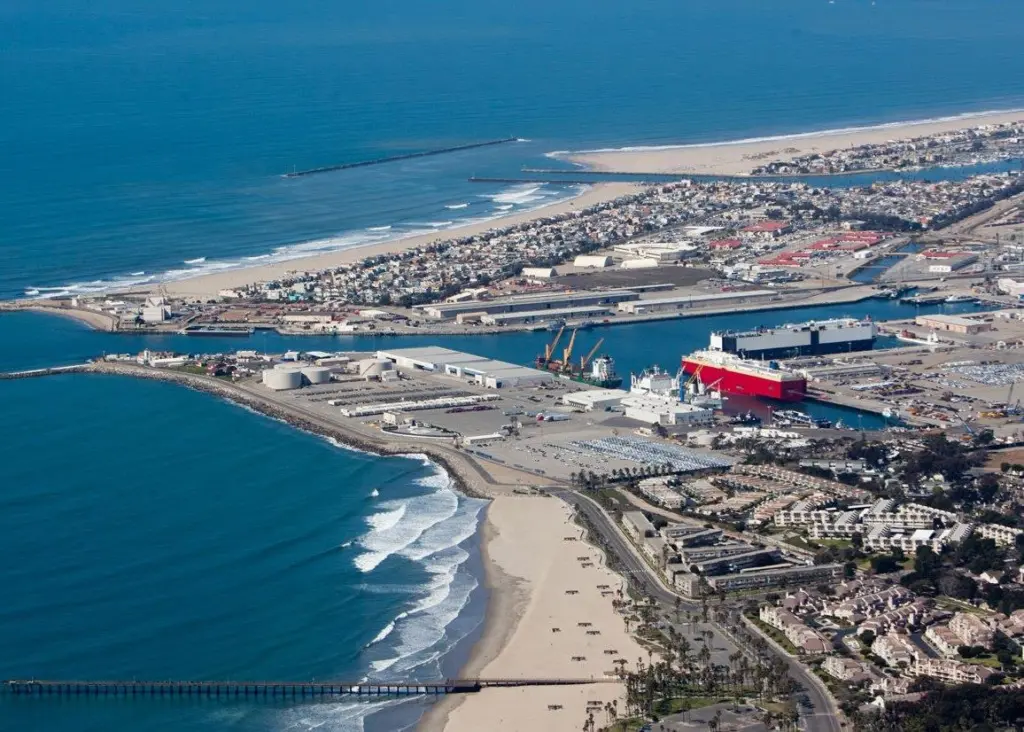
Port of Hueneme, about 100 kilometres north of Los Angeles and 500 kilometres south of San Francisco, largely escaped unscathed from the slowdown and congestion that plagued so much of the US West Coast.
Industry executives attribute this to its small size, overwhelming reliance on breakbulk cargoes and a realisation by both the trade union and employer association that so much of the cargo handled is perishable.
“Huge amounts of fruit, especially bananas, go through there,” says an executive, “ and congestion on the scale that hammered LA/Long Beach would have really spelt trouble for the port, with tens of thousands of tonnes left to rot. Hueneme let the contract negotiators know exactly the situation – and common sense prevailed on both sides.”
In the first eight months of the fiscal year that ends on June 30, cargo volumes and revenue were 7%-10% better than in the same period the previous year. “We had forecast a 5% increase, so the numbers are really good,” says John Demers, chief operations officer. In the fiscal year to June 30, 2014, 655,589 tons of bananas and 115,257 tons of fresh fruit were handled, accounting for 23% of operating revenue. Fiscal 2014 saw a record high of operating revenue at $14. 3m, of which two-thirds was from vehicles and automobiles – vehicle exports increased 30%.
Recent reports from consulting economists in California have noted that there has been a surge in vehicle imports and exports and it is likely that this will benefit Hueneme. The three most important port tenants are Global Auto Processing Services, Wallenius Wilhelmsen Logistics and BMW North America, which account for about 35% of total revenue.
Says a port spokesman: “We are in the process of completing our Strategic 2020 plan, which looks at improvements through a five-year lens and incorporates a longer-term planning approach that ensures responsiveness to the global marketplace.”
“Improvements on the horizon include enhancements to shore power that will provide for three simultaneous vessel plug-ins, as well as a battery storage system to minimise peak demand loads,” says the spokesman. “The plan also calls for a deepening of the channel, turn basin, and berths to 40 feet in order to accommodate larger vessels. Other provisions include the installation of an environmentally-friendly treatment facility for imported produce, the possible expansion of the south terminal wharf space, and the enhancement of container handling abilities.
Customer focus
“The plan is a reflection of the long-term commitment to outstanding customer service,” says Kristin Decas, port director and chief executive. “Sometimes our customer reach can go surprisingly far,” adds Mr Demers. “Recently, companies that routinely use Los Angeles and Long Beach had vessel calls at Hueneme. We’re confident that these customers were sufficiently pleased to return for future calls.”
The port says that one of the advantages of its development plan is that acre-for-acre, it ranks as one of the highest volume ports on the Western Seaboard. “It also offers the promise of stability, having functioned as a landlord port with no intention of changing to an operating port model or any other configuration,” says the spokesman.
The port is the operating name for the Oxnard Harbor District, which is a Special District formed in 1937 under the Harbors and Navigation Code of the State of California. It is independent from the City of Port Hueneme and Ventura County.
The Oxnard Harbor District’s policies are set by a five-member Board of Harbor Commissioners elected at large from the district. Day-to-day business operations of the Harbor District are administered by the chief executive, port director and their team.
The port plays a pivotal role in the economic health of the county and state. According to its own statistics it handles over $8bn in cargo annually, generates $1.1bn in economic impact, pays $69m in annual taxes and provides more than 10,226 direct, indirect, induced and influenced jobs regionally.
Its top trading partners include: Austria, Brazil, Canada, Costa Rica, China, Ecuador, Germany, Great Britain, Guatemala, Japan, Korea and Mexico.
Related Articles
 CONTAINER & CARGO HANDLING
 CONTAINER & CARGO HANDLING
 BULK HANDLING