![PortStrategy[GreenPort]](https://www.portstrategy.com/wp-content/uploads/2026/09/PortStrategyGreenPort.svg)





Russian rollercoaster
Global Ports has learnt to take the rough with the smooth in the Russian box market. Alex Hughes reports
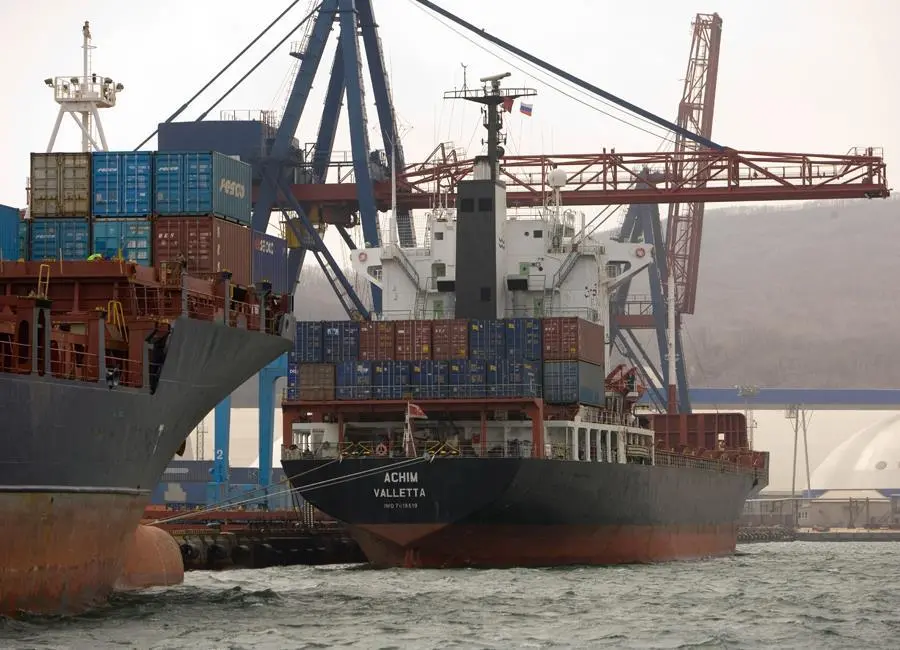
Performance of Global Ports’ Vostochnaya Stevedoring Company in 2014 mirrors the difficulties into which the Russian economy has become embroiled.
In the first half of the year, throughput was up 9% to 243,000 teu on the back of “relatively buoyant intra-Asian trades and its principal location at the start of the Trans-Siberian Railway”, according to chief commercial officer Egor Govorukhin.
However, by the end of the year, total throughput amounted to 475,000 teu, almost exactly similar to the previous year, as the recession began to bite.
The group’s combined Russian container terminal business also showed first half growth – of 1.6% – followed by a 4.2% downturn in the second half, leaving traffic for the year down 1.3%.
However, Mr Govorukhin remains undaunted, pointing out that the company’s management team has the experience and track record to deal with this challenging environment after having successfully navigated the global financial crisis of 2008-2009.
“We focused on efficiency and cost control, reducing Operating Cash Costs by over 13% and CAPEX by over 40% in the first half, as well as realising a successful commercial campaign in order to drive revenues,” he said.
VSC is perhaps a little better protected than the company’s assets further west, given its proximity to the burgeoning Chinese market next door. Most of the cargo handled there is import/export, with some cabotage, although no ship-to-ship transhipment.
“In 2014, we saw strong growth in the export side of the business, supported by the devaluation of the rouble. Furthermore, VSC is very well positioned to ship transit cargo from China to countries in Central Asia, being just 8km from the Nakhodka-Vostochnaya railway.”
Asia eyes
Asia remains an important market, with potential existing for more growth. Currently, VSC handles a large part of transit container traffic to the Central Asia and enjoys an ideal location to handle any cargo flows from China. For this reason, it is being developed for the long term. Last year, capacity was increased by a further 100,000 teu to 650,000 teu, although there is sufficient land to boost this to over 2m teu.
With about 80% of containers handled by VSC leaving the terminal by rail, quality and pricing of railway dispatching is key to the terminal’s competitive position. Since 2008, it has provided block trains to destinations, including Moscow, Novosibirsk and Yekaterinburg, as well as to Kazakhstan, Uzbekistan, Slovakia, and Poland.
“More than 60% of import containers leave the terminal on block trains organised by VSC, which today operates around 400 of its own flatcars,” says Mr Govorukhin.
As well as Vostochny container terminal – the second most important in the Russian Far East basin – Global Ports is also responsible for container terminals at St Petersburg and Ust-Luga, and has interests in two Finnish ports. For 2015, Global has earmarked $27m investment in its box terminals, of which 85% will be focused on PLP and VSC.
Mr Govorukhin says that all the company’s terminals are outfitted with modern technology, citing two new ship-to-shore cranes acquired by VSC in 2014.
“Productivity on both vessels and landside rail operation compares favourably to other similar ports in the Russian Far East,” he says, adding that VSC is the only stevedoring company in Russia that has the permission to accommodate Maersk’s Triple-E container ships.
Also of note is the proposed ‘Primorie-1’ transport corridor development which promises a container route from China’s northern provinces to the Russian Far East. From Vostochny, containers could be shipped by sea to ports in the south of China or to countries in the Pacific Rim. This would help to significantly reduce transport by land – by up to 360km – and hence cut both the time and the cost of transport. It would also give access to maritime shipping lines and avoids transit ports.
In August 2014, test cargo deliveries were successfully sent on the Suifenhe-Grodekovo-VSC-Busan-Japan railway route, giving a rail transit time from Suifenhe to the VSC terminal via the Primorie-1 corridor of 10.5 hours.
Related Articles
 CONTAINER & CARGO HANDLING
 CONTAINER & CARGO HANDLING
 BULK HANDLING