![PortStrategy[GreenPort]](https://www.portstrategy.com/wp-content/uploads/2026/09/PortStrategyGreenPort.svg)





Pour point
Stevie Knight finds that there is no simple path for ports looking to offer new fuels
As heavy fuel oil fell from grace as the energy of choice for powering shipping, the ports industry braced itself for the need to change its fuel supply choices. But it seems it wrongly assumed that just one or two alternatives would differentiate themselves.
Certainly while oil prices stood at over $100 per barrel, LNG looked like the way forward and many European facilities started to investigate quite complex infrastructure: “But in fact we haven’t seen the massive rush to LNG we expected, instead the market appears to be fracturing with batteries, hydrogen, biofuels, methanol and others all making an appearance,” explains David Bull of RHDHV.
“Shipping is shedding at least a few of its conservative tendencies,” he says. “While the whole industry went from coal to oil as one, now it’s not necessarily moving together.”
Micha Hes of the Port of Amsterdam agrees: “It’s a much more scattered palette” than first thought, he says, adding that he sees “a wide variety of energy products coming up”.
Some do require much more proactivity from the port from the start: “As soon as there’s a gaseous product it’s a bigger challenge, whether this is hydrogen or LNG,” says Mr Hes, explaining that while the bunkering technology itself will often initially be taken care of by the supply companies, it’s still down to the ports to provide the stage for all this, as well as the overarching principles governing operations.
He points out that developing regulations as well as technology and infrastructure at the same time can be challenging. Although Amsterdam, Rotterdam, Antwerp, Gothenburg (and others) have developed a bunker checklist within the World Ports Climate Initiative, these standardised rules require detailed implementation in the port’s bylaws.
So, though Amsterdam already has a couple of inland boats filling up with LNG from trucks, the port is looking to visits from a bunker barge to service other vessels. Therefore while the broad brushstrokes have been laid down with no ships yet appearing to help firm up and test out operations, Mr Hes admits “we are in a twilight zone, still waiting for the floating infrastructure to appear”.
Alternative options
However, some fuels can give a port a leg-up into a greener future without a huge outlay in either time or budget.
Second generation biofuels (having dumped the drawbacks of the first generation) now hold out the promise of being ‘drop in’ substitutes, using exactly the same handling equipment and infrastructure as more traditional fuels. Since Boskalis prides itself on global operations, the dredgers need to retain the ability to bunker wherever they can. However they are also often working within sight of the shore and winning a contract can rest on the ships’ green credentials, so Rotterdam and Amsterdam are offering low-emission, cleaner fuel that won’t result in a plume of black smoke – giving Boskalis a good reason to come in and load up.
While usually limited to getting creative with incentives like reduced fees, making hook-up space available and so on, ports have an important part to play when it comes to encouraging alternatives for ferries or other vessels with a limited sphere of operations – although what’s required can include nerve.
Dan-Erik Andersson of the Port of Gothenburg admits “it’s not easy being first to bunker a novel fuel”, adding that the biggest challenge in helping realise Stena Germanica’s conversion to methanol was simply that “no-one had so much idea about what was involved”. Even though it had developed the onboard systems, the ship owner’s insight was somewhat limited when it came to port operations and while the bunkering business was well versed in supplying other fuels, methanol was news for them too. So, although it was found the bunkering process only requires minor modifications to existing infrastructure, the dialogues, risk analysis, rule development and support for Stena’s business plan took just under a year to come to fruition.
Mr Andersson firmly believes ports can be proactive: getting involved in discussions to see what might be on the horizon – Gothenburg regularly chats with Antwerp and Rotterdam – as well as looking at how existing regulations intersect with potential developments. He concludes: “I’d say that although ports might be tempted to say no if something hasn’t been tried before, it’s worthwhile being open.” Interestingly, he points out that one experience may underpin another: after all, Gothenburg was able to leverage its familiarity with LNG by crossing over the relevant regulations to methanol.
There are now novel fuels coming into play which call for other kinds of involvement. Sjors Geraedts of Goodfuels Marine explains that if both the port and owner were to consider adapting a little to bunkering converted lignin biofuels, a short hop operation could take advantage of much reduced fuel costs with the port gaining a long-term, lucrative customer. Although getting a supplier to provide a filling truck might be the first step, more economy could be gained by entertaining a larger scale storage solution.
Further, since there are a wide variety of feedstock sources for this type of biofuel it probably wouldn’t be subject to the same market volatility as MGO – or methanol for that matter, an issue which has caught Stena off guard.
Waste not
At the ‘other end’ of the fuel line it’s been noted that quite a number of ports are struggling to find a way to respond to their Marpol and EU reception obligations for oil residues. It is pretty nasty stuff and as you might expect, there are legitimate concerns around disposal and the whole business can be costly: any handling fees often go straight over to the slops collection companies.
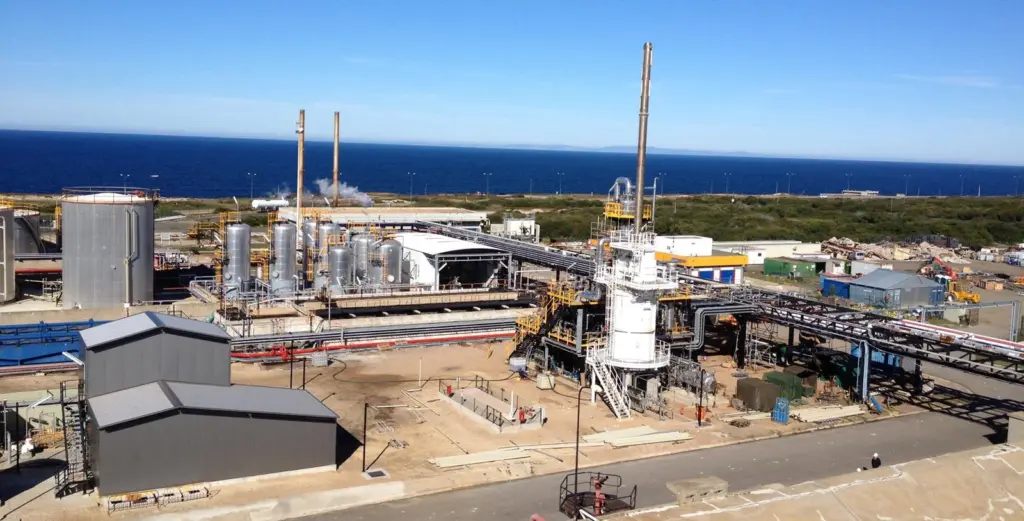
However, the aptly named Ecoslops has started to recycle sludge and dregs into marine fuels, creating Marine Diesel Oil (MDO) and Intermediate Fuel Oil (IFO 380) by feeding them into a vacuum distillation column. The service also helps green the environment; as the slops aren’t being burned there’s no CO2 emissions or local air pollution and even the bottom-of-the-barrel stuff comes out as waterproofing bitumen. Most importantly, because the company makes its money from selling the recycled products and not when collecting the waste, none of this costs the port a penny.
It looks like being attractive to a number of facilities as Ecoslops has different deals on the table: bottom level the company runs a collection round and is willing to invest in additional storage if what’s there is inadequate. Where there’s more developed services, Ecoslops is willing to combine its technology with existing collection companies, helping them offer greater processing efficiency. Top level, given enough space, there’s also the potential for creating an onsite plant, “without putting money into the till,” says chief executive Vincent Favier. Instead, what the company asks for is “industry facilitation, site location near the terminal and help in speeding up authorisation processes, plus finding slop collectors who are willing to barter with a company like ours”.
Any doubts should be dispelled by the first of these facilities at Sinès, Portugal (although there are other projects in Belgium, France, Romania and one even starting at Abidjan). The Sinès plant is presently working at capacity, taking in 30,000 tonnes of slops per annum, and Mr Favier explains while 40% of the residues are collected at Sinès, 60% are imported in small, 8,000 to 10,000 tonne tankers.
Of course this presence results in additional traffic: although Ecoslops negotiates reduced rates for the collection vessels, lines are charged less – and the port still comes out ahead.
THE POTENTIAL TO FUEL PORT BUSINESS
There is good reason for ports to keep ahead with their fuel offering says RHDHV’s David Bull.
He points out not only does this bring in ships who might not otherwise call “but likewise the flipside is that if ports don’t do it, lines may well bunker somewhere else”. On the same note, Micha Hes explains Amsterdam is keen “to make sure it can cater for the first movers”.
However at the moment there’s just the one ship running from methanol, and likewise, the number of vessels actually running from other novel fuels is small, often limited to pilots and trials.
This means, says Mr Bull, that at least in the beginning the ports can’t offer any economies of scale. It might not matter so much at the start when things are small and the supplier is handling most of tech, usually by truck. But he predicts there will be a moment where if things pick up, in order not to disappoint customers the port may well have to commit to upping its bunkering operation – potentially fairly quickly.
Then negotiations will have to get underway on the subject of bullet tanks, loading arms, pipes and so on, elements potentially offset by bigger deliveries – although he admits the calculations need some hard thinking and possibly a crystal ball.
Related Articles
 CONTAINER & CARGO HANDLING
 CONTAINER & CARGO HANDLING
 BULK HANDLING