![PortStrategy[GreenPort]](https://www.portstrategy.com/wp-content/uploads/2026/09/PortStrategyGreenPort.svg)





Modal moves
Shifting the cargo mode is a move that all ports can pursue, explains Martin Rushmere
Last year, the UK’s Peel Ports launched a ‘cargo initiative’ urging shippers to rethink supply chain and services routes in order to reduce road and rail freight mileage by 200 million miles by 2020. It was a bold move with ambitious, yet sensible aims. But is there a need for such targeted action?
US ports and logistics specialists have gone beyond the so-called Cargo200 initiative of Peel Ports and taken a much broader strategy in directing traffic to become both more environmentally responsible and efficient. As cargo volumes ramped up and ships became bigger, the first and simplest tactic was the “four corners” approach of scattering shipments through the four main geographical regions, partly to get goods quicker to the general region where they were destined but, more importantly, as a backup for disruptions in any one area.
Paul Bingham, vice president of EDR Group consultancy, explains: “It was a risk reduction and cost reduction-driven strategy aimed at improving overall US market reliability and reducing supply chain costs. No single port marketing initiative drove the move towards the four corners strategy alone. The adoption of the four corners strategy was not primarily about land transport mode use reduction or emissions reductions.”
Distribution became more sophisticated to cope with the increasing volumes just when the business sector realised that pollution was becoming a national health problem. Ports and shipping lines jumped in and set up their own environmental programmes, prodded by the federal Environmental Protection Agency.
In practice
“I would point you to Virginia Inland Port at Front Royal, VA which is operated by the Virginia Port Authority and connects by rail deep inland into Virginia, eliminating thousands of truck trips per year. Also, the Port of Virginia operates a very successful barge operation with a terminal in Richmond, Virginia with a twice weekly service, used by companies seeking to lower their carbon footprint while also allowing heavyweight shipments that do not need to transit the highways.
“South Carolina operates a new inland port in Greer, South Carolina which is the location where BMW produces all the SUVs in their global platform,” says Mr Schellenberg. “This location is also supported by numerous Tier I suppliers to BMW and all shippers are encouraged (by favourable rates) to use the rail routing over the truck routing between Charleston Port and the Inland Port at Greer.
“Columbus, Ohio is another inland port which receives freight by both rail carriers from multiple eastern and western ports,” says Mr Schellenberg, “and provides a platform for global distribution and fulfilment in both retail and e-commerce activities.”
Georgia has Atlanta and Cordele. “Both are served by rail primarily from Savannah Port, however, if you look closely at the CSX terminal in Fairburn, Georgia, which is in southern Atlanta, you will find a direct connection from Los Angeles/Long Beach with direct rail from the western carriers who terminate cargo in Atlanta,” says Mr Schellenberg.
Mr Bingham notes that Georgia has been very successful: “The ports authority focused long ago especially on attracting individual company import distribution center development in proximity to the Port of Savannah, which in turn led those shippers to pressure carriers to increase their services calling the port. This initiative has worked and helped Savannah capture market share from US West Coast and even competitor East Coast ports.”
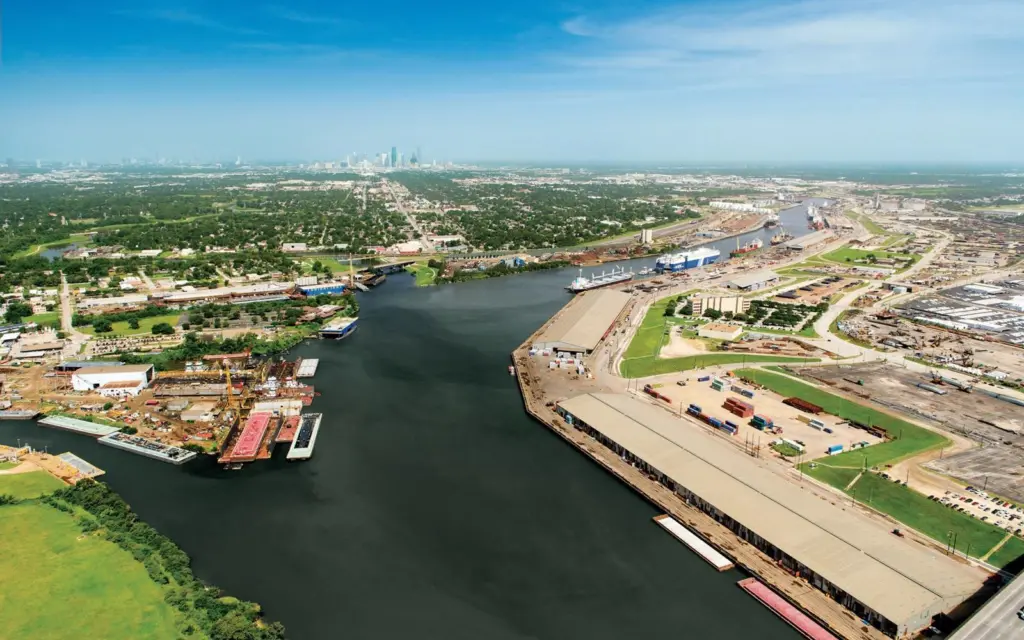
Adds Mr Schellenberg: “Houston, Texas is also considered an inland port despite the fact that we are also a water port,” he says. “Significant volumes of freight are routed to Houston from the western ports, making Houston both a port and inland port for ocean containers.”
He says that this strategy provides both efficiency and environmental care. “While these are location and not necessarily customer specific, in each case, you will find shippers or their logistics services providers who route in favour of the inland port because it provides a more predictable supply chain, often a lower cost supply chain and certainly more environmental stewardship of the supply chain.”
Different perspective
Mr Bingham says that in some respects the Peel Ports strategy has been in existence in the US for some time, although not from a sustainability/carbon reductions perspective. “Perhaps new efforts by some regional ports could induce further diversification beyond a four corners strategy, partially justified by the carbon emissions reductions achieved, even if operating cost saving and incremental risk reductions are small.
“The largest volume retail importers such as Walmart and Target Stores have already moved well beyond use of four regional gateways for the US market, importing on vessel services calling at more ports,” he says. “They’ve done this where they have the volumes to justify the further diversification of use of the potential route network, often using ports closer to the many regional import distribution centers they’ve located around the country.
“This ever-evolving network design is driven by ongoing efforts to reduce costs while maintaining reliability through risk management. This practice further reduces total truck and rail distances and emissions over time, though that is not the primary purpose serving large retail store networks.”
The Northwest Seaports Alliance – the combined marketing arm of Seattle and Tacoma in Washington – sees Peel Ports from a different perspective. “It appears that most of UK’s ports—and definitely the larger ones—are in the south, while most of the cargo is destined for the north. Peel Ports plans to try to attract more cargo to Liverpool, which is farther north, so the cargo won’t have to travel as far by road or rail,” says spokesperson Tara Mattina.
“You could almost say we’ve already done that because we are centrally located. We’re close to Interstate 90, which carries the agricultural exports from Eastern Washington directly to our terminals, as well as the imports destined for Chicago or the Ohio Valley. We’re also next to the US West Coast’s second-largest concentration of warehouses and distribution centers. And while we don’t have a large local population, most of Washington state’s population is in the Puget Sound region right where we’re located.”
TAKING THE ENVIRONMENTAL TACK
As well as reducing excess freight on road and rail, Peel Port’s Cargo200 initiative has another eye on environmental safeguarding. Paul Bingham, vice president of EDR Group consultancy, questions whether this approach could help ports in the US to attract more shippers.
“My impression is that for some retailers with particular environmentally-oriented clients, this might work. A risk is that a company advertising a focus on improving environmental performance of import supply chains may run up against the ‘food miles’ advocates and the trade protectionists who see international trade itself as bad, no matter the attempts to minimise its carbon footprint.
“In the US right now,” he says,” the politics of international trade are such that companies may not wish to call attention to how much of their supply chains are comprised of international trade, no matter the associated reductions in carbon footprints.
“Walmart has an extensive advertising campaign focused on their made in America initiative over the next few years, a campaign that has been careful not to highlight just how large a percentage of Walmart’s current sales volumes are of imported goods. Yet I could see retailers such as Whole Foods or Patagonia being attracted to further port diversification justified for environmental reasons in order to be consistent with their positioning as having sustainable, organic, fair trade imported products for sale. That works best for products such as coffee with little domestic production substitution potential.”
Richard Bank, chief executive of Millennium International Consultants in Washington DC, says that third-party logistics providers have to be involved for any initiative to work. “They work in conjunction with carrier consortiums and their presence is essential.”
Mr Bingham suggests that smaller, specialised ports could be the main force behind carbon reduction, including maritime ports inland that are harder to reach by sea, either because of long, relatively shallow draft channels such as Port of Portland Oregon or Great Lakes ports such as Cleveland, Ohio, or to ports on inland waterways that would require ship-to-barge transhipment such as on the Mississippi River system or upstream on the Columbia/Snake River system east of Portland.
“True carbon minimisation by shippers would likely go beyond even inland waterway use of container-on-barge services”, says Mr Bingham, “to include short sea shipping – ‘Marine Highways’ in the language of the US DOT Maritime Administration – and more substitution of rail for truck on the land-side for that matter.”
Related Articles
 CONTAINER & CARGO HANDLING
 CONTAINER & CARGO HANDLING
 BULK HANDLING