


A taste of life Offshore
As a new generation of LNG tankers looms, the terminals for such ships will – in most instances – be located far from conventional, sheltered harbours. David Foxwell investigates.
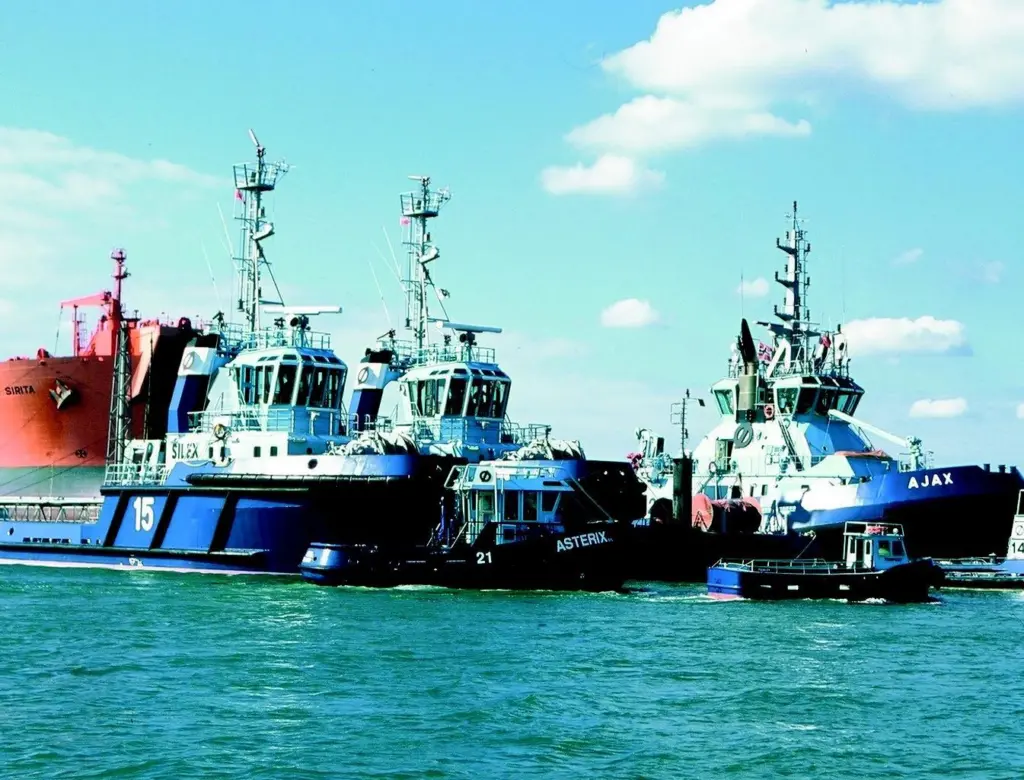
Terminals such as these will be located in positions exposed to high winds and sea states which will have consequences for the tugs, mooring vessels, and mooring systems required to manage the berthing of LNG tankers.
Studies in The Netherlands and elsewhere suggest that a new generation of tug combining the attributes of a harbour tug with those of an offshore supply vessel will be needed to support the many offshore LNG terminals that are planned.
The first examples of a new generation of tug are already on the drawing board – indeed the first has been delivered and is in service, but as Bas Buchner, a naval architect at the Maritime Research Institute Netherlands (MARIN) explains, more and more such vessels are likely to be required because of the particular conditions likely to prevail at offshore LNG terminals.
If the new generation of offshore LNG terminals are to be a success, operators will require low downtimes combined with safe operation. To date, most tugs have been used in the mainly sheltered waters of ports and harbours, and if tug operations are not to become a ‘bottleneck’ hampering efficient operations at LNG terminals, existing designs will have to be modified and new ones developed.
Operations at offshore LNG import or export terminals will be carried out in what is really an offshore environment, with waves of a type that one would expect in such locations, Buchner explains in a paper he presented in Singapore recently. He says that experience with tugs assisting crude carriers during lightering operations has shown that waves may hamper tug operations significantly noting that, in ‘pull’ mode, motions of tugs in the waves can cause extreme line loads resulting in breaking of the towline or the danger of the tug capsizing when large transverse loads are applied to the tug.
In ‘push’ mode, the motions of tugs in waves can induce high impact loads in fenders, resulting in large stresses in the side shell of the LNG carrier. Green water on the deck of a tug could affect the stability of the tug as well as the safety of the crew; excessive motions could influence the ability of the crew working on the tug;
tugs might need to use a significant part of their power to remain on station themselves; and large tug motions and (relative) wave motions could result in ‘thruster ventilation’ and thus in reduced thruster efficiency.
In order to better understand the behaviour of tugs in waves, a pilot study was carried out in the offshore basin at MARIN using a 1:35 scale model of an LNG carrier in combination with a 35 metre tug having a bollard pull of 50 tons/500kN, the main focus of attention being the local interaction between the tug and the LNG carrier. The model test results confirmed that motions of tugs assisting LNG carriers in waves are significant.
SLACK TOW LINES, PEAK LOADS As Buchner explains, it became apparent quite quickly that optimum wave headings for berthing and mooring LNG carriers (close to head waves) are actually critical beam wave conditions for tugs assisting them, resulting in large rolling motions. Slack tow lines and peak loads often occur, especially when the pulling tug is in unshielded conditions, and in reduced wave conditions in push mode, the tug has the tendency to roll around the fender tip. In worse conditions, with larger waves, the tug’s fender comes free from the hull regularly, and the relative motions of the fender with respect to the LNG tanker are large, with peak fender loads occurring when the tug hits the hull of the vessel.
In certain conditions leading to large rolling motions, the dummy thrusters on the model tested by MARIN regularly came up out of the water. Were this to happen in the real world it would obviously have an adverse effect on thruster efficiency, although, as Buchner notes, many modern tugs are equipped with azimuthing stern drives or Voith Schneider propellers which lie deeper in the water and are thus less prone to this phenomenon.
Robert Allan Ltd (RAL), naval architects based in Canada, have already developed a number of designs for offshore terminal tugs capable of operating in the very demanding environment at offshore LNG terminals, the first example of such a design, the RAmpage 5000-ZM tug SEABULK ANGOLA, having been delivered in May.
Speaking at the same conference in Singapore, Allan drew attention to the lack of published information on how exactly tugs might perform in such conditions. This being the case, RAL has conducted extensive independent research into the subject of tug performance in a seaway, as well as evaluating tug-ship interaction forces, work that had led to the design of two classes of powerful tug designs capable of performing reliably in extreme sea states.
RAL’s objectives in the development of the RAmpage class had, he explains, been to respond to demand from industry for tugs of 90100 ton bollard pull, capable of operating in severe offshore conditions, but which did not necessarily incorporate an escort capability or large cargo-handling capabilities in the design.
Related Articles
 EQUIPMENT
 EQUIPMENT