
East Asian ports are at the vanguard of container ship development.
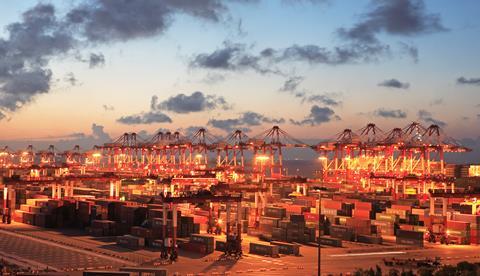
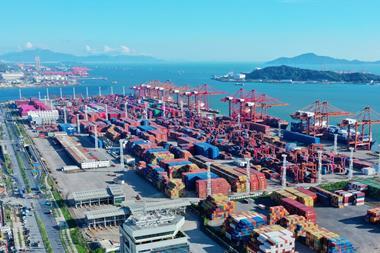
East Asian ports are at the cutting edge of the deployment of bigger ships by shipowners. The East-West tradelane will make or break the economic arguments behind vessels of 18,000 teu and upwards and therefore the ports of China, Hong Kong, Taiwan, Korea and Japan must decide if they wish to position themselves to handle the mega ships, and if so, what investment is required in new infrastructure.
That decision is not easy to make. East Asian ports are not immune from the global slowdown in container traffic, albeit ports such as Shanghai, Ningbo, Busan, Qingdao and Guangzhou have still managed to grow.
Also, while the volume of development in Eastern China is driven by organic growth, ports in locations such as Southern China have seen competition intensify from other regional hubs.
Looking at cargo flows since 2000, the period up to 2008 was China’s “golden age”, driven by the increase in Chinese manufacturing. South Korea also drove ahead with local organic growth plus Chinese exports using Busan as a transhipping hub.
From 2008-2015 the Chinese engine lost some fire but growth has still been healthy. South Korea is also still progressing, benefitting from vessel upsizing and ship operators reviewing their networks, while Hong Kong is seeing a decline.
Close analysis

Drewry separates out the way the various ports have reacted to the changing conditions. Busan has built sufficient capacity with deep draft to cater for bigger vessels. As it absorbed more volume, hubbing has grown there (including Japan using the port as a hub) and it is well prepared to welcome the challenges ahead.
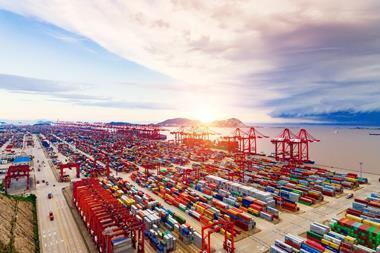
The Central Chinese ports (Shanghai, Ningbo) are all gateway ports which have added capacity and upgraded quay cranes for bigger vessels. South China ports (Guangzhou/Shenzhen) have pursued continuous investment in facilities and in Taiwan, Kaohsiung built new berths for big vessels. However, Drewry sees North China (Qingdao/Tianjin) as not being able to attract enough 18,000 teu vessels, and Hong Kong as not having invested in new capacity.
Given the timelines required to dredge or build new facilities, how are ports managing to keep up with the speed of deployment of bigger ships?
Drewry senior consultant Han Ning says the decision-making process for Korean and Chinese ports is more straightforward with fewer stakeholders involved.
“As long as there is a demand, Korea and China ports (compared with US ports) can prepare themselves ahead of time, or catch up quickly. Key concern for the operator is, is there a demand? – i.e. if they build 18,000 teu berths, will these mega vessels call at them?”
Even if the ports are able to provide the water depth, quay cranes and so on, there’s still the question of providing the necessary yard capacity, and road and rail transfer facilities.
“For the newbuilt berths, they have proper yard capacity which is in line with quay side capacity. For the upgraded berths, yard [space] is a problem,” she says.
Plans versus reality
Fox Chu, global lead and managing director of Accenture Ports Industry, says major Eastern Asian hub ports either have investments in hand to upgrade or build new facilities or do both in order to cope with the rising demands of mega ship – but challenges abound.
He says that while it is encouraging to know that some ports have already made large investments to prepare for mega vessels, a more pressing issue to address is to learn how to be “volume ready” rather than merely “mega vessel ready”.
“Otherwise, the economics of mega ships will not be able to flourish and the incentives for port investment will not be high.
“Operationally the industry has not yet evolved to a mature operating model for carriers, alliances and ports to collectively achieve the desired efficiency for mega vessels. For ports, most of them are facing productivity and utilisation performance challenges, and operations complexities of compressed time for planning and flexibility to handle changes as well as difficulties in landside activities and yard activities to handle mega vessels.
“Commercially, ports are struggling to maintain profitability and ROCE performances [return on capital employed] given the incurred port investment and ongoing operating cost to serve mega vessels.”
Busan vision

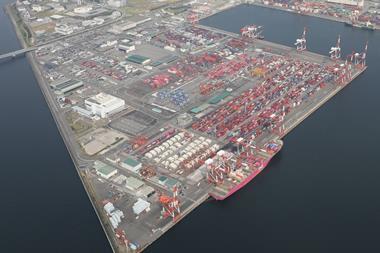
Busan New Container Terminal in South Korea has a firm view on where it is heading. With a throughput of 19.5m teu in 2015 evenly split between transhipment and domestic cargoes, the port is working towards volume growth.
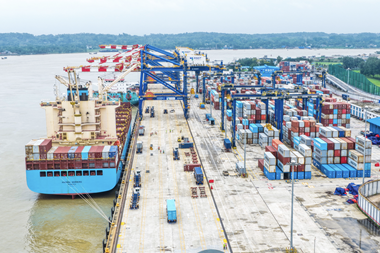
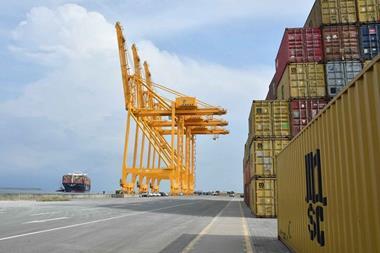
The terminal has four berths, 11 ship-to-shore cranes with an outreach of 24 rows and height to handle today’s largest vessels. With a water depth of 17 metres it can already handle vessels over 18,000 teu. The yard operation is fully automated with automatic stacking cranes and capacity for over 2.5m teu.
John Elliott, president and chief executive of BNCT, says that the yard can be expanded further, to above 3.5m teu if necessary. “The facilities in Busan have always anticipated the growth in vessel size. Busan probably knew about the next generation vessels first as many of the vessels are constructed in Korea. Therefore, the various port facilities have prepared by purchasing STS cranes with 50-metre lifting heights.
“In terms of dredging, the Korean Government has been fairly proactive. Dredging had been done which deepened around the container facilities and turning basins. In addition, dredging works are underway for not only deepening the approach channel but also widening for improved manoeuvrability.”
BNCT itself is looking to invest in additional equipment to correspond with volume growth.
“Our general strategy is the same as the past – mainly to be a port and logistics hub of the North East Asia region. In addition, ensuring that we provide our customers with efficient and reliable service while being prepared for the future,” says Mr Elliott.
Price tag
He recognises that keeping up with the growth in vessel size comes with a large price tag as equipment, construction and deep dredging incurs a higher cost.
“Clearly larger vessels place an increased strain on a facility as a larger surge of containers may be discharging or loading at a given moment. In most locations around Asia, land is a valuable asset and possibly in short supply. As volume increases, many facilities have needed to reduce the time in which the customer’s containers sit in the facility.”
As to how the port scene in East Asia will change in the next two to three years, Mr Elliott says the one thing in Asia that you can count on is change. “Although, China has slowed down, they still have growth levels that most western countries greatly envy. As economies in the US, Europe and some countries in South America continue on a path of recovery and growth, the question will be where will the foreign trade growth occur and which Asia countries will gain the most benefit?
“Port growth and development will always go hand-in-hand with trade growth.”
Hong Kong loss
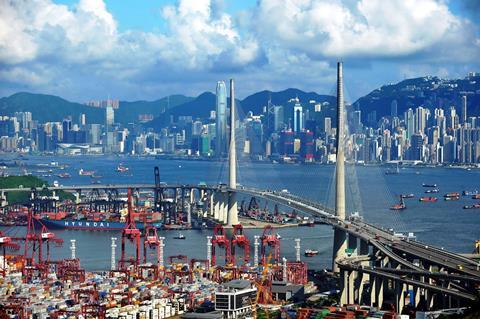
On the other side of the coin is Hong Kong, which recognises the effects of changing trade trends.
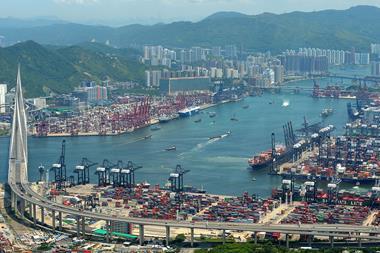
A spokesperson for the Hong Kong Government Transport and Housing Bureau said that Hong Kong Port (HKP) handled 20.1m teu in 2015, representing a decline of 9.7% on the previous year.
“It is estimated the decline will continue in 2016, as the international trade remains sluggish in the region. Given that Hong Kong is very much an external-oriented economy, the performance of HKP hinges largely on the external economic environment,” the spokesperson said.
Nonetheless, Hong Kong is pursuing its own investment plans. A dredging project to deepen the Kwai Tsing Container Basin and its approaching channel from 15 metres to 17.5 metres has been substantially completed.
Upon completion, ultra large container ships exceeding 15 metres in draft can access the Kwai Tsing Container Terminals (KTCT) at all tides. Compared with newly-developed ports, HKP’s yard-to-berth ratio is on the low side due to land constraints, but the Government is also integrating some adjoining back-up land into the KTCT to provide additional yard areas and barge berths. This will improve the operational efficiency of transhipment cargo handling and enhance HKP’s competitiveness.
Multi-storeys
Another initiative is looking into the feasibility of developing multi-storey complexes in the Kwai Tsing area for cargo handling, container storage or truck parking, to release more land to back-up the operations of container terminals.
Rail is not a factor as HKP is not connected by a freight railway system. Rather, it is well supported by an efficient road and river network for freight distribution.
The spokesperson said the HK Government is committed to ensuring that supporting infrastructural facilities are provided in timely fashion to meet the demand from increasing cargo throughput.
“We maintain close liaison with the trade and the shipping industry so that we may respond to any new situation promptly, thereby maintaining HKP’s position as a transhipment hub in the region.”
Looking to the future, Hong Kong is sure of its place. “As the ports along the coast of the mainland are facing the challenge of overcapacity, the competition among ports in the region will remain keen.
“Nevertheless, given Hong Kong’s strategic location, institutional strengths and free port status, HKP will continue to serve as a transhipment hub in East Asia,” the spokesperson said.
Looking ahead

In the short to medium term, the East Asia port scene will evolve further. Accenture’s Fox Chu says it is possible that ports will focus more on addressing the landside challenges and extend the reach to their hinterland in order to achieve better overall efficiency beyond berth and crane productivity.
“To address the commercial challenges, ports can work to protect the core business and gradually diversify for more service offerings.”
He adds that digital technologies and processes driving efficiency, transparency and ultimately cost savings are a hot topic being discussed in the industry. “Ports are uniquely positioned to take advantage of this trend given their spot on the supply chain with access to an intensified information flow.
“The term ‘digital ports’ is set to evolve very soon, and this will be the new differentiation for port operators.”
Drewry’s Han Ning says Busan will see steady organic growth in the short- to medium-term. “For its tranship traffic, its potential competitor will be from mainland China. If China lifts cabotage, Busan will be significantly affected. But we do not think it will happen in the near term.
“In Mainland China, growth will be still positive but lower - maybe 3%-5%. I will not be surprised if Hong Kong keeps negative growth.”
Learning From Airports
Given that only a few ports can accommodate mega ships, can those ports now charge a premium to the major carriers? It is an interesting question and one that Mark Yong, director – Business Development for BMT Asia Pacific Ltd, describes as a “very sensitive commercial issue” between the carriers and ports.
Fox Chu, global lead and managing director of Accenture Ports Industry, says ports could learn from the airports model here.
“There is no question that ocean carriers are struggling when it comes to upstreaming to ports. The affordability to ports’ premium charges is certainly questionable. Yet, it is not a one-sided price pressure to ports in all locations and there are a few exceptions.
“For example, efforts can be put forth to spend on revamping the tariff structure as well as the respective service and operating model in order to incentivise a win-win for ports and ocean carriers.”
Mr Chu compares the pricing structure of airports to that of ports, and says one can easily identify possible improvements. Airports derive income from areas such as air traffic control charges, landing fees, aircraft parking, passenger and freight charges, apron services and handling and fuel charges.
“The revenue composition of passenger charges versus aircraft parking as in aeronautical charges is more balanced than that for box lifting versus dockage charges for ports. Moreover, the contribution of non-aeronautical income to total revenue can even be higher than aeronautical income.
“Although this might not be directly comparable to ports, it also gives clues for ports to explore more ancillary services and uplift their revenue contribution.”
A study of the airports model could provide some lessons for ports to follow.
A Hierarchy of Ports
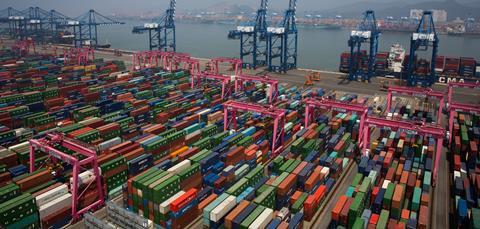
The pressure to accommodate mega container ships is creating several tiers of container ports, with only those at the top able to invest in the necessary infrastructure needs.
However, Accenture’s Fox Chu says the situation is very dynamic: “Shipping alliances, competition, fuel prices and most container traffics can all affect shipping economics which would determine network configurations.”
Drewry’s Han Ning says shipping lines keep reviewing shipping networks, which is based on total logistics and time cost: “With bigger vessels against infrastructures capabilities, several tiers of ports are shaping up. This is the hub effect.
“But there is more than one factor that influences the liner’s port choice. Apart from the infrastructure, the hinterland demand plays an essential role. Maybe hinterland demand is more important than port infrastructure.
“For the ports that have significant container flow, even if they have no 18,000 teu infrastructure, shipping liners will still call.”