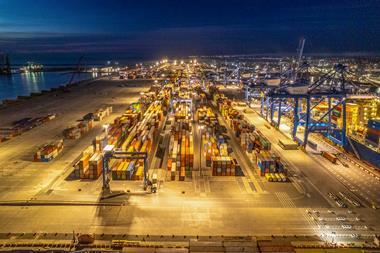



DaChan Bay Container Terminals in Shenzhen in the southern part of Guangdong province in China, has completed full electrification of its in-yard tractor fleet, writes Ramadas Rao.
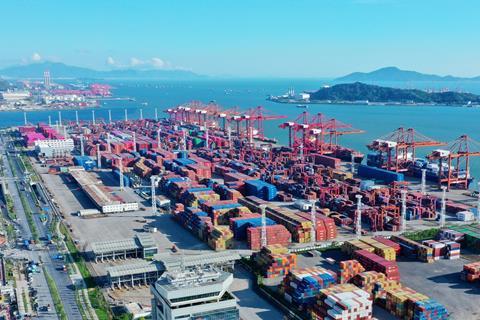
With the conversion, port operator Modern Terminals estimates that direct carbon emissions will reduce by 5,000 tonnes annually.
“Conversions of tractors has helped reduce diesel consumption at DaChan Bay Terminals by more than half,” Brian Yeung, managing director, DaChan Bay Terminals, reveals to GreenPort adding that emissions are subject to a number of variables including throughput.
Throughput at DaChan Bay Container Terminals rose 16% to 2.6M teu in 2025. The terminal has an annual capacity of five million teu.
Tractor conversion
Conversion of previous full fleet of diesel tractors to electric ones has also contributed to the total reduction in emissions.
Mr Yeung stresses that DaChan Bay was the first port in the world to deploy a full fleet numbering 50 of electric rubber-tyred gantry cranes (RTG) when the terminal commenced operations as far back as 2007.
At present the number has risen to 90. New equipment including electric forklifts, electric heavy forklifts, electric patrol cars, electric stackers and LED lighting were added to reduce total emissions.
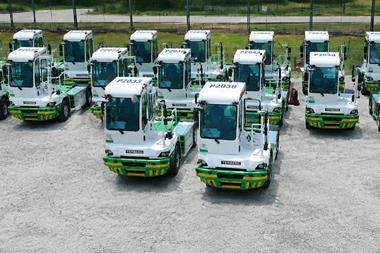
Full electrification of in-yard tractor fleet was possible after taking delivery of 27 battery-swap tractors to replace LNG powered units in late May this year.
Electric tractors provide strong heavy-load performance substantially reducing noise, improving environment not only for port staff, but also for the surrounding community, Modern Terminals has stated, citing advantages of electrification.
Energy efficiency of vehicles is also said to be enhanced because they are equipped with regenerative braking technology, which means tractors can recover energy during braking to recharge batteries.
While exact costs of the latest move towards electrification have not been revealed, GreenPort understands that “tens and millions” of RMB were poured into the project that included battery swapping stations, procurement of a full fleet of electric tractors, upgrading electrical infrastructure besides training technical and operations personnel.
The entire project is said to have taken 22 months from start to completion. Technical challenges included maturity of electric tractor powertrain and traction battery technology guaranteeing operational stability of battery swapping stations and successfully implementing the battery swapping business model, Mr Yeung explains.
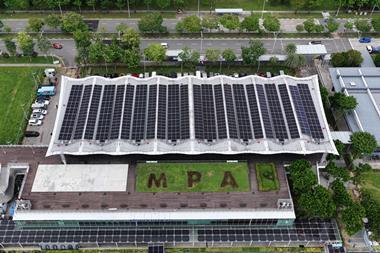
The battery swapping system is said to enable electric tractors to swap in a fully charged battery pack in less time than is required at a conventional diesel fueling station. At present the charging stations are connected to the local power grid. Dachan Bay is evaluating the possibility of deploying renewable energy systems such as solar power.
Electrification to the fore
Mr Yeung affirms that while some equipment and vehicles still consume diesel or petrol, the process of full electrification will continue. These will include heavy forklifts, empty stackers, reach stackers, patrol cars and upgrading RTG cranes with batteries.
The move towards electrification is part of a long-term sustainability strategy in line with China’s port decarbonisation goals. Shenzhen’s dual decarbonisation goals aim at reaching peak carbon emissions by 2030 and to become carbon neutral by 2060, similar to China’s objectives.
All five container berths at DaChan Bay Terminals are equipped with shore power since 2019. Low voltage shore power is available at three of the five berths. Vessels calling at DaChan Bay Terminals in western Shenzhen can also avail of LNG bunkering services.
“Our company started its sustainability journey as early as 2005,” Horace Lo, group managing director, Modern Terminals Limited, reveals.
A Sustainability Strategy was identified in 2021. Long-term goals for “Five Sustainability Pillars - Corporate Governance, People, Health and Safety, Environment and Community Involvement – were identified.
Towards this end Modern Terminals has identified three possible approaches including electrification, deployment of biofuels such as hydrotreated vegetable oil (HVO) and hydrogen.
“We will continue to look at emerging new technologies,” Mr Lo affirms.