


At biting point
Theres much more than a vehicle and its load riding on the gritty interface between tyre and quayside, says Stuart Pearcey
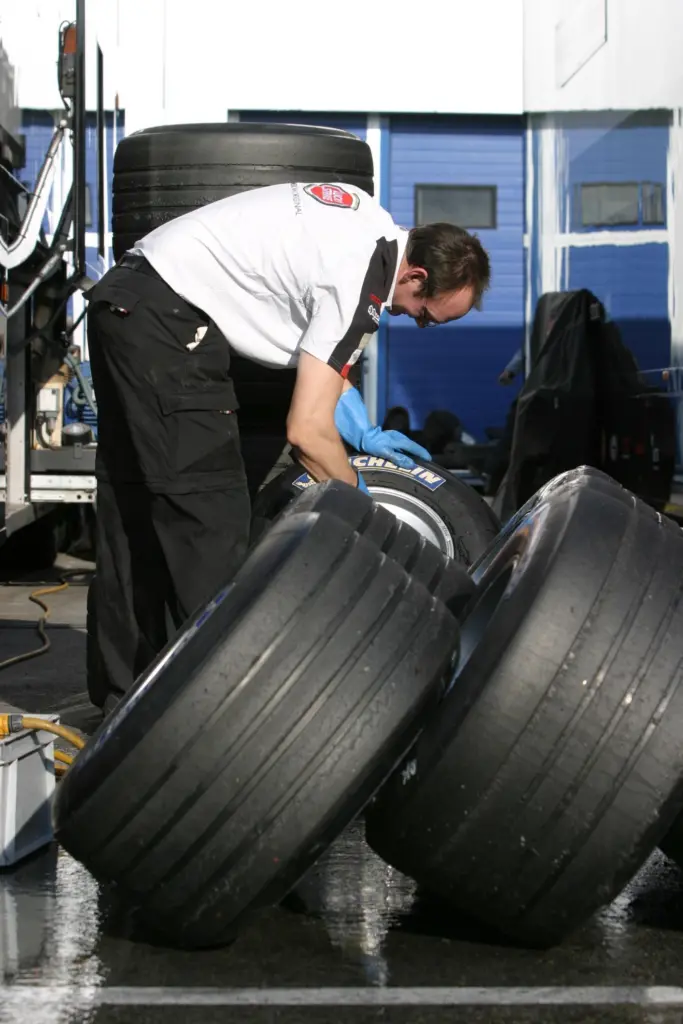
When the irresistible force of the rubber-tyred gantry crane motor meets the immovable object of the quayside concrete, it’s the tyre footprint that has to take the full force of the meeting.
Although that gritty interface is small, it’s also pretty intense, because there’s much more riding on it than just a crane and a container – there’s a lot of money too.
That’s true for all tyres at work on the world’s quaysides, but perhaps it’s the RTG that best illustrates the point. The tyre footprint forms the sharp point of focus for a number of disparate influences, from the weight of the load, the pressure inside the tyre, the speed the machine is driven at, and the terrain and route it’s expected to cover.
All of that adds up to the need for a fine financial balancing act, because getting any of them wrong can increase fuel consumption and reduce tyre life, making tyres on quayside plant far from a ‘fit-and-forget’ item.
Sure, they don’t need the cosseting given to Formula 1 tyres, with their heated overcoats and hand washing, but the clue to maximising the not inconsiderable investment in them lies in a little of the ‘personal touch’.
Nokian Tyres product manager Marko Muhonen says it’s vital to choose the right tyre for the job, and to make sure it’s inflated to the right pressure. With loads comfortably exceeding 100 tonnes able to make high demands on tyres, these two points can’t be emphasised enough, he says.
When it comes to the right tyre for the job on RTGs, Nokian claim to have developed a bespoke one for the job.
Says Mr Muhonen: “Nokian has been supplying ports for some time, but is putting a closer focus on it. We have thought for some time that tyres here could be improved, and we have developed a machine-specific tyre for RTGs, optimised for that application. It is proving very popular, and is raising a lot of interest.”
RTG wheels are typically expected to turn when the machine is stationary, which demands a lot of power from the actuators. The new tyre – a cross-ply – has a rounded tread pattern, shoulder area and ribs, which mean the RTG’s actuators don’t have to work quite so hard, and that in turn reduces fuel consumption. The tyre also offers reduced rolling resistance, and both of those dimensions reduce heat build-up, and with it the risk of tyre damage, as well as a further opportunity to reduce fuel consumption.
When it comes to selecting the right tyre for a particular application, the right solution for one might be entirely wrong for another, says Mr Muhonen.
“A tyre needs to suit its environment,” he says. “It is important to select tyres based on real operational needs and machine requirements. The operational needs could involve planning a route through the terminal and controlling speeds, because the way a vehicle is driven has a significant influence on the way its tyres wear. Equally, the number of moves per hour required for efficient operation of the port is a key factor.
“A balance has to be struck between all of these things, and it’s a fine one,” he adds.
In one particular instance a balance has been struck through collaboration with a client which allows the Port of Rotterdam to be what Nokian claims to be the world’s largest test track.
Here they’re in a long-term relationship with client Handelsveem, operator of 30 reach trucks in the Netherlands.
Co-operation between the companies has yielded mutal benefits. For Handelsveem it’s meant regular inspection visits from tyre engineers checking pressures, and on the lookout for wear and tear, giving tyres an average 3,000-hour life. For Nokian it’s meant access to a ‘real’ long-term test track, and a valuable source of key information that’s useful going forward to refine and improve product design and their manufacturing process.
Similar ‘real life’ testing has been undertaken with Kalmar and Konecranes, in pursuit of the right choices for tyre structures and rubber compounds – of which there can be several in any one tyre – to ensure low heat emission, which in turn protects the integrity of the tyre.
Another manufacturer, Alliance, speaks highly of the need to be in close contact with customers. Spokeswoman Virginie Carmillet says: “We are working actively on developing more customer-inspired solutions for this market. As a specialist in off-highway tyres we felt we should invest in port tyres. Our acquisition of GPX means we are even better positioned, and our ability to offer tyres directly from our warehouse in The Netherlands means we are in a good position to service all major port facilities.”
As a final thought Mr Muhonen adds: “Making use of the best properties of the machine and its tyres makes container handling efficient. The owner is happy with the maximum hourly output, and the driver, in turn, is pleased with the fluent and safe work.”
Related Articles
 CONTAINER & CARGO HANDLING
 NEWS
NEWS
 CONTAINER & CARGO HANDLING