One of the largest container networks in Europe says that it expects delays in barge processing to continue at the Ports of Rotterdam and Antwerp so it may have no choice but to introduce a container surcharge.
Contargo said that since January it has recorded increasingly long processing times and accruing substantial additional costs due to the bottlenecks.
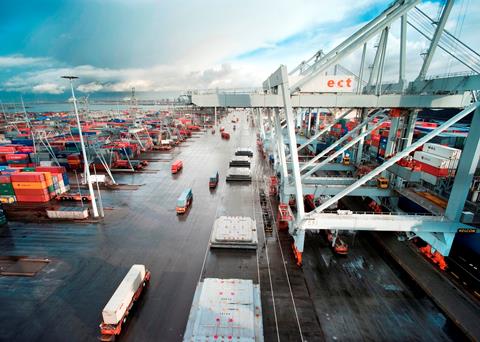
It said that in Rotterdam barges are having to wait up to 92 hours for processing and in Antwerp there are also waiting times of up to 72 hours. It is an issue that the Port of Rotterdam is well aware of. Last year there was a 6% growth in teu and the first two months of 2015 show the same upward spiral, but congestion is an inevitable side-effect.
Contargo said it has had to hire additional tonnage in order to bridge the waiting times of the vessels and can no longer guarantee acceptance and delivery dates for containers. It said that in spring and summer of 2014, bottlenecks in Rotterdam lasted for five months and many transport services reacted by charging Contargo a delay surcharge.
It pointed out that increasing numbers of containers and the usual personnel shortages during the summer months make it unlikely that the situation will improve in the short term and if there is no improvement it will have to introduce a container surcharge.
A spokesperson from the Rotterdam told Port Strategy: "We realise that parties may have to adapt the way they’re doing business to this situation, but that’s the best alternative. It’s better for instance to have a minimum call size for inland barges than to have long waiting times. When compared to last year we’re taking measures much earlier in the process and much attention is being paid to communication with all parties involved."
Rotterdam's ECT terminal and the Port of Rotterdam Authority have agreed to work together and talk with stakeholders in the coming weeks to discuss opportunities to mitigate congestion. ECT has stipulated that inland vessels must load and/or unload a minimum, but unspecified, number of containers during the summer months to prevent an inland vessel from occupying valuable quay space with just a couple of containers.
The operator also wants to utilise the storage capacity as efficiently as possible by restricting the time containers stay at the terminals and by no longer storing empty containers in the automatic stacks, unless they are destined for a particular ship. It also wants to keep a stricter control on agreed times for container delivery and pick-up.
It has assured customers that provision of information will be improved and that the capacity of the interterminal transport and the landside handling will be increased.
Meanwhile, a spokesperson from the Port of Antwerp told PS that although Rotterdam has been suffering congestion for some time now, Antwerp had two peak moments in the past two months so both situations can not be compared. The port authority did confirm though that it is currently in talks with several players, including Contargo, to improve communications with port users in times of peak capacity.