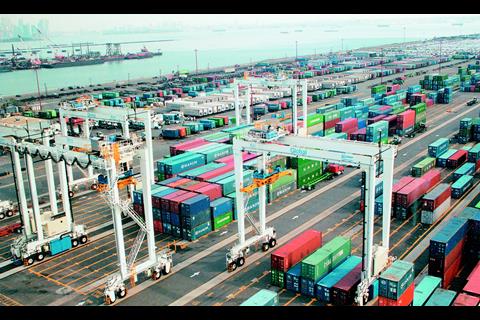
The current boom in port development is creating record demand for new RTGs and they are getting bigger, smarter and greener, writes Benedict Young.
There is no doubt that space constraints are leading ports to demand taller RTGs to enable denser stacking of containers. There were over 640 RTGs scheduled for delivery in the last twelve months and manufacturers' feedback shows that one-over-five units account for around 65% of these orders. Less than 13% of orders were for one-over-four units and the trend looks set to continue. One-over-six and one-overseven units already account for around 10% and 6% respectively, though it is interesting to note that the majority of these are produced by ZPMC for its blossoming Chinese domestic port market.
Although one-over-four units are fast diminishing, there is still some demand. "A new terminal may choose one-over-four because there is a flood of local business such as trucks collecting boxes and no transhipment; and it's faster if you have a lower stack height, " says Tuomas Saastamoinen, sales manager for container handling at Konecranes.
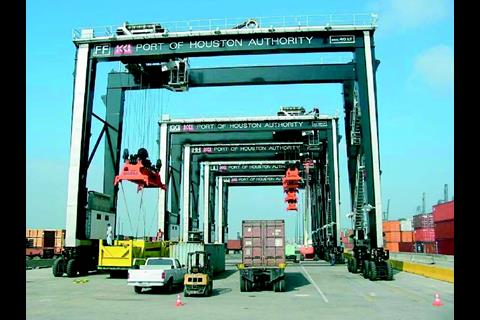
Almost all of Konecranes' recent deliveries have been for one-overfive units. Even the Port of Houston Authority (PHA), which took delivery of seven one-over-four units, specified that they should be prepared for heightening at a later stage. This relates to their eventual transfer to the new terminal at Bayport which is under development.
It may seem unusual not to go straight for one-over-five units but there is some merit in ordering one-over-four knowing they are likely to be increased because in PHA's case the port already has one-overfour units in its existing fleet and so there are operational benefits.
"Increasing the height is not such a big job especially when the unit is prepared with suitable steel work and cabling, " adds Saastamoinen.
With RTGs getting taller, is there any limit? Rene Kleiss, Kalmar's vice president for container cranes says: "We see now a wide variety in executions from small units to big and high volume machines.
Kalmar can cope with both due to modular design. There will be limits.
However we have not yet experienced any situation in which we cannot cope with customers' ideas in span and hoisting height."
Saastamoinen is more circumspect: "With higher units the load control is less straightforward. Driver visibility and ergonomics also gets more challenging and there would be more moves required to lift containers from lower in the stack. However, if there was demand for one-over-seven, or if somebody tendered a higher number, we would look into a design.
"No matter how you do the sway prevention, all the systems have the same problem which is as you go higher, you have to increase the forces from the trolley in order to get the same horizontal impact in the spreader. That naturally is the problem with whatever system you use."
SMART SOLUTIONS The high performance demanded by today's container terminals has made high-tech solutions such as auto-steering and container position verification essential tools using GPS technology. "The benefit for customers is higher performance, " says Kleiss. "Auto steering means that operators can concentrate more on core operations.
Less damage is likely with solutions like Smartrail and there is higher reliability while with Smartpath, there are no lost containers."
"Nowadays GPS is a standard, " says Saastamoinen. We haven't been making a big fuss about that. Our approach has been a little bit different from other manufacturers. We have been flexible in applying outside GPS systems from a third party provider. Imagine having a proprietary system from one crane manufacturer. If you later want to change the brand or your other equipment and you would like to go to container positioning, then you'd like to get the same system.
"Auto steering is a bit different because it is nowadays so standard that using more than one brand at the same time is not a problem. With container positioning system, all the equipment handling your boxes has to be fitted with it in order to be updated all the time with where the boxes are. Our approach has been to enter into a marketing cooperation with a company called Savcor One which makes GPS systems for container terminals. We can supply the system with the crane, or we supply the crane and the customer can directly talk with Savcor, depending whether the customer wants to apply the system to all of their equipment."
GREEN GIANTS Growing environmental awareness and recent rises in fuel prices have stimulated increasing interest in greener RTGs. Kalmar reports that last year it received orders for around 100 units of its E-one RTG design. Kleiss says, "The state-of-the-art design uses the best technology available as far as electrical systems, spreaders, mechanical components and design are concerned. It is environmentally friendly due to no-hydraulics and lower fuel consumption. All electrical functions include steering, spreader and anti-sway."
Konecranes introduced its no-hydraulics RTG design ten years ago and has since delivered over 300 units. "Konecranes is the biggest crane drive manufacturer and our development has been focused on crane drive controls and other key components." says Saastamoinen.
"These are heavily related to emissions because the best way to reduce emissions is to reduce fuel consumption. This goes hand in hand with the total cost of ownership approach. We are also looking at diesel technology and we are cooperating with the diesel manufacturers. In addition, we are working on how you treat the exhaust gas with catalytic converters. The environmental issue and emissions are really the focus of technology developments."
Hybrid drive technology which is making an impact in the auto industry is now making its debut in port handling equipment as Siemens Cranes has launched the ECO-RTG system, developed in close cooperation with APM Terminals.
The revolutionary new drive system for hybrid solutions was developed from Siemens Transportation Systems' background in rail solutions and trolley buses. The proven concept used in hybrid traction systems for buses and propulsion systems for ships uses Duo inverters. Over 700 buses with Siemens hybrid drive technology have accumulated over 85m km of experience on the road.
With the ECO-RTG, the energy generated through lowering of the load or braking of the gantry is stored in the DC link of the drive system and released again during hoisting or accelerating of the gantry. The design enables most of the energy stored during lowering to be available during hoisting. Other benefits of the system are a smaller sized power pack and no unnecessary high speed idling. Engine and drive maintenance is also reduced as is brake maintenance due to regenerative braking.
Field tests demonstrate that terminal operators can save more than 50% of fuel consumption, based on the same operating conditions and throughput as conventional RTGs. Siemens points out that these savings will more than offset the initial higher investment of the ECO-RTG system in a short period. Additional fuel savings can be achieved by installing an ultra capacitor energy saving module.
"We have followed this development and it is very interesting for the future of RTGs, " comments Konecranes' Saastamoinen "There are several ways to handle eliminating the idling. All the manufacturers who are involved in certain market places like West Coast USA, have to be very interested because environmental issues are the number one concern. All crane manufacturers must follow the technology that is reducing fuel consumption and emissions and that applies to everybody."