
!["[Floating cranes] might be especially useful in developing ports which have limited space available on the shore," Minco Van Heezan, Port of Rotterdam](https://d245ovzhixo1a2.cloudfront.net/Pictures/480x320fitpad[0]/5/4/5/97545_Rotterdam-Minco-2.JPG)
Is there really any viable alternative to traditional shore-based cargo handling, asks Alex Hughes
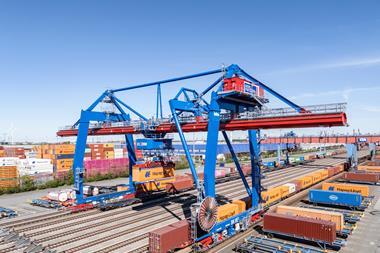
Nowadays, many ports take for granted that a certain percentage of their business will come in the form of transhipped containers, either between deep-sea vessels and feeders or simple swaps on relay services. Naturally enough, these are handled by shore-based gantry cranes.
However, the Large Vessel Interface (LVI) lift on-lift off crane, jointly being developed by the Office of Naval Research and Oceaneering International, suggests that alternatives to the current system might be just over the horizon.
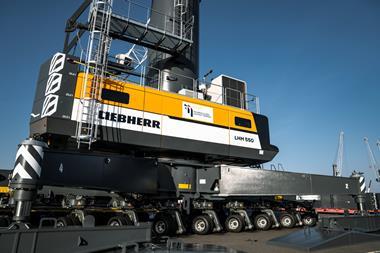
The LVI crane, which is mounted on board the ship, is equipped with an array of cameras and sensors, as well as a motion-sensing algorithm, to enable vessel-to-vessel transfer of containers in Sea State 4 conditions, implying one-metre high waves.
Furthermore, the transfer requires a team of just three operatives: one in the crane and one on board each of the two vessels. “The motion compensated cargo transfer capability of the LVI lo-lo crane has definite commercial applications in re-supply of at-sea vessels or platforms,” says Larry Karl of Oceaneering International.
Concept crane
The current crane, he explains, was built as proof of concept, to demonstrate that motion compensated container transfer is viable. That has been done. If a particular mission is identified requiring use of such a crane, a commercial version could be developed relatively quickly.
“The added complexity of the crane would likely require the operator to possess skills beyond those for a standard ship-to-shore gantry crane. Multiple operational modes are required to transfer cargo between two moving platforms and the operator would need to understand this functionality for operation,” says Mr Karl. He also concedes that productivity is not going to be as high as that for a shore-based gantry crane, but then this is not the point. The objective of the crane is to be able to safely transfer cargo in situations where this operation was previously not possible and this could include on the sea just outside a port.
“Using this crane, containers on larger vessels could be unloaded on to smaller vessels that could then enter shallow draft ports,” he says. “The LVI Lo/Lo crane could also be used to offload cargo to shore in addition to the use of shore based cranes, but this would likely not be cost effective unless the deep water ports either did not have shore based cranes or their cranes were damaged.”
Asked whether he could envisage a time when a floating version of the crane – not necessarily attached to a deep sea vessel – could be routinely deployed in container ports to tranship containers between vessels, Mr Karl says this is possible. “The amount of motion compensation required for a crane that would operate in port would likely be much less than that required for offshore use. However, this would be a mission for the crane only if there was a continuing need to transfer small numbers of containers between ships in a given port.”
He stresses that the LVI crane was designed specifically for vessel-to-vessel transfer and therefore port applications are actually an extension of this. Nevertheless, there is a potential return on investment to be made given that shallow ports could henceforth be accessed, potentially reducing landside logistics costs. Ports lacking the necessary infrastructure to handle large vessels could also benefit from this technology, as could damaged ports.
“Ports could store cargo on floating platforms, effectively enlarging their capabilities,” says Mr Karl.
Niche market
Speaking with Port Strategy, Minco Van Heezen, the Port of Rotterdam's media spokesperson, says he doesn't know what application there would be for such a crane at a large, modern port, although he does concede that possibilities do exist to exploit such a concept at ports with few shore-based facilities.
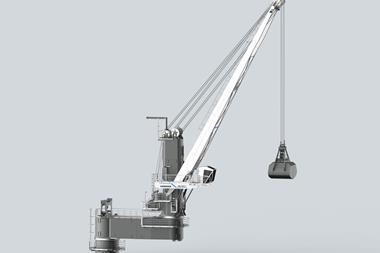
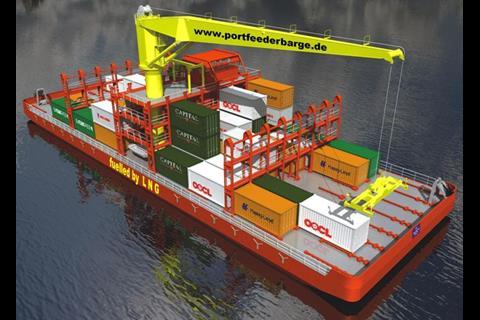
However, he acknowledges that several other alternatives to traditional gantry cranes do exist. Several years ago, Royal Haskoning, together with the Technical University Delft, Kalmar and Port of Rotterdam got as far as the project stage for a pontoon-based container crane for use in Rotterdam, although no working unit was ever produced. The underlying idea was that containers could be directly transhipped from deep sea ships on to a barge without making use of terminal facilities.
“Technically, the concept would have worked, but there were several complications. One of the most important was that the loading and unloading of the vessel required containers to be stowed in a certain order, which meant having to place them in the exact position alongside the quay. In addition, the whole process of direct transhipment would have complicated the clearance of the boxes by customs officials,” he says.
Mr Van Heezen is also less than convinced by the argument that floating container cranes can speed up productivity through deployment on the seaside of the vessel to enable the simultaneous handling of cargo from two sides. “As long as shipping lines get good service by, for example, terminals increasing the number of cranes dedicated to one vessel, this is unnecessary. This, surely, was one of the reasons why the Ceres concept failed at Amsterdam, since its unique selling point was undermined by higher productivity at other ports through the use of more cranes,” he says.
In addition, the higher speeds now offered by modern cranes means that driverless shore-based units and the loading and unloading by AGVs on to platforms effectively means that floating cranes aren't necessary for productivity, argues Mr Van Heezen.
However, he recalls that the research did identify a niche application for floating cranes, which would involve positioning them between the vessel and the shore, obviating the need for a quay wall, limiting the amount of dredging require and meaning that only a handful of mooring dolphins would also be needed. “This might be especially useful in developing ports which have limited space available on the shore,” he suggests, although remains dubious as to whether a case can be made for floating transhipment other than for liquid bulk.
“We have done some studies to look into this, but this type of transhipment would only be really useful serving as a temporary storage tanker for the vessel-to-vessel transfer of liquid bulk, of which we handled around 18m tons last year,” he says.