

Do third party assembled fenders compared with original equipment manufactured products?
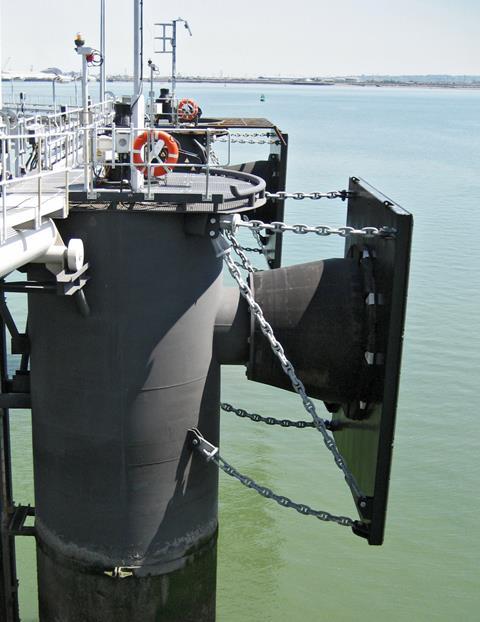
Increasingly, the fender market is dividing into two camps, one occupied by manufacturers of fender systems and the other by companies assembling third party-sourced components and trading these products on the open market.
But the market leaders have major doubts about misleading claims being made by some about in-house manufacturing, testing facilities and credible certification.
Scott Smith, regional director of Trelleborg Marine Systems, says of primary concern is port owners, operators and consultants putting their trust in cheaper fenders and taking PIANC-type approval for the product at face value.
Recent tests show the materials used to produce the low-cost fenders do not meet standards set in PIANC’s 2002 guidelines and contain a high percentage of both recycled rubber and filler.
He adds it should be noted that PIANC does not enforce the standard and it is up to consultants and owners to ensure their specifications are adhered to and ask for proof. Or at least, be aware of the pitfalls so they can make fully-considered, informed decisions.
“We want to keep this issue on the industry agenda [and] industry decision-makers to be as well-educated as possible in the risks of putting low-cost procurement before whole life costs, and the implications for safety and efficiency if low-cost procurement is put first.”
Safety first
Trelleborg’s 2011 Barometer Report indicated the industry is aware of efficiency gains brought about by having a safer port environment – “we feel there is now just a need for further market education in order to ensure decision-makers are fully versed in how to achieve this safer environment that they are striving for”, says Mr Smith.
David Harrison, communications manager at QuayQuip, says there is some evidence of harmonisation among the major standards bodies and their forthcoming codes. “QuayQuip support and, where necessary, advise standards bodies as they inch toward a worldwide consensus,” he says.
He agrees customers need to insist that their fender manufacturer is open and honest about test methods and results — “They should never be shy of asking which tests are being carried out, and how they are conducted. Sadly this level of transparency is still rare.
“QuayQuip’s test equipment is the most advanced in the industry and measures every relevant parameter to the correct standards and protocols. Full results are available to the customer, and customers and their representatives are welcome to witness tests at our factory. Full standards compliance also means that our QA certification is second to none.”
Mr Harrison says the balance between purchase and life-cycle costs varies with region and owner. “Money is tight in many sectors. Ports are well aware of the ideal situation but current economic constraints tie their hands.
“Younger, more adaptable manufacturers can offer the most help. A focus on higher-grade materials, better design methods, flexible manufacturing and simplified installation usually delivers a better system for less up-front expenditure. When systems are better designed and built for a longer service life, life cycle costs are lowered by default, and berth operability will always be maximised.
“The supplier must help customers learn how to choose the best systems. Ports owners already know that the best system is the one that meets their needs exactly.
“Experienced manufacturers know what will work, and should use their experience to steer customers in that direction.”
Solution led
Trelleborg’s Mr Smith says there is never an off the shelf solution as every port is different, but it is clear that most ports are placing far higher emphasis on safety, maintenance and the quality of fender systems being procured.
“Certainly the findings of the Barometer report suggest a far greater emphasis is being placed on full-life costs. The interest and success of our patent pending Design for Maintenance system would suggest that this is certainly the case.”
Both companies are progressing with key technical developments.
Over the last year Trelleborg has focused on a number of areas including improvements in performance and efficiency for its arch and cone fender range, translating to greater energy absorption; conducting research into the effects on correction factors of the different types of rubber materials used in fender manufacturing, indicating that many compounds that use SBR (synthetic based) have a far higher velocity and temperature correction factors; and research into the longer-term effects of the use recycled rubber, and alternative non-reinforcing fillers.
Maintenance eye
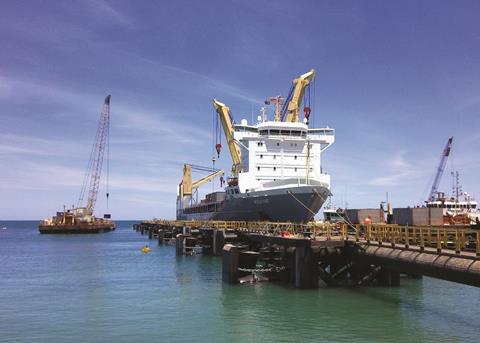
Trelleborg has also achieved patent pending status on its Design for Maintenance concept fender system which has been installed in three locations. The system utilises removable sliding panels to significantly reduce time taken to complete a fender wear pad change-out.
It has also received patent pending status on a new system for monitoring the load on marine fenders. The system can be used to measure both the impact on fenders when a vessel berths, and the ongoing force applied as the vessel continues to bear against them while docked.
QuayQuip has tested and installed Energy Dissipator systems, which protect nearby structures by absorbing energies in precisely-controlled stages. Energy absorbed is 13,000kJ — more than double that of the largest-production rubber fender in the world and with a reaction of only 250t, the company says.
The new QuayQuip Combi wheel fender has been chosen to guide vessels into the locks of the Panama Canal. Over the last year another 20 advanced wheel systems have been ordered by other ports.
QuayQuip is also launching a Designing Away Maintenance (DAM) programme, which aims to reduce and eventually remove the need for major system maintenance. Under the DAM programme, QuayQuip uses finite element (FE) analysis on every project. The load paths through panels and structures are analysed in detail, especially where panels connect to chains and fender units.
An early step was introducing the low-profile boss for fastening UHMW-PE facings to steel fender panels which more than doubles wear allowances and offers a tenfold strength increase compared to traditional studs.
QuayQuip has long championed “Virgin” grade UHMW-PE in its products which offers a far lower coefficient of friction and lasts far longer than grades common to most manufacturers.