
Forget traditional cable-operated mobile harbour cranes, hydraulic units have a better overall performance, provide higher levels of operator comfort, generate improved cost efficiency, are more operationally precise, are lighter and highly flexible.
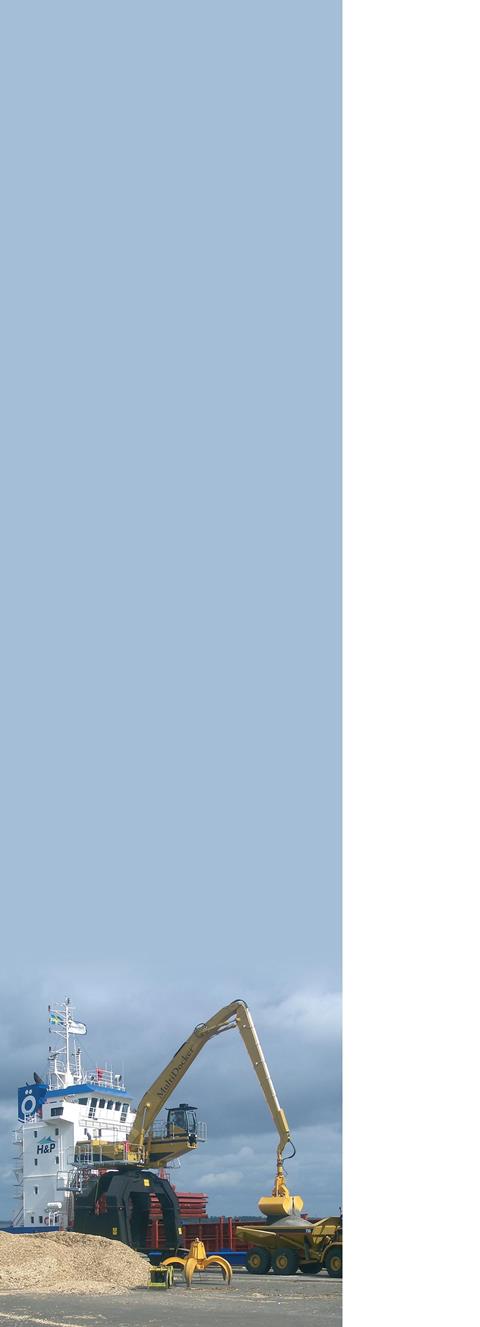
That’s according to MultiDocker company director Egil Koch.Perhaps most crucially, he says that MultiDocker units cost 50% less than cableoperated mobile harbour cranes. For this reason, he is convinced that the increasing uptake of hydraulic cranes in maritime dry bulk terminals will continue.
“Thanks to the use of caterpillar tracks, the operator can easily manoeuvre both the unit and the material being handled at relatively high speeds,” says Mr Koch. In fact, the CH65 is based on a standard Caterpillar 365 MH and most of the critical components are Caterpillar standard components. MultiDocker crane owners can therefore tap into Caterpillar’s global maintenance and services network, which also means spare parts are readily available.
Mantsinen area sales manager Asko Kinnunen adds: “Compared to a typical cable crane, our units are much faster. Taking material out of a ship’s hold and discharging it into a hopper or truck can be achieved significantly faster, because our crane operator can see the grab at the end of the boom and can place it extremely accurately.
“In contrast, the operator of a cable-activated mobile harbour crane is dealing with a grab positioned easily 25 metres away at the end of a rope,which makes accuracy much more difficult. It is for this reason that we can discharge dry bulk directly from a ship into an alongside truck.”