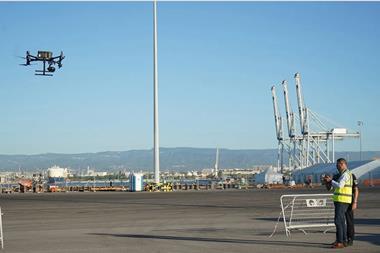





Sustainability in ports is receiving a boost from the emerging technologies associated with drone aircraft.
From inspection of equipment to deployment in emergencies, drones have already become part of the scene at ports worldwide. A new capability, that of sniffing out illegal emissions, is propelling drones to the forefront of environmental protection in ports and beyond.
In particular, this new feature available to drones is expected to be of value in enforcing the new sulphur limits that kick in from January 2020. The Netherlands is developing a ‘super drone’ that will see drones patrol port areas with the capacity to travel more than 10 miles from shore to enforce the new rules. In the Port of Rotterdam, the drones will complement the work already being done by existing ‘e-nose’ (electronic nose) installations, which capture data on emissions in the port.
Hong Kong is also testing technology to sniff out air pollution. In a report by Bloomberg, Professor Zhi Ning from the Hong Kong University of Science and Technology as saying: “It takes only two to three minutes for us to finish one scanning of the plume of one ship…We hope to have this joint effort between Hong Kong and Shenzhen for the Greater Bay area.”
Evidence from the drones will be used in court to prosecute offenders. Last summer, the Norwegian Maritime Authority (NMA) conducted sulphur testing using a drone. Describing the testing as “a great success”, the NMA has announced plans to purchase three new sulphur sensors as part of its cooperation with the Coast Guard and the Norwegian Radiation Protection Authority.
The equipment will be used to detect illegal emissions, improve oil pollution control and help with rescue work. Norse Asset Solutions has been awarded a contract in this regard, with a value close to NOK 14 million. According to the NMA, “It is a framework contract giving the government agencies as much as five drones and specialized equipment. The new drones will among other things, be used to measure sulphur emissions in the exhaust from ships.”
Thomas Angell Bergh, Head of Section for Inspection, Audit and Emergency Preparedness, commented: “Sulphur emission control of exhaust will now be expanded to a larger geographical area than today, and the control will become more effective.”
The Danish Maritime Authority (DMA) has also deployed a large sulphur-sniffing drone in its coastal waters. In April, a drone supplied by the European Maritime Safety Agency conducted its first ‘sulphur mission’, entering ships’ exhaust gas plumes to register the amount of sulphur in the fuel.
The data sourced in this manner is immediately available to Danish authorities, who can follow up if a ship does not comply with the requirements. The drone will operate in an area north of The Great Belt, which is used by large tankers on their routes to and from the Baltic Sea.
The DMA said that “the project will contribute to a more efficient enforcement of the sulphur rules, thereby ensuring fair competition for shipping companies and less pollution from ships”. The drones will support the work that the DMA already does with ship inspections in Danish ports.
Drone drops
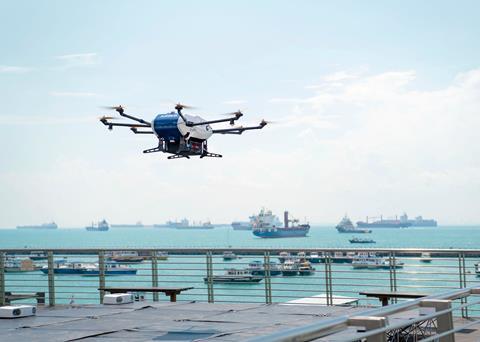
In March this year, Wilhelmsen, partnering with Airbus, launched the first use of drone technology for the delivery of small, timecritical items to anchored vessels in port. The groundbreaking move came in the form of a shore-to-ship pilot project in Singapore.
The first Airbus Skyways drone took off on a 1.5km flight from Marina South Pier to Eastern Working Anchorage in Singapore, to deliver 3D printed consumables from Wilhelmsen’s onshore 3D printing microfactory.
It successfully deposited the package on the deck of Swire Pacific Offshore (SPO)’s Anchor Handling Tug Supply (AHTS) vessel, M/V Pacific Centurion and returned to base within ten minutes.
Marius Johansen, VP Commercial, Wilhelmsen Ships Agency, said: “The now proven, seamless operation of drone deliveries from shore-to-ship, in one of the world’s busiest ports, proves the hard work, investment and faith we, and indeed our partners, placed in the Agency by Air drone delivery project over the past two years was not misplaced.”
![vF Unregistered drones are an escalating threat for UK ports[91]MM](https://d245ovzhixo1a2.cloudfront.net/Pictures/380x253/4/7/2/312472_vfunregistereddronesareanescalatingthreatforukports91mm_489875.jpg)